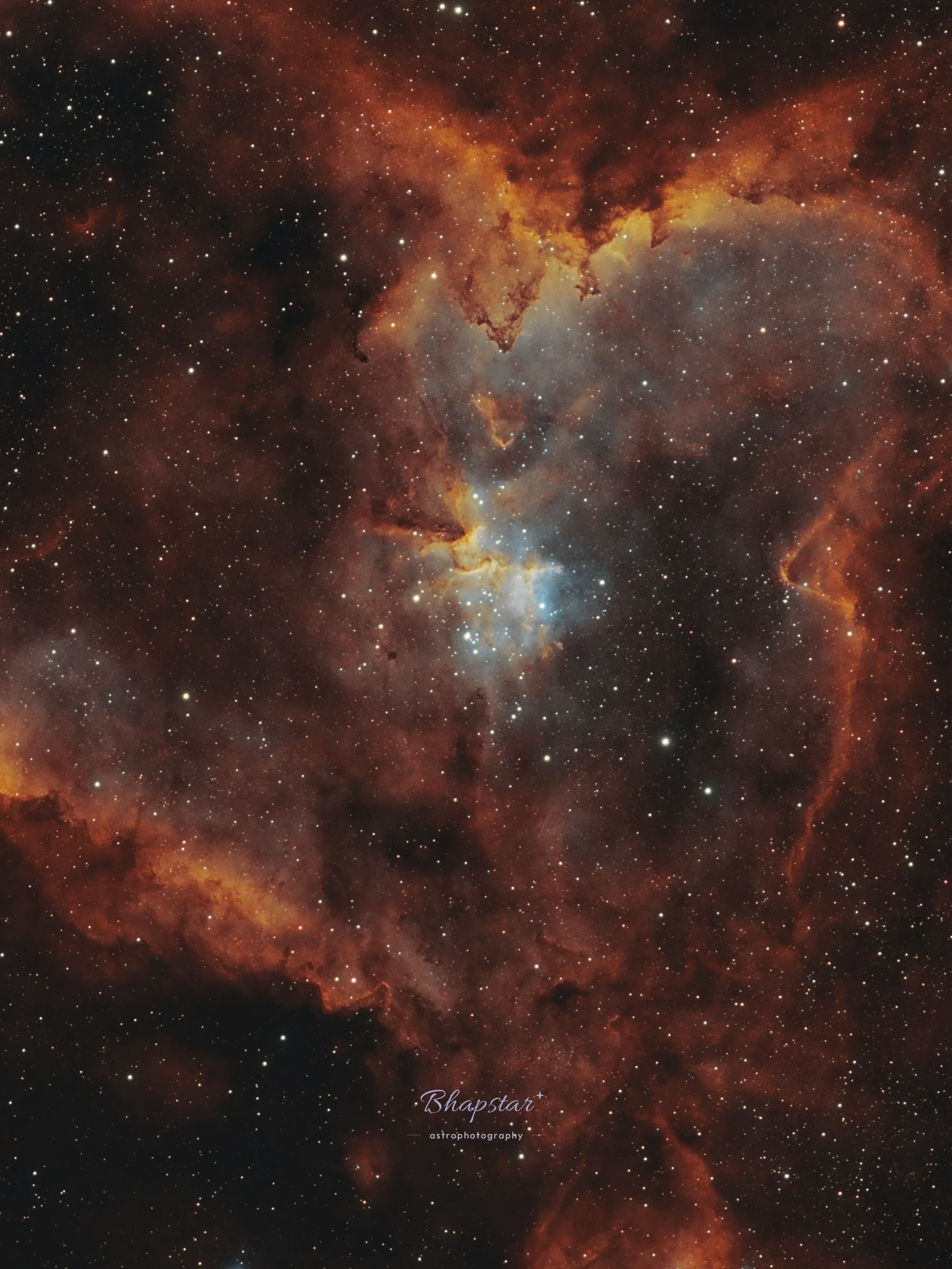
The Heart Nebula is a huge cloud of glowing gas in Cassiopeia. This frame looks into its centre, where a cluster of young stars is slowly clearing away the gas they formed from.
The Heart Nebula lies around 7,500 light-years away in Cassiopeia. The whole cloud spans almost two degrees of sky, about four times the width of the full moon, so this frame shows only its middle. Its brightest knot, on the western edge, was the first part to be found, by William Herschel in 1787.
The glow is powered by Melotte 15, the cluster of stars near the centre of the picture. A few of its stars are nearly 50 times the mass of the Sun. Their ultraviolet light makes the surrounding gas shine, and their radiation and winds are pushing that gas outwards. The dark pillars pointing in towards the cluster are denser clumps of gas and dust that are wearing away more slowly than the cloud around them.
From the UAE the Heart is an autumn and winter target. It climbs to just over 50 degrees above the northern horizon and is highest around midnight in early November.