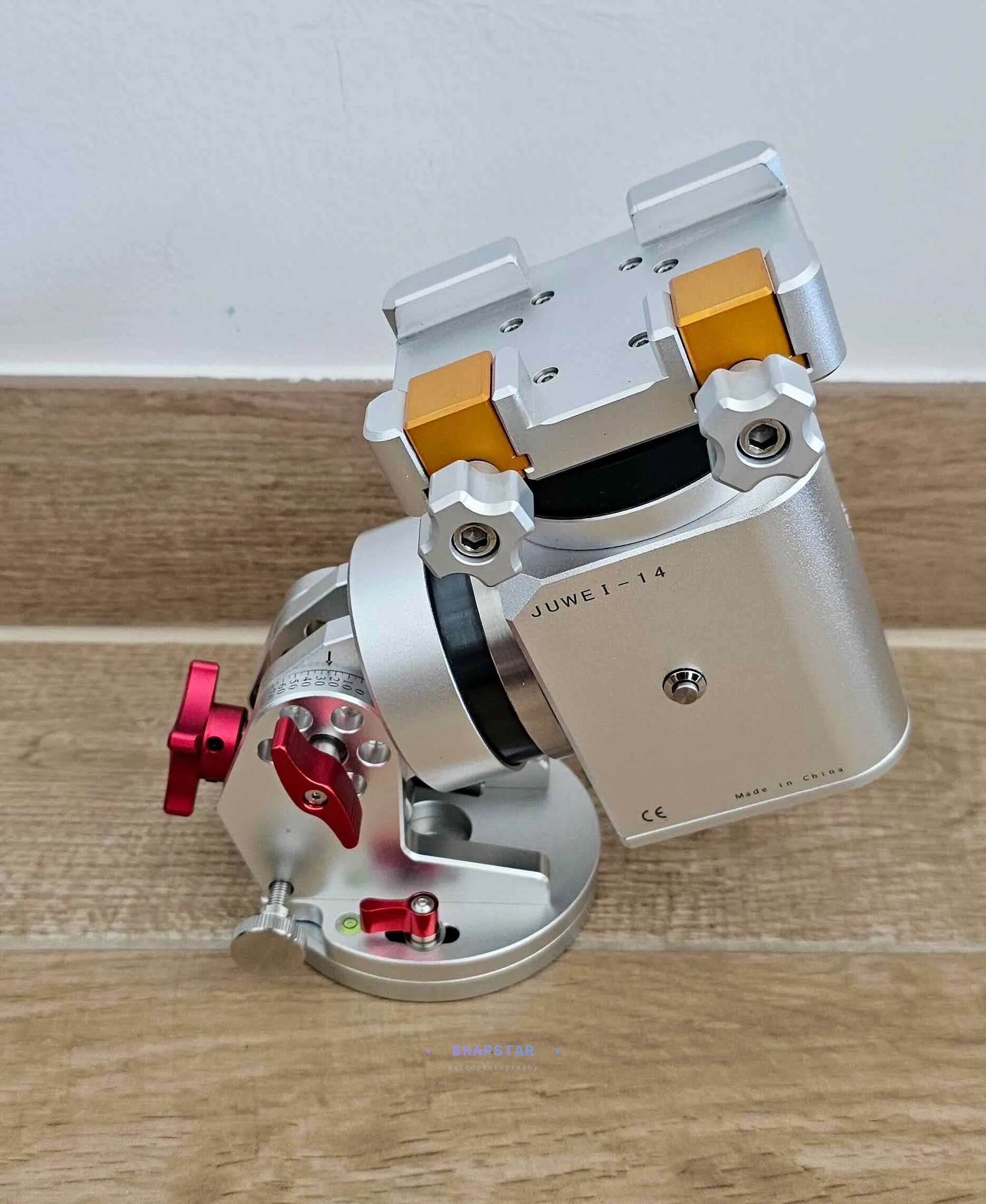
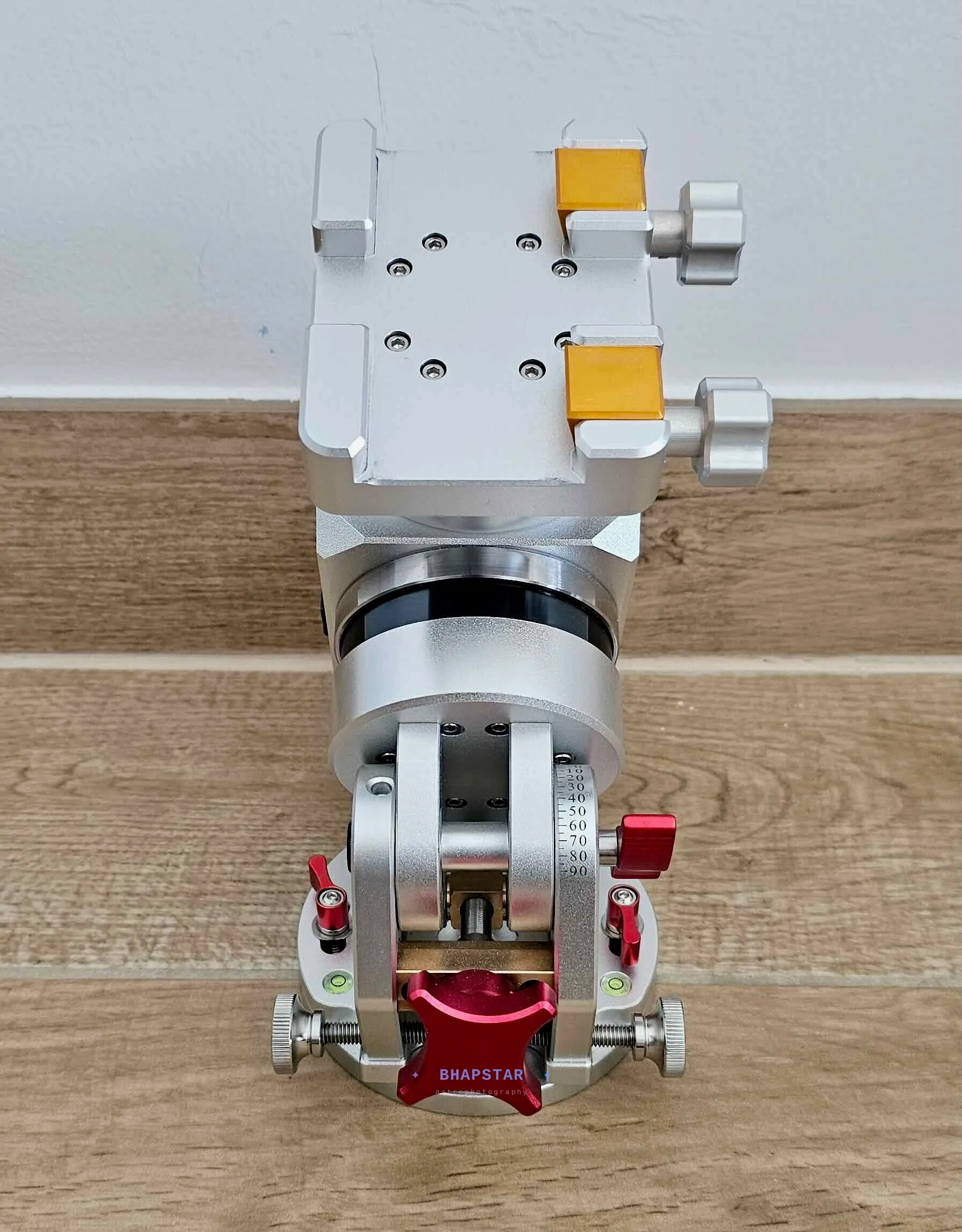
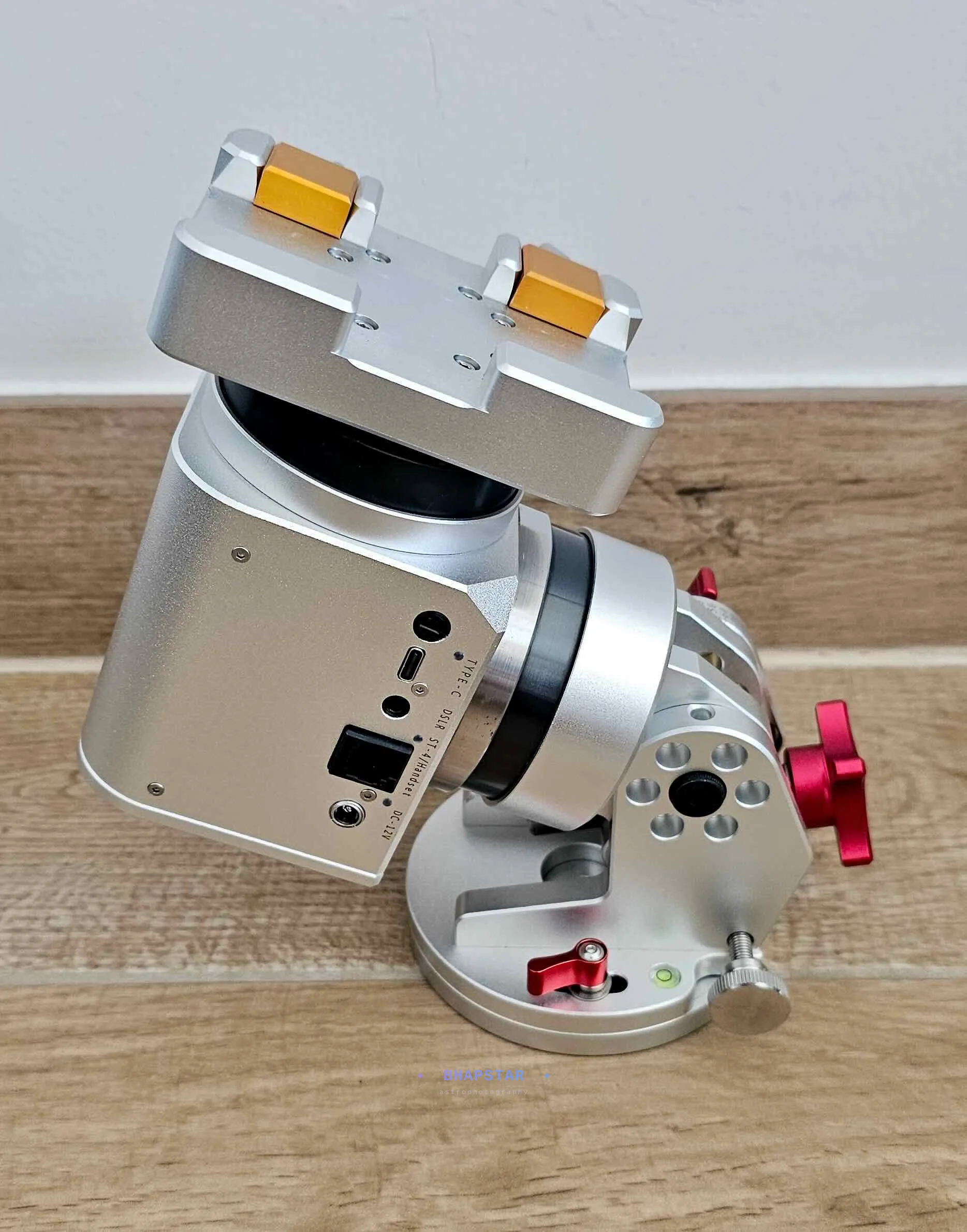
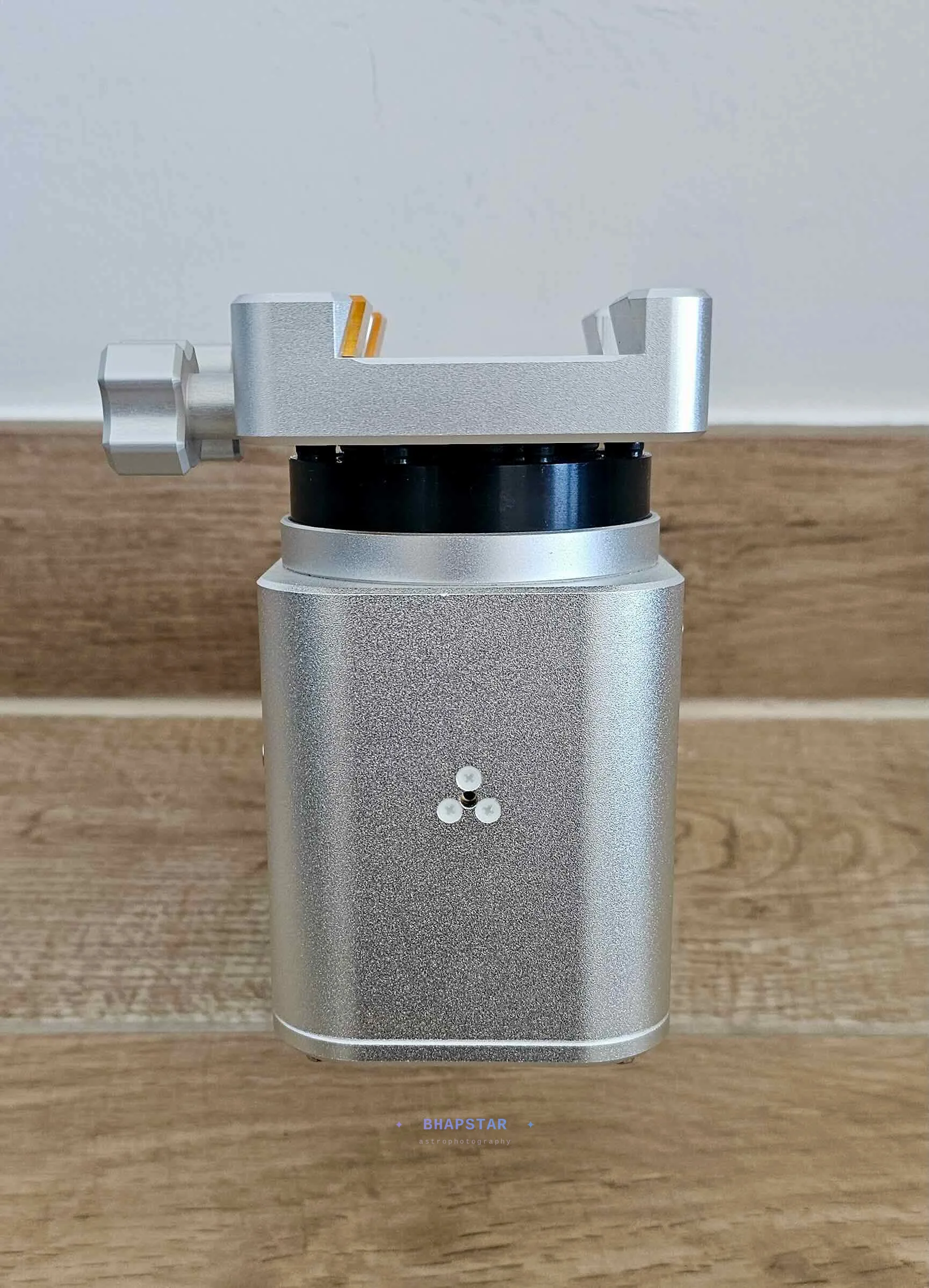
Juwei 14 Harmonic Equatorial Mount
The part of the setup most people never see, yet everything depends on it. A seriously light-weight harmonic-drive mount that carries the full imaging rig, trackingThe mount turning slowly to cancel out Earth's rotation, so a star stays in the same spot on the sensor instead of drifting into a line. the slow rotation of the sky with quiet, backlash-free precision. Small enough to travel anywhere, steady enough to trust completely; and the integrated laser is very cool!
The part everything else depends on
Optics and sensors set what is theoretically possible. The mount decides what you actually get, and it is the least photogenic item in any setup.
Harmonic driveA very compact gearbox that can hold a heavy telescope with no counterweight. It is the reason a mount this small can carry this much. changed the arithmetic for portable imaging. A traditional equatorial mountA mount with one axis tilted to line up with Earth's own axis. Once it is aligned, tracking the sky is one steady turn on that axis at a single constant rate. It still has a second motor for the other axis, but that one is for pointing and small guiding corrections rather than for keeping up with the stars, and the framing never rotates during an exposure. needs a counterweightThe heavy block on the far end of a traditional mount's shaft. It balances the weight of the telescope so the motors are not fighting gravity. roughly matching the payloadThe weight a mount is built to carry. Loading one near its limit works, but everything about it behaves worse than it does at half., so you carry that mass as well as the telescope. A harmonic drive holds position through gear reduction rather than balance, and for small-scope payloads the counterweight disappears entirely.
What that buys
Setup is quicker because there is less to assemble and less to balance, and the whole rig goes out in one trip. That sounds like a convenience and is actually the thing that determines how many nights get used. A mount that gets carried outside on a marginal Tuesday produces more than a better mount that stays in its case.
It matters more still for the drive out to Al Qudra or Al Quaa, where everything has to come with you and go home again in the dark. The willingness to make that trip is what separates a BortleA scale from 1 to 9 for how dark a sky is. Class 1 is a truly dark desert sky and class 9 is the middle of a bright city. 2 image from a Bortle 8 one, and the mount is the item that decides whether the trip feels worth it.
The integrated laser turns out to be genuinely useful rather than a gimmick. Rough polar alignmentLining a mount's main axis up with the point the sky turns around. Get it right and one slow, steady turn follows the stars all night. is quick with it, which on a balcony with a restricted horizon and no view of PolarisThe bright star that sits almost exactly above the Earth's northern axis. It barely moves all night, which is why polar alignment usually starts by pointing at it. is the difference between starting and giving up.
Worth knowing
Harmonic drives generally show more periodic errorA small tracking error that repeats every turn of the mount's gears, because no gear is perfectly round. Guiding corrects it. than a good belt-driven mount, so guidingA second small camera watches one star and sends tiny corrections to the mount, keeping the target locked in place over long exposures. matters rather than being optional. Payload ratings on any mount also assume forgiving conditions, and loading one near its maximum then imaging at 600mm asks considerably more of it than half that at 300mm.
It carries the Askar V comfortably across its range.
Getting one to the UAE
Mine came directly from AliExpress in China, shipped to Dubai without incident. That is worth stating plainly, because buying a mount from a Chinese marketplace is the sort of thing people hesitate over, and in this case the hesitation was unnecessary.
It is also the route that makes harmonic mounts affordable. The established Western brands price this class of mount considerably higher, and the reason to consider a Juwei at all is that the direct-from-manufacturer route removes a layer of cost.
Where to buy
Some links above are affiliate links. If you buy through them I may earn a small commission, at no extra cost to you. It does not affect which gear I use or recommend.