Askar V Modular APO Refractor
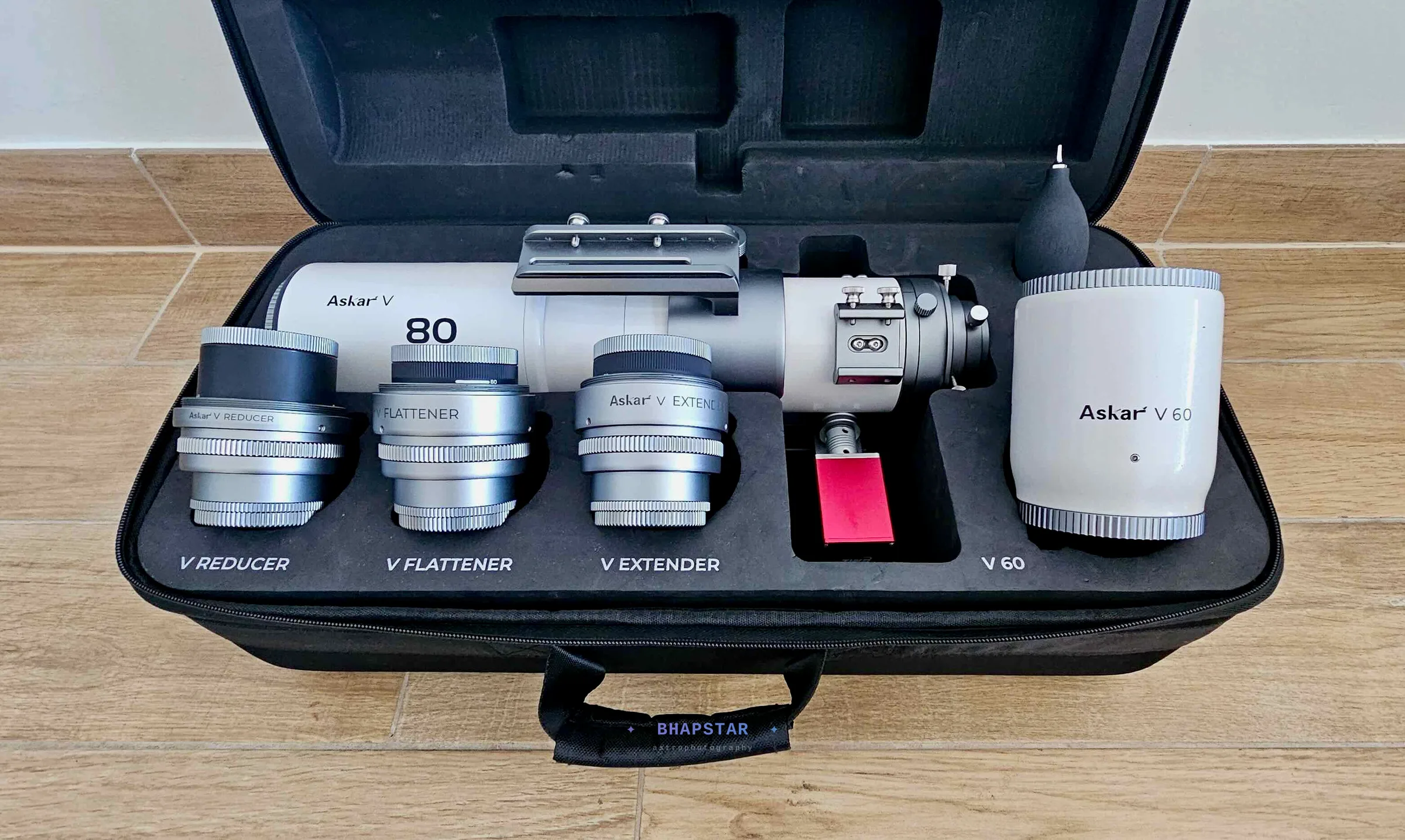
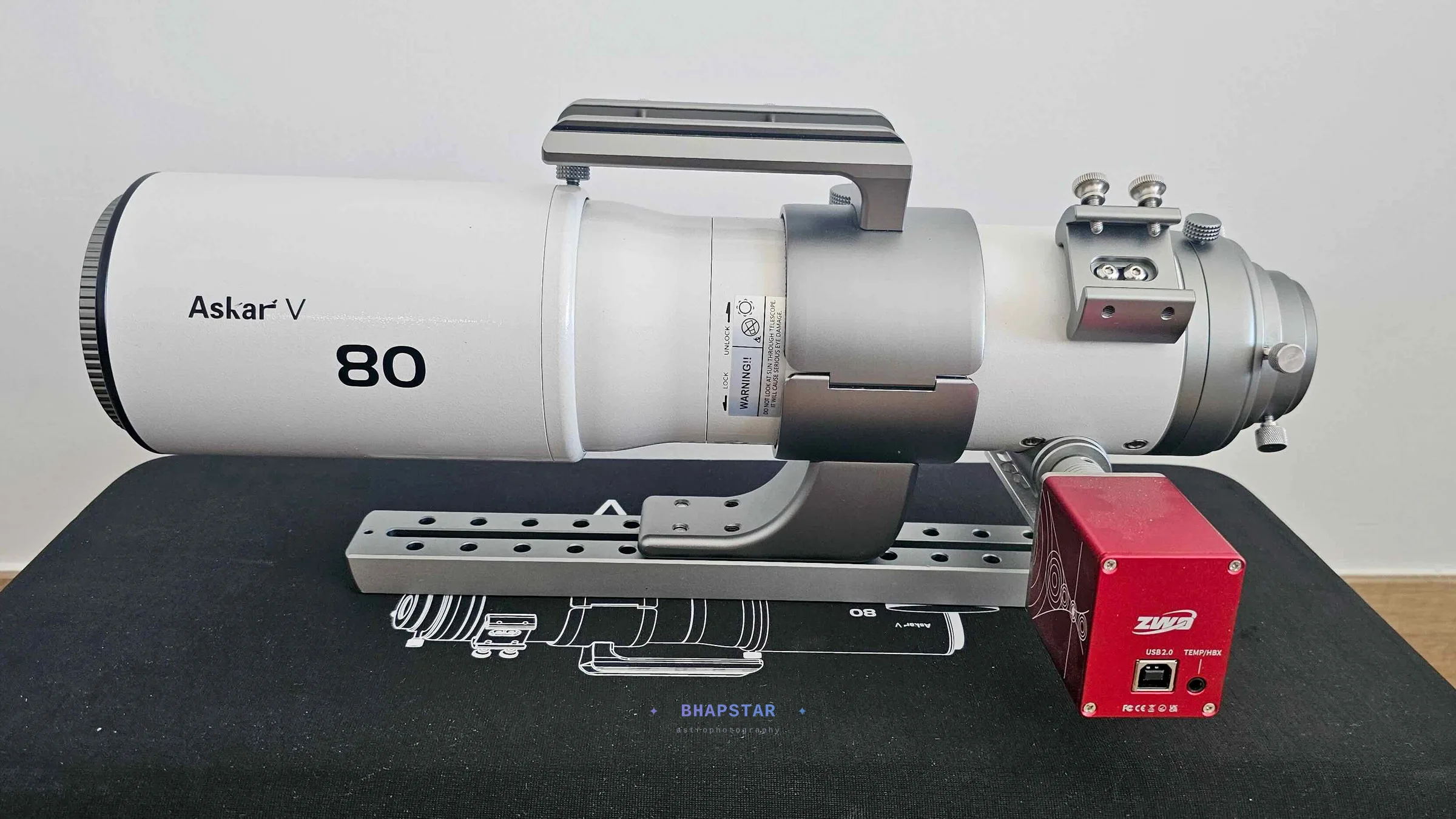
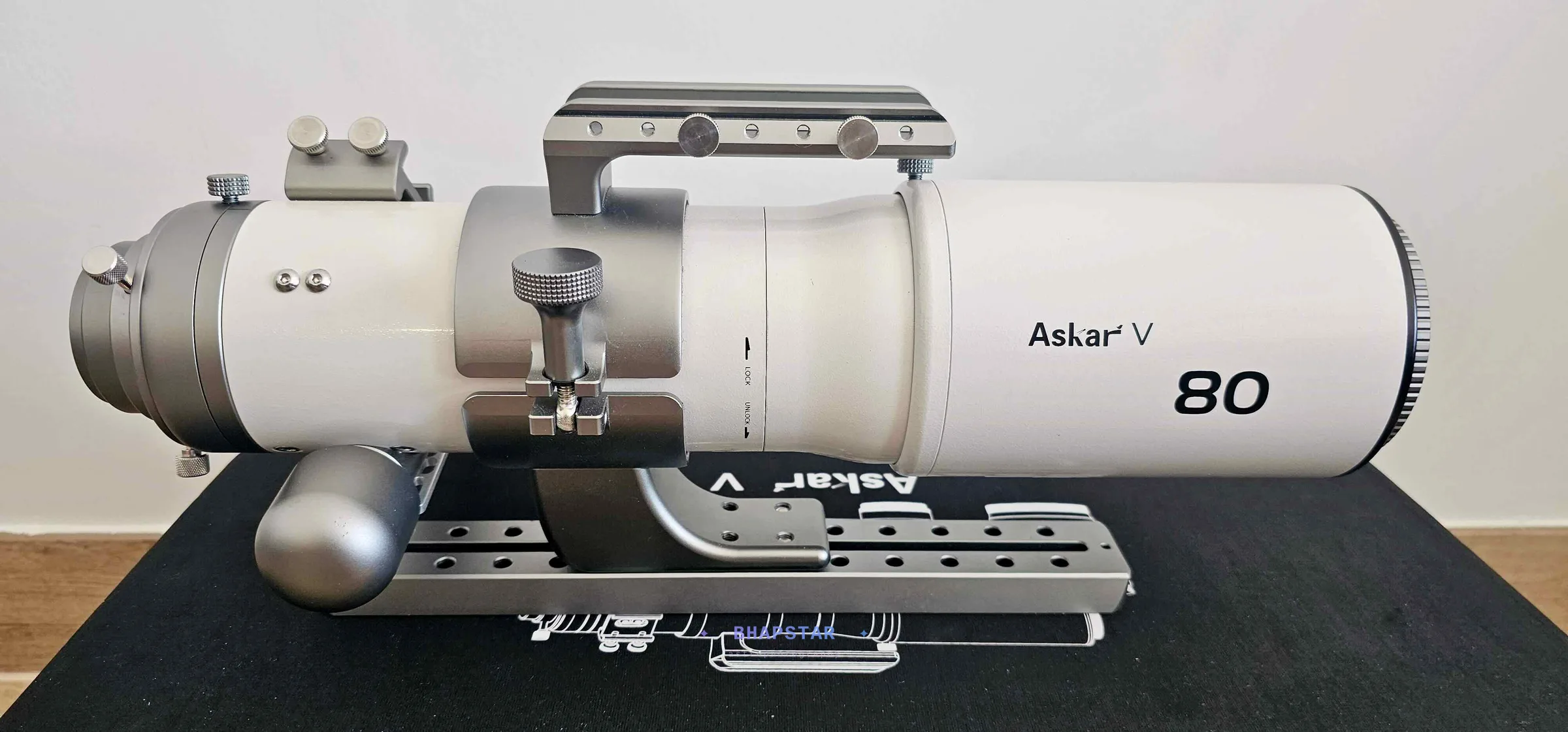
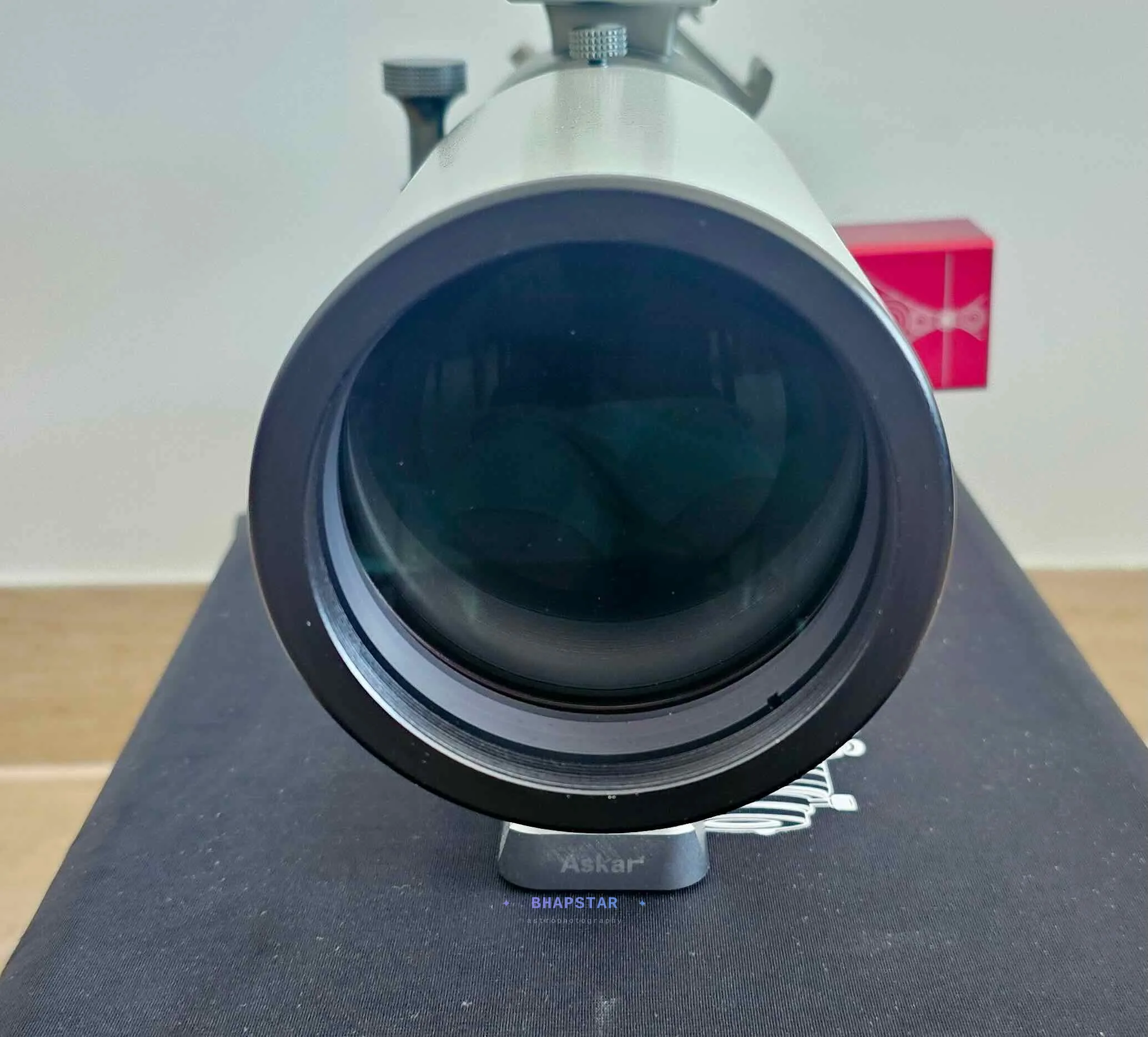
The Askar V is a unique telescope system that features two interchangeable 60mm and 80mm EDExtra-low dispersion glass, a specific type of glass used in better lenses. It keeps the different colours of light travelling together, which is how a two-element lens gets close to the colour correction of a three-element one. apochromaticA lens design that brings the red, green and blue parts of light to the same point of focus. Without it, bright stars pick up a purple halo. objectivesThe main lens at the front of a refractor. Its width is the telescope's aperture, and it is the part that does the real work., a reducerAn extra lens that shortens the focal length, giving a wider view and gathering light faster. The picture covers more sky and needs less time., a flattenerA small lens that corrects the naturally curved focus of a telescope, so the stars in the corners are as round as the ones in the middle. and an extenderThe opposite of a reducer: an extra lens that lengthens the focal length, so you get a closer view of a smaller patch of sky.. This offers six distinct focal lengths from 270mm to 600mm. Wide and sweeping one night, tight and intimate the next.
One telescope, six framings
Focal lengthHow much a lens or telescope magnifies, measured in millimetres. A small number gives a wide view of the sky, a large number a narrow, closer one. decides framing, and no single focal length frames everything. The usual answer is to own several telescopes. The Askar V answers it the other way: one tube, interchangeable 60mm and 80mm objectives, and a reducer, flattener and extender that combine into six configurations between 270mm and 600mm.
The value is less in the number than in the fact that the combinations are worked out for you. Building an equivalent range from separate scopes and third-party reducers means solving backfocusThe exact distance a flattener or reducer needs between itself and the sensor. Get it wrong and the stars at the edges of the frame stretch into little dashes, and no amount of processing will fix it. from scratch every time something changes. Here the spacings are defined and repeatable, which is the difference between a system you use and one you fight.
How it gets used
Changing configuration is a bench job rather than a field job, so in practice the target is chosen before going out and the scope is set up for it. That suits the way I work anyway, particularly for a drive out to darker skies where the night is planned in advance.
Most of the deep-skyAnything beyond our own solar system: nebulae, galaxies and star clusters. Faint, far away, and the reason for long exposures. gallery came through this telescope, across most of its range. The Rosette and the Christmas Tree at 60mm with the reducer, the Cat's Paw at 80mm native, and Thor's Helmet at 80mm with the extender, which is the tightest the system goes.
Worth knowing that the 60mm and 80mm objectives differ in apertureThe size of the opening the light comes through, written as an f number such as f/2.8. Confusingly, a smaller f number means a bigger opening and more light. as well as focal length, so the widest configurations gather less light than the longest ones. Six focal lengths is closer in practice to two telescopes with useful adjustment either side, which is still a great deal more than one.
What it pairs with
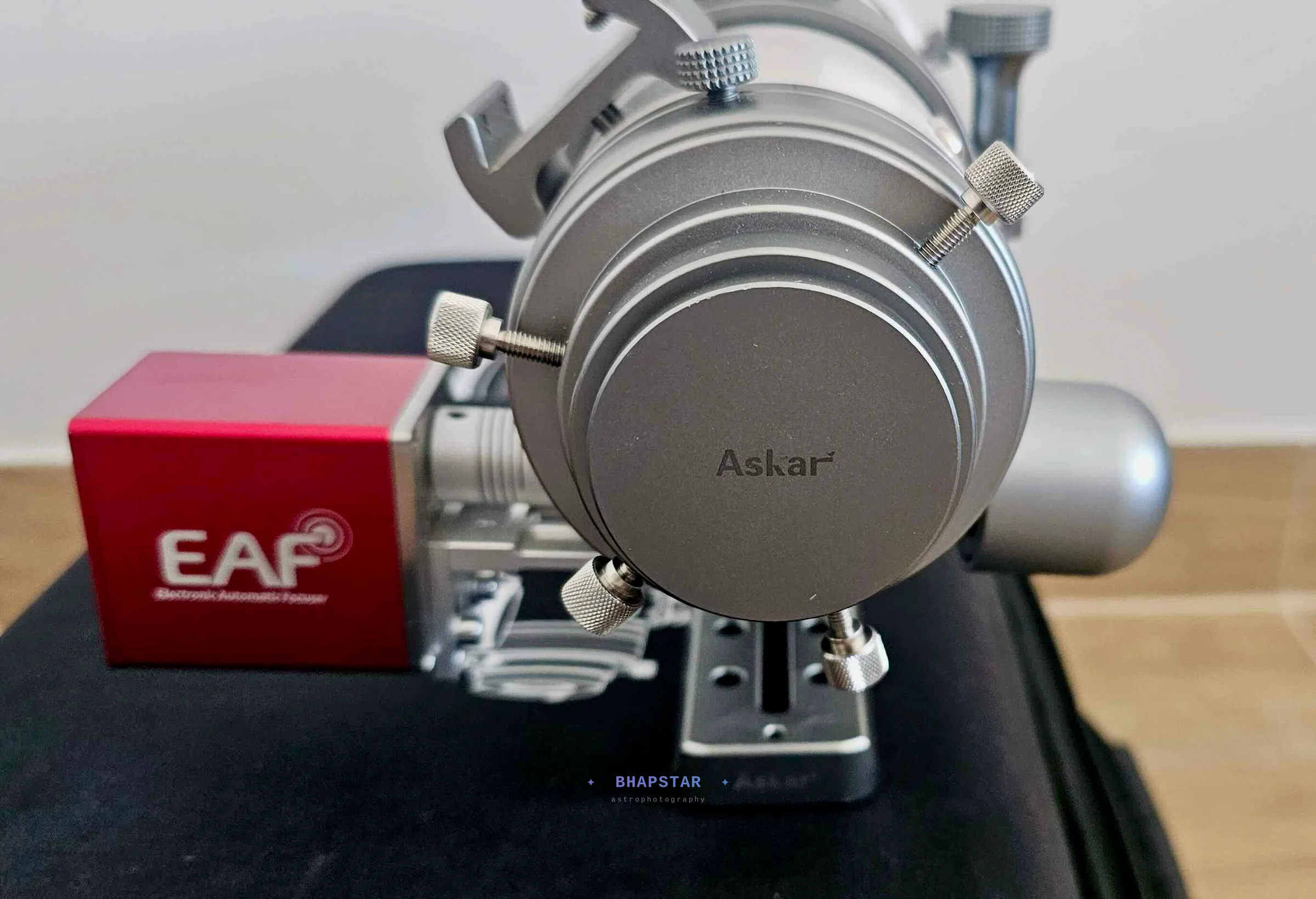
It sits on the Juwei 14 without difficulty, and the ASI585MC Air's small sensor is a sensible match across most of the range. The EAF is close to essential at the faster end, where the usable focus zone is genuinely small.
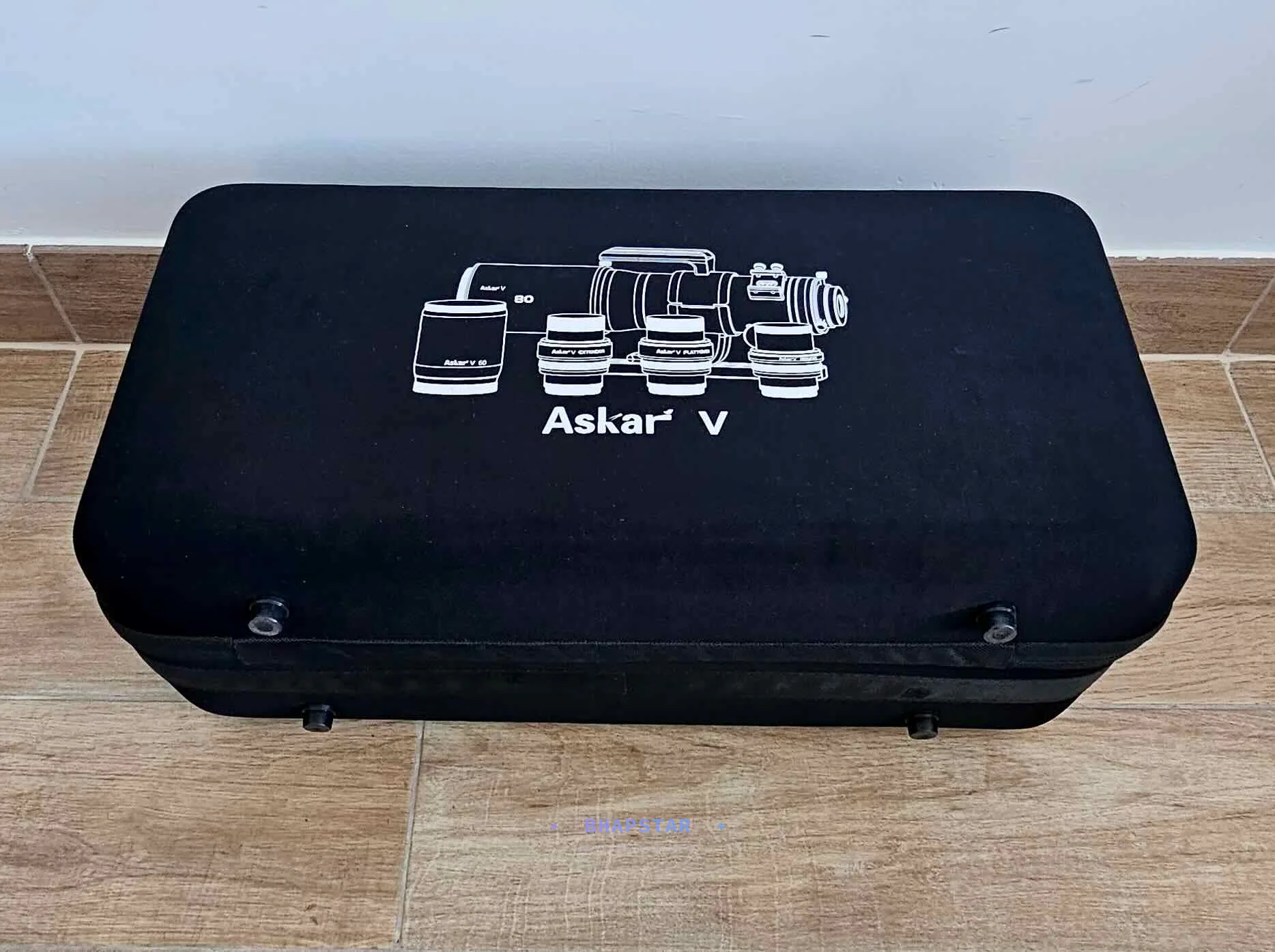
The supplied case holds everything properly, which matters when the gear travels. It is bulky for hand luggage, but it means nothing gets left behind.
How mine got to the UAE
Bought from High Point Scientific in the United States and forwarded to Dubai through MyUS. Neither end gave any trouble, which is worth saying because the usual obstacle to buying astronomy gear from this part of the world is not price, it is whether anyone will ship at all.
If package forwarding is new to you, the arrangement is simple: the forwarder gives you a US address, the retailer ships domestically to it, and the forwarder reships onward. It turns any US shop that will not post internationally into one that effectively does.
The timings, since nobody publishes these. High Point despatched within a couple of days. MyUS took about a week to process the package once it arrived, which is the step people underestimate. Onward shipping was another week or so. Around two and a half weeks door to door, and the forwarding and import charges came to roughly 250 US dollars on top of the purchase price.
That figure is the one to plan around. On a telescope at the old price it is a meaningful addition, and on a cheaper item it can be most of what you pay. Consolidating several purchases into one forwarded shipment is the obvious way to soften it.
Where to buy
Some links above are affiliate links. If you buy through them I may earn a small commission, at no extra cost to you. It does not affect which gear I use or recommend.