The Cat's Paw Nebula (NGC 6334)
The Cat's Paw Nebula is a large emission nebulaA cloud of gas that glows with its own light, in a few exact colours, because nearby stars are energising it. This is the kind that narrowband filters are built for. in the southern constellation Scorpius, named for the rounded lobes of ionisedGas whose atoms have had an electron knocked off by strong light from hot stars. As the electrons are caught again the gas glows, which is what makes many nebulae shine. hydrogen that resemble a giant paw print.

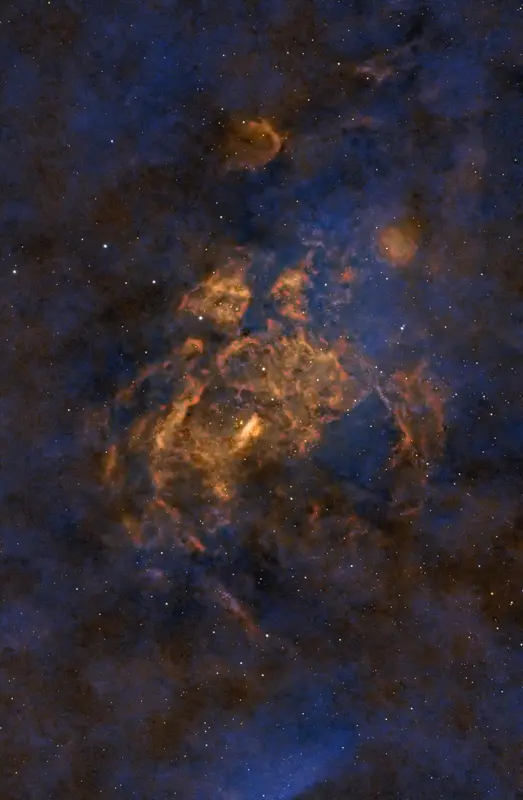
The Cat's Paw Nebula (NGCThe New General Catalogue, a list of nearly 8,000 nebulae, star clusters and galaxies published in 1888. NGC 2244 means number 2244 on that list. 6334) lies roughly 5,500 light-years away in the constellation Scorpius, low in the southern sky. It is one of the most prolific stellar nurseries in the galaxy - its glowing lobes mark regions where tens of thousands of stars have formed over the past few million years, including some of the most massive stars known in the Milky Way. The nebula spans around 50 light-years and was first catalogued by John Herschel in 1837.
This one was shot from my balcony in Dubai over two nights, under BortleA scale from 1 to 9 for how dark a sky is. Class 1 is a truly dark desert sky and class 9 is the middle of a bright city. 8 skies. The emission is dominated by hydrogen-alphaThe deep red light given off by hydrogen, at a wavelength of 656 nanometres. It is the single most common thing being photographed in a glowing gas cloud., so it responds very well to narrowbandA filter that only lets through the few exact colours that glowing gas clouds give off, and blocks nearly everything else. Streetlight is mostly blocked, the nebula is not. and dual-bandOne filter with two windows open at the same time, usually the red light from hydrogen and the blue-green light from oxygen. It suits a colour camera, which records both at once. filters - the paw structure and the dark dust lanes separating the lobes come through strongly even at modest integrationThe total time of every frame added together. Three hours of integration might be one hundred and eighty frames of one minute.. At a southern declinationThe sky's version of latitude, measured in degrees north or south of the celestial equator. Straight above the North Pole is +90 degrees. of about -36°, it never climbs high from here, so a clean southern horizon and steady seeingHow steady the air is. Moving air makes stars twinkle and blurs fine detail on the Moon, the Sun and the planets. Good seeing means steady air and sharper pictures. make a real difference.