The Jellyfish Nebula (IC 443)
A supernovaThe explosion of a dying star, briefly bright enough to rival its whole galaxy. What is left behind is a shell of gas thrown outwards at enormous speed, still glowing thousands of years later. That wreckage is the remnant. remnant in Gemini, the Jellyfish Nebula is what is left of a stellar explosion that happened between 3,000 and 30,000 years ago, its tangled filamentsA thin bright thread running through a nebula. Often it is not a thread at all but a sheet of gas seen edge-on: looking along the fold stacks the same faint material over a much longer path, so it brightens into a line while the face-on parts stay invisible. still expanding outward through space.

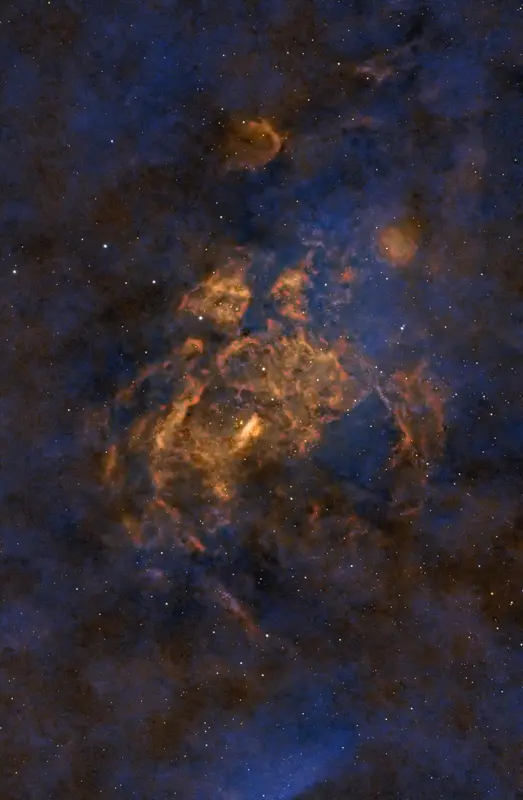
ICThe Index Catalogue, two additions to the NGC published in 1895 and 1908 that listed more than 5,000 extra objects. IC 443 means number 443 on that list. 443 sits around 5,000 light-years away in the constellation Gemini, and is one of the most studied supernova remnants in the sky. Unlike many nebulae, which glow because new stars are forming inside them, the Jellyfish is left over from the death of a single star. It is the expanding shockwave from that explosion, still colliding with surrounding molecular cloudsA cold, dense cloud of gas and dust where the atoms have joined up into molecules. These clouds are where new stars are born. thousands of years later.
On its southern edge lies a neutron star, the compressed core left behind after the explosion. The collision between the expanding remnant and the thin gas around it creates the complex, filamentary structures that give this nebula its distinctive shape.
The Jellyfish is a challenging narrowbandA filter that only lets through the few exact colours that glowing gas clouds give off, and blocks nearly everything else. Streetlight is mostly blocked, the nebula is not. target - it is fainter than objects like the Orion or Rosette nebulae, and the structure is complex enough that processing requires care to bring out the filaments without introducing artefactsSomething in a picture that was added by the camera or by the processing, rather than being there in the sky. A dark ring around a bright star is a common one.. Just beside it sits Propus, a bright orange giant star in Gemini, and keeping its glare under control without losing the faint filaments nearby was one of the trickier parts of processing this image. This image is six hours of exposures added together.