The Christmas Tree Nebula (NGC 2264)
NGCThe New General Catalogue, a list of nearly 8,000 nebulae, star clusters and galaxies published in 1888. NGC 2244 means number 2244 on that list. 2264 is a rich star-forming complex in Monoceros containing both the Christmas Tree Cluster and the Cone Nebula, a region where glowing hydrogen gas, dark dust lanes and newly formed stars sit side by side.

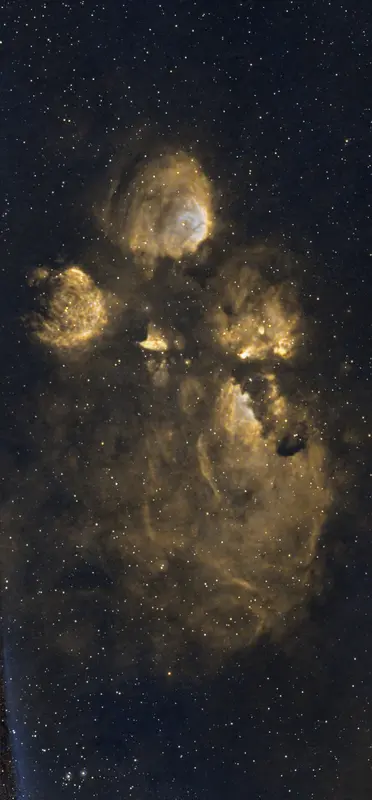
NGC 2264 is a designation that covers an entire region of activity - a young star cluster whose arrangement resembles a Christmas tree when viewed in the right orientation, surrounded by glowing emission nebulaeA cloud of gas that glows with its own light, in a few exact colours, because nearby stars are energising it. This is the kind that narrowband filters are built for. and punctuated by the Cone Nebula, a striking dark pillar of cold molecular gasA cold, dense cloud of gas and dust where the atoms have joined up into molecules. These clouds are where new stars are born. rising against the brighter hydrogen behind it.
The region sits around 2,500 light-years away in Monoceros, making it one of the closer star-forming regions to Earth. The young, hot stars of the cluster are energising the surrounding gas, causing it to glow, while denser pockets of dust block the light from behind and stay dark, giving the mix of bright and dark areas across the picture.
Framing this region requires some thought - the Christmas Tree orientation and the Cone Nebula don't always sit comfortably in the same field depending on your focal lengthHow much a lens or telescope magnifies, measured in millimetres. A small number gives a wide view of the sky, a large number a narrow, closer one.. Worth planning carefully in StellariumFree planetarium software. You give it your location, date and time and it draws the sky as it will look, including where a target sits and how it will be framed. or similar before you image it.