The Pleiades (M45)
The Pleiades are among the most recognisable objects in the night sky, a young open cluster of hot blue stars surrounded by delicate wisps of interstellar dust that catch and reflect their light.
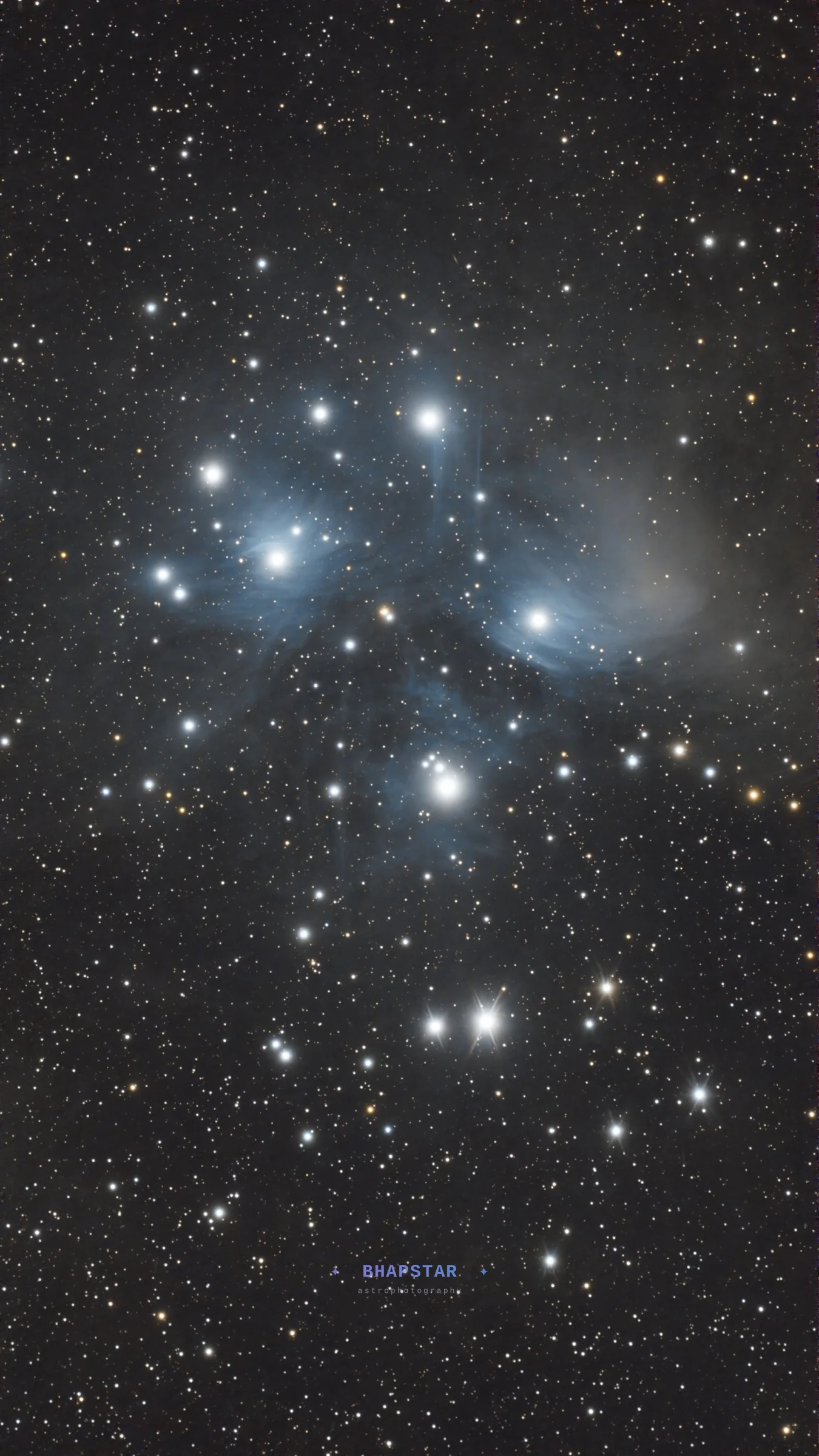
Messier 45, the Pleiades, have been known to every human culture that ever looked up at the night sky. At only around 440 light-years away, they are one of the nearest star clusters to Earth and easily visible to the naked eye, appearing as a tight, shimmering knot of blue-white stars in the constellation Taurus.
What makes this target so rewarding to photograph is the nebulosityThe faint glowing gas itself, as opposed to the stars in front of it. Fainter than it looks in a finished picture, which is why it takes hours to record.. The blue reflection nebulaA cloud of dust that has no light of its own and simply reflects the light of nearby stars, usually a soft blue. A narrowband filter blocks it almost completely. surrounding the cluster, particularly around the brightest star Merope, is not material left over from the stars' formation, but a separate dust cloud the cluster is currently passing through. Getting this faint, delicate haze to show up without blowing out the bright stars requires careful exposure management.
The Pleiades are a broadbandA filter that keeps most of the spectrum and blocks only a slice of it. It suits galaxies and star clusters, which shine in every colour rather than a few. target - the reflection nebula is blue and doesn't respond to narrowbandA filter that only lets through the few exact colours that glowing gas clouds give off, and blocks nearly everything else. Streetlight is mostly blocked, the nebula is not. filters the way emission nebulaeA cloud of gas that glows with its own light, in a few exact colours, because nearby stars are energising it. This is the kind that narrowband filters are built for. do. Short individual exposures to protect the star cores, combined with longer exposures for the faint dust, is a common approach worth considering.