The Orion Nebula (M42)
The Orion Nebula is the closest large star-forming region to Earth and one of the most studied objects in the sky - a vast cloud of gas and dust glowing just below Orion's Belt, visible to the naked eye on any clear winter night.
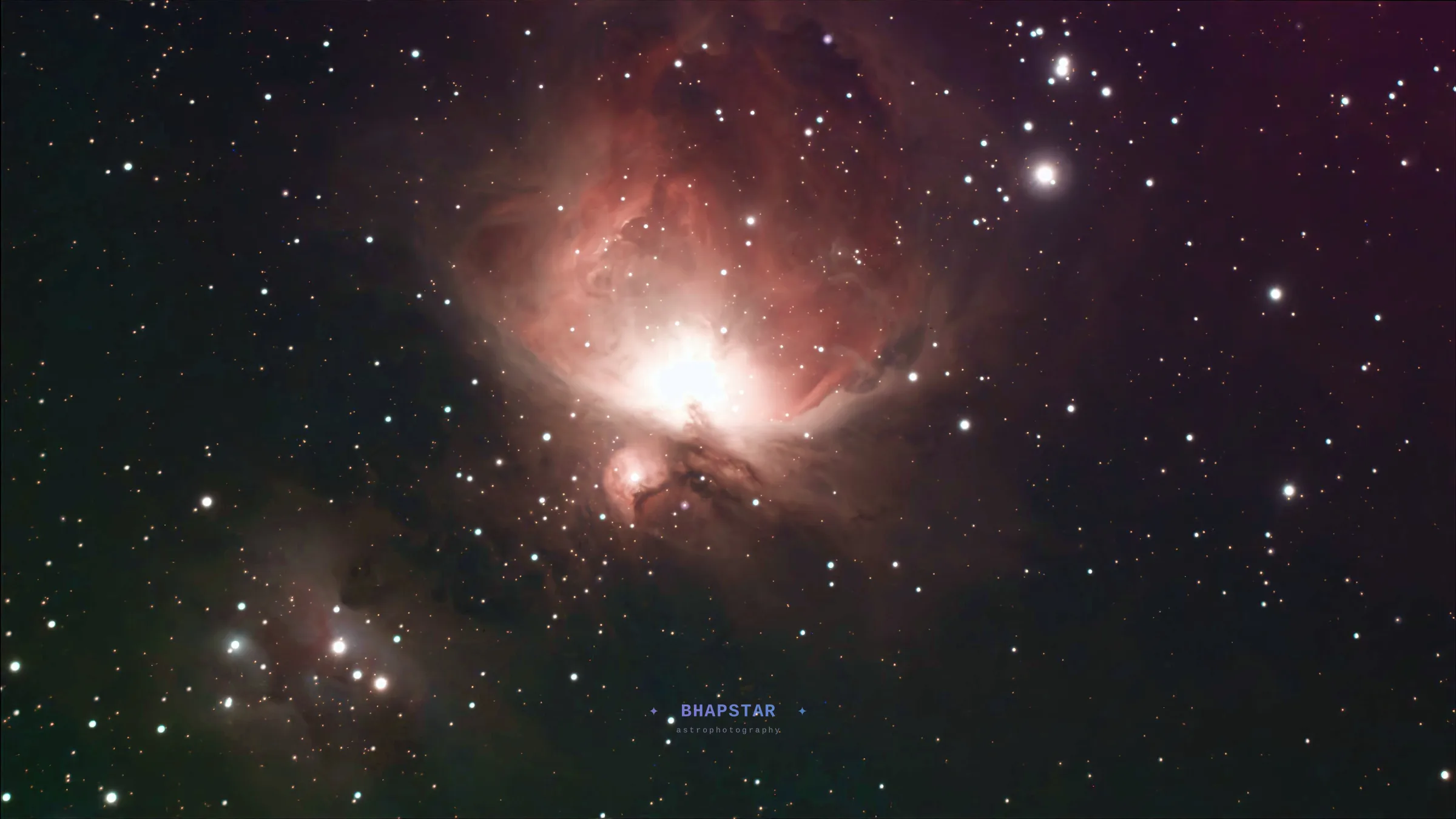
Messier 42 lies just 1,344 light-years away, practically next door in cosmic terms, making it the nearest region of massive star formation to Earth. At its heart sits the Trapezium, a tight cluster of four extraordinarily hot young stars whose ultraviolet output is responsible for ionising and illuminating the entire nebula.
For any astrophotographer, M42 is an early and inevitable target. Its brightness and proximity mean it shows up in virtually any exposure, but that same brightness makes it genuinely challenging to image well - the core is so bright that it saturates long before the fainter outer regions become visible.
The Orion Nebula is a rite of passage target. Every astrophotographer images it early, and most go back to it repeatedly as their equipment and technique improves. The challenge of capturing both the Trapezium detail and the faint outer wisps in a single image is one that keeps drawing people back.