The Flame (NGC 2024) and Horsehead (B33) Nebulae
The glowing Flame Nebula and the dark, silhouetted Horsehead, two well-known nebulae close enough together to share the same field of viewHow much sky fits inside one frame. A wide field shows a whole constellation, a narrow one a single small galaxy., beside Orion's Belt.

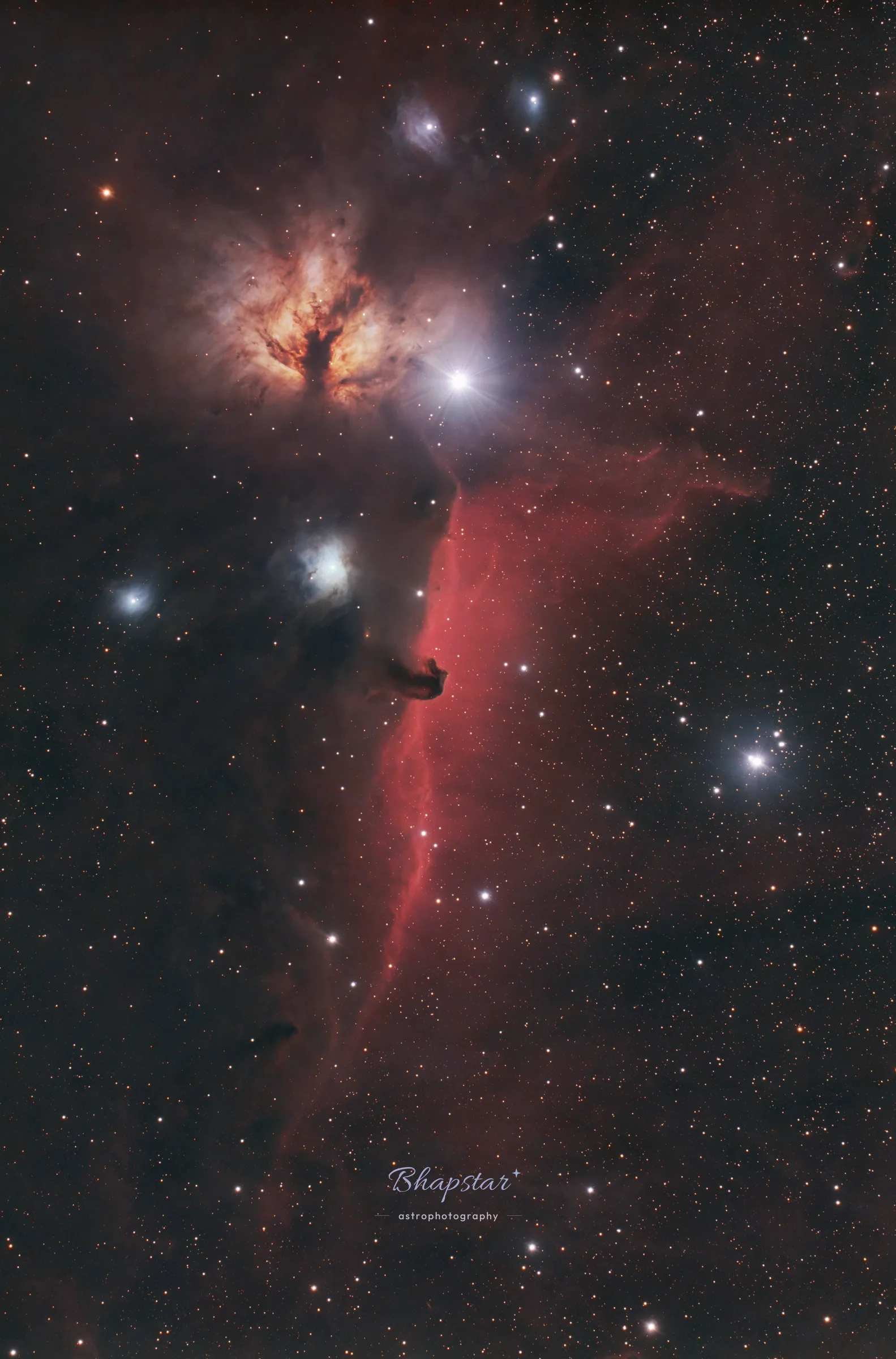
The Flame Nebula (NGCThe New General Catalogue, a list of nearly 8,000 nebulae, star clusters and galaxies published in 1888. NGC 2244 means number 2244 on that list. 2024) and the Horsehead Nebula (Barnard 33) sit just to the south of Alnitak, the easternmost star of Orion's Belt, around 1,400 light-years from Earth. They are physically close to one another, so both fit in the same picture.
The Flame is an emission nebulaA cloud of gas that glows with its own light, in a few exact colours, because nearby stars are energising it. This is the kind that narrowband filters are built for., a cloud of gas that glows with its own light. For a long time Alnitak was thought to be what lights it, but in 2003 astronomers looking in infrared light, which passes through dust, showed that it is really lit by a hot young star hidden behind the dark lanes in the middle of the Flame. The Horsehead is something different entirely - a dark nebula, a dense column of cold dust silhouetted against the bright emission region ICThe Index Catalogue, two additions to the NGC published in 1895 and 1908 that listed more than 5,000 extra objects. IC 443 means number 443 on that list. 434 behind it. Having both kinds of nebula in one picture shows the difference between them clearly.
Alnitak itself can cause problems - it's bright enough to produce diffraction spikesStraight lines of light that stick out from bright stars in some pictures. They come from something in the light path bending the light, such as the supports that hold a telescope's mirror, not from the star itself. and bloomingWhen a star is so bright that its light overflows the pixels it lands on and spills into the ones next to it, so it looks swollen or streaked in the picture. that require careful handling in processing. Getting the star under control while preserving the delicate nebula detail around it is one of the main challenges with this target.
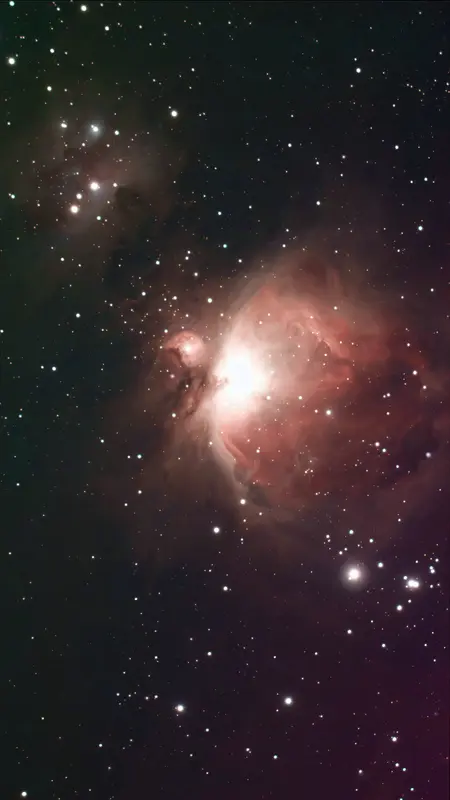
Move the slider on the picture to see a second version. It takes in a wider patch of sky, so the Horsehead looks smaller and more of the area around it fits in.