The Andromeda Galaxy (M31)
The Andromeda Galaxy is our nearest large galactic neighbour - a vast spiral system over two million light-years away, and usually said to be the most distant object you can see with the naked eye.
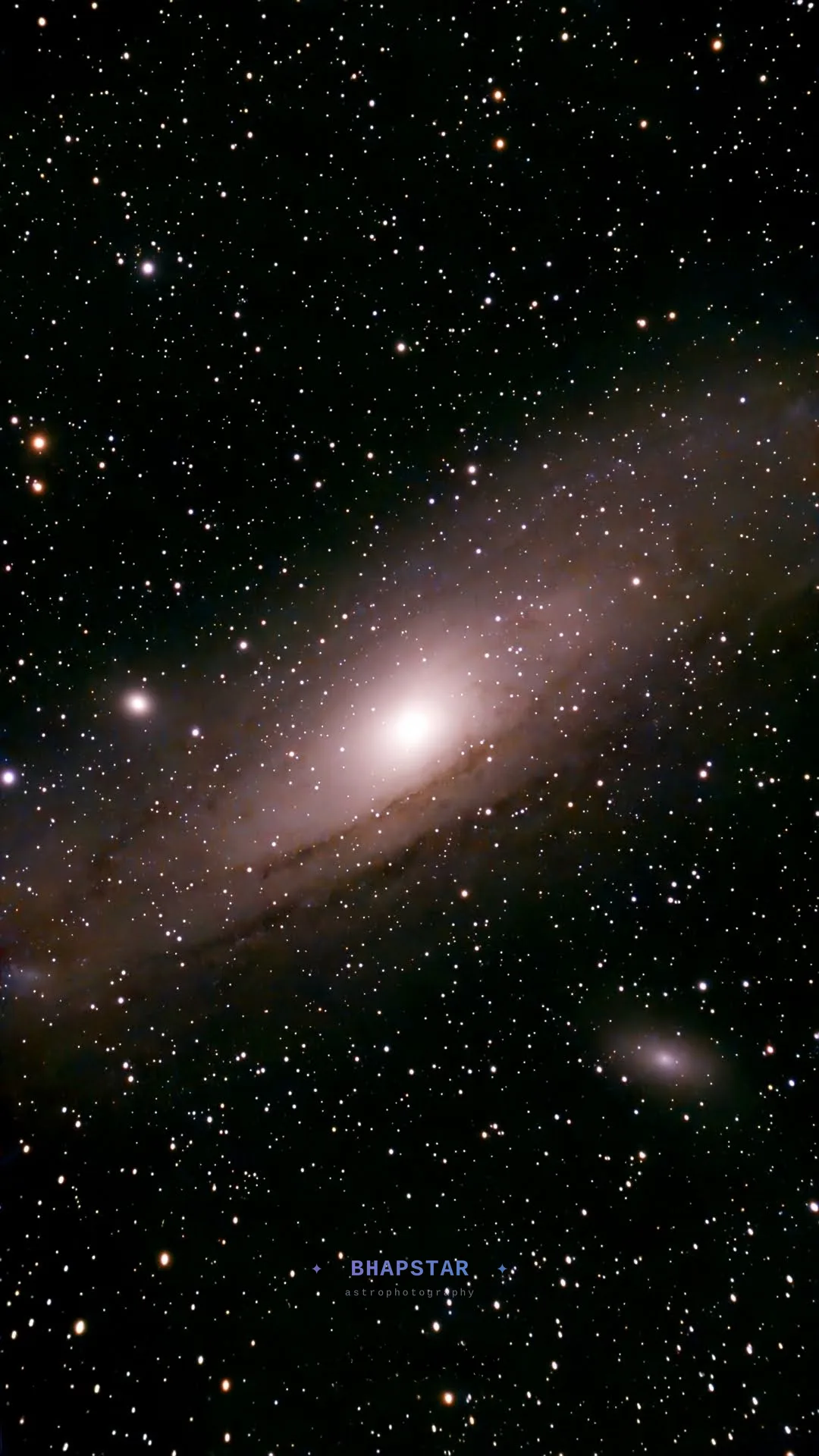
MessierA list of 110 fuzzy objects in the sky, started by the French astronomer Charles Messier in the 1700s so he would not mistake them for comets. M42 means number 42 on his list. 31 is a spiral galaxy roughly 2.537 million light-years from Earth in the constellation Andromeda. It is larger than the Milky Way, spanning some 220,000 light-years across, and is accompanied by several satellite galaxies, most notably M32 and M110, which are often captured in the same field.
Andromeda and the Milky Way are on a collision course, expected to merge in approximately 4.5 billion years. For now, it drifts toward us at around 110 kilometres per second, its ancient light arriving here after more than two million years of travel.
The sheer angular size of Andromeda, it spans roughly six times the diameter of the full Moon on the sky, means that capturing it in full requires either a very short focal lengthHow much a lens or telescope magnifies, measured in millimetres. A small number gives a wide view of the sky, a large number a narrow, closer one. or a mosaicSeveral overlapping frames joined together into one much wider picture, for targets too big to fit in a single view.. The outer halo and the faint tidal streamsA long, faint trail of stars pulled out of a galaxy by the gravity of a neighbour that came too close. are the hardest details to pull out.