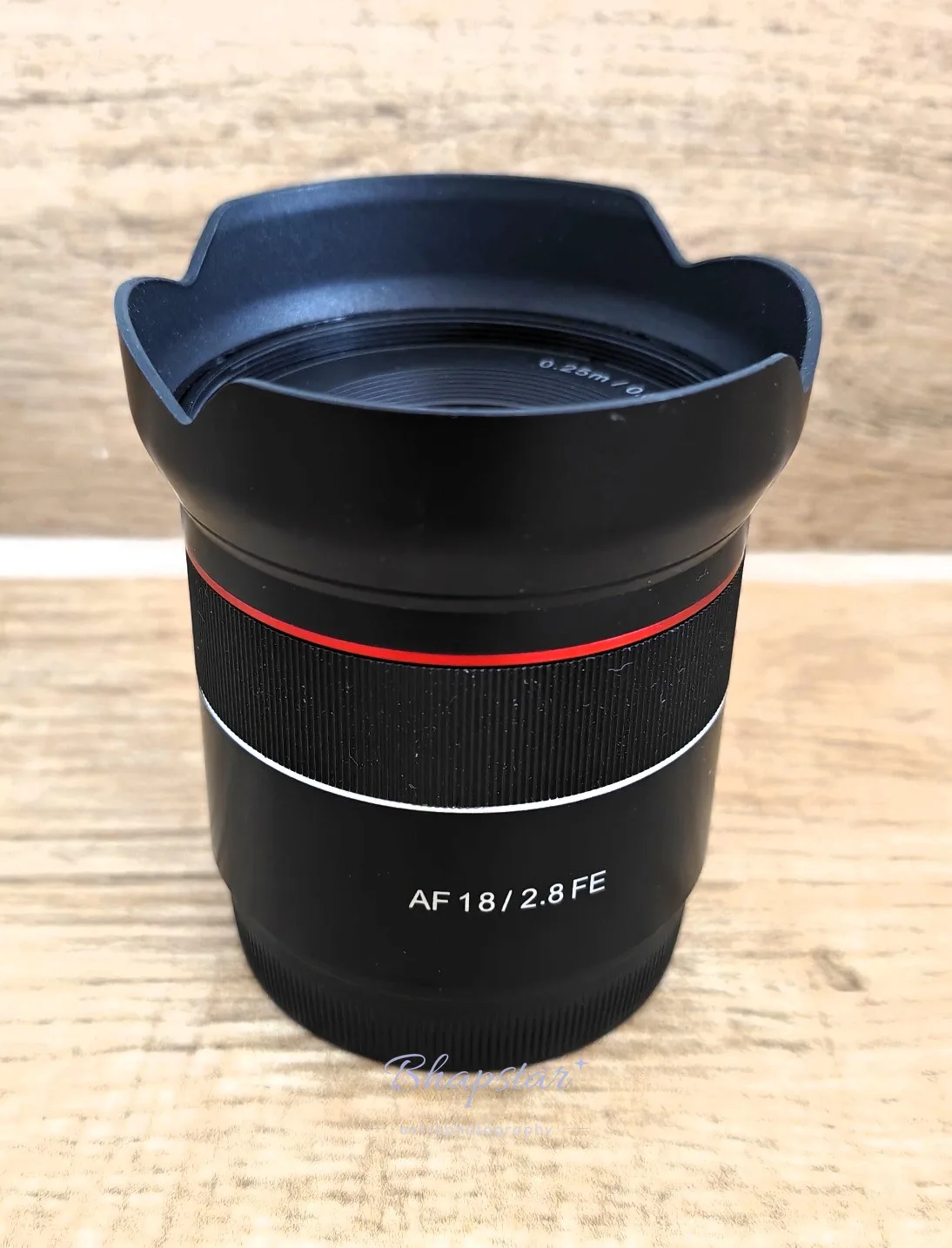
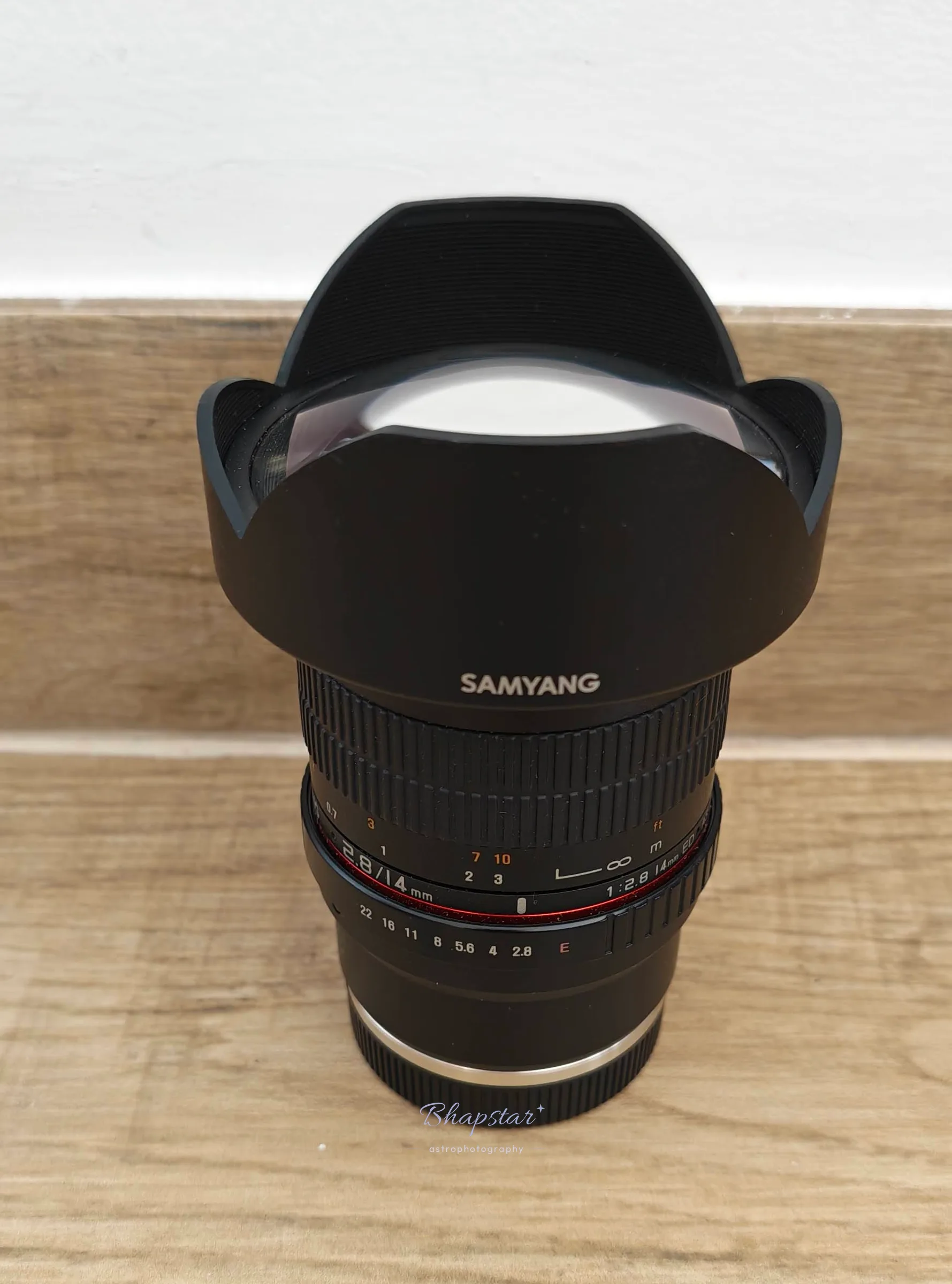
Rokinon 18mm f/2.8 & Samyang 14mm f/2.8
Two manual ultra-wides that do the same job from slightly different distances: cover as much sky as possible, as fast as possible, for as little as possible. These are the meteor shower and Milky Way lenses, and neither of them needs autofocusA programmed routine through an Electronic Automatic Focuser that refocuses the telescope as the temperature drifts through the night, or at set timed intervals. to do it.
Why these two together
Both of these lenses exist to answer the same question: how much sky can I cover, how fast, for how little. A meteor lands somewhere random and lasts a fraction of a second, so the two variables that decide whether you catch it are the amount of sky in frame and the apertureThe size of the opening the light comes through, written as an f number such as f/2.8. Confusingly, a smaller f number means a bigger opening and more light.. Neither is negotiable, and neither of these lenses asks you to pay much for them.
They differ mainly in how far they push it. The 14mm covers about 115 degrees diagonally on full frameA camera whose sensor is the size of an old 35mm film frame. Bigger sensors gather more light, which is why they cope better in the dark. — close to the practical limit before the sky starts looking distorted. The 18mm covers around 100 degrees, which is still very wide but noticeably easier to compose with, and it is tiny and light in a way the 14mm is not.
The Samyang 14mm f/2.8
This is the older design and the one with the reputation. It is fully manual, it is heavy, and it has a bulbous front element with a fixed petal hood, which means no screw-in filters at the front at all. What it gives you in return is an enormous field for very little money.
It is not a clinically perfect lens. There is comaA fault that makes stars near the corners of the frame grow small wings, so they look like tiny comets rather than points. in the corners wide open — bright stars grow small wings — and there is a distinctive moustache distortion that matters if you photograph architecture and does not matter at all if you photograph sky. Stopping to f/4 tidies the corners considerably, though at f/4 you have given up much of the reason you bought it. My approach is to shoot it at f/2.8 and accept the corners, because for a meteor frame the corners are not the subject.
The Rokinon 18mm f/2.8
Much newer, much smaller, and it autofocuses — worth saying, because Samyang's manual reputation is strong enough that people assume otherwise. It weighs almost nothing, takes ordinary 58mm screw-in filters, and lives in a jacket pocket. Corner performance wide open is better than the 14mm's, and the modest reduction in coverage is a fair trade for that.
For a night on the lawn with strangers, this is the one I would hand to somebody else. It focuses itself if it has to, it is small enough not to unbalance a light tripod, and it is hard to get a bad frame out of it.
Which to use for what
| Samyang 14mm f/2.8 | Rokinon 18mm f/2.8 | |
|---|---|---|
| Focus | Manual only | Autofocus, manual override |
| Weight | Around 550g | Around 145g |
| Filters | Rear gel only | 58mm screw-in |
| Max exposure before trailing | About 20s | About 15s |
| Best for | Maximum sky, Milky Way arch, foreground drama | Meteor watch, travel, handing to a friend |
| Weak point | Corner coma, no front filters | Slightly less coverage |
Getting the best out of either
- Focus by hand regardless. Even on the autofocus 18mm, switch to manual at night, magnify live viewThe camera's rear screen showing what the lens is pointed at right now. You can magnify it to check that a star is properly sharp. on a bright star and set it yourself. Autofocus hunts on stars and the infinity mark on a manual lens is not trustworthy — most of them focus past infinity by design, to allow for temperature.
- Tape the ring. A strip of gaffer tape over the focus ring after you set it saves the night you would otherwise lose to a knock in the dark.
- Shoot wide open. These lenses are bought for f/2.8. Corner coma is a smaller problem than a meteor too faint to record.
- Watch the corners for gradientsAn uneven brightness across the frame, usually because light pollution was worse on one side of the sky. Software measures it and takes it back out.. Ultra-wides see a lot of horizon, and at 115 degrees you will have streetlight in the frame whether you meant to or not. Compose so the worst of it falls where the foreground is.
Buying
Samyang and Rokinon are the same lenses under different names, which means the used market is bigger than it first appears — search both. The manual 14mm has no electronics and no moving motor, so a clean used copy is a safe purchase; check the front element carefully, since the protruding design and fixed hood make it more exposed to knocks than a conventional lens. The autofocus 18mm does have a motor, so confirm it drives smoothly and quietly before buying used.
Both live on the A7 III, and the settings I use with them are written up in the camera Milky Way guide.
Where to buy
Some links above are affiliate links. If you buy through them I may earn a small commission, at no extra cost to you. It does not affect which gear I use or recommend. As an Amazon Associate I earn from qualifying purchases.