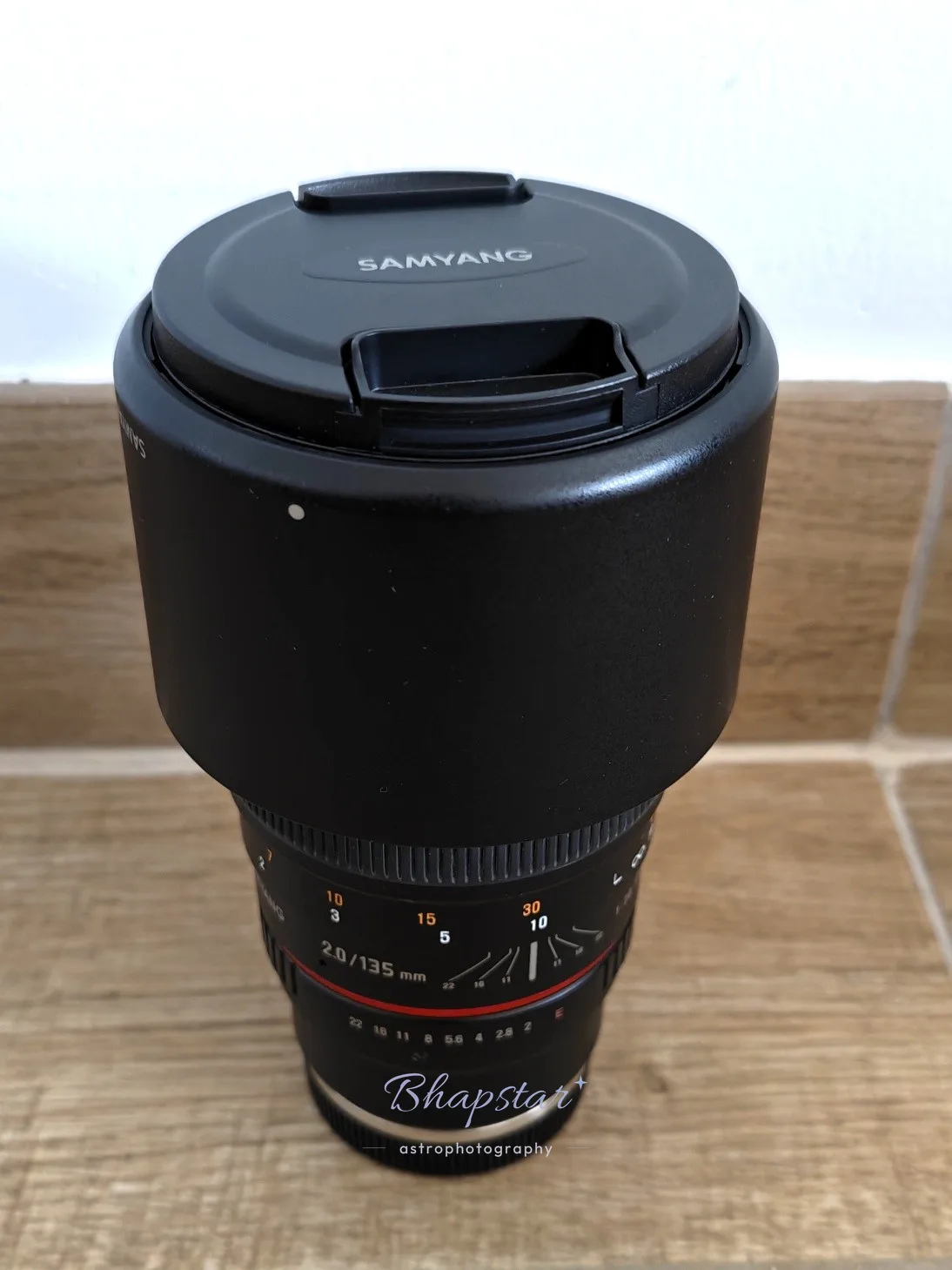
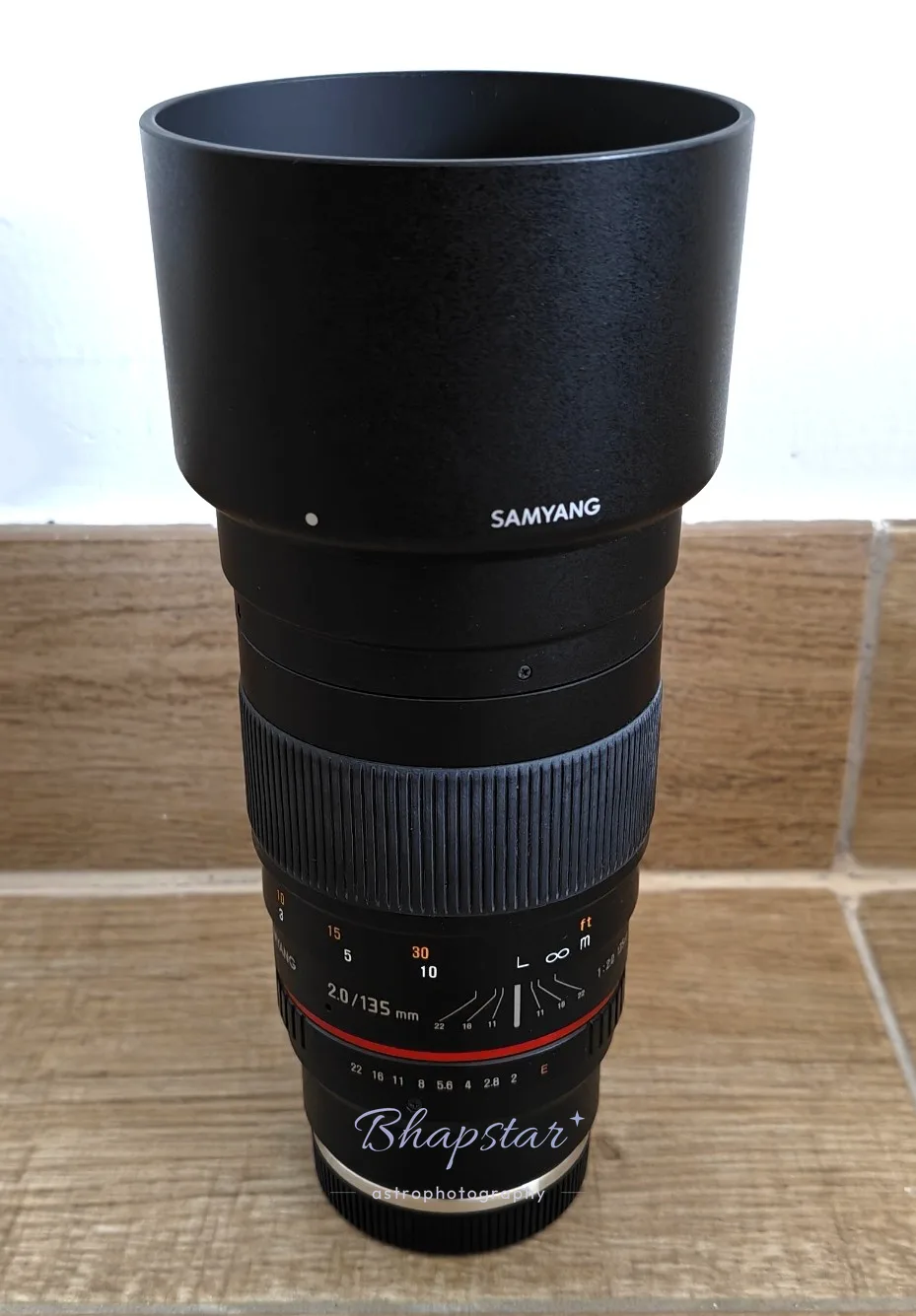
Samyang 135mm f/2
A manual telephoto with an almost unreasonable reputation among astrophotographers. Sharp corner to corner wide open, fast enough to reach faint nebulosityThe faint glowing gas itself, as opposed to the stars in front of it. Fainter than it looks in a finished picture, which is why it takes hours to record. in minutes, and effectively a very well corrected 135mm refractorA telescope that uses lenses to gather light, like a very good spotting scope. The other main type uses mirrors instead. that happens to fit a camera mount.
A telescope that fits a camera mount
Astrophotographers talk about this lens the way they talk about a good refractor, and the comparison is fairer than it sounds. At 135mm and f/2 the apertureThe size of the opening the light comes through, written as an f number such as f/2.8. Confusingly, a smaller f number means a bigger opening and more light. works out at around 67mm — a small apochromatA lens design that brings the red, green and blue parts of light to the same point of focus. Without it, bright stars pick up a purple halo., in other words, with a field flat enough to use wide open and no focuserThe part that slides the camera in and out until the stars are sharp. An electronic one does it with a small motor, on command. to sag. The difference is that it costs a fraction of what a comparable telescope would, and it screws straight onto a camera body.
What it buys you is the middle ground. A 14mm lens gives you the whole Milky Way and a telescope gives you one nebula; 135mm gives you the region — the North America and Pelican together, the whole of the Rho Ophiuchi complex, Orion's belt and sword in one frame with the Flame, the Horsehead and the Running Man all present. Those targets are too large for most telescopes and too small to register on a wide-angle lens.
Wide open, which is the point
Fast lenses are usually a compromise: you buy f/2 and then stop downMaking the lens opening smaller, from f/2 to f/2.8 for instance. The corners of the picture get tidier and less light comes in. to f/4 to get acceptable corners, at which point you have bought an f/4 lens. This one is genuinely usable at f/2. There is a little comaA fault that makes stars near the corners of the frame grow small wings, so they look like tiny comets rather than points. in the extreme corners on full frameA camera whose sensor is the size of an old 35mm film frame. Bigger sensors gather more light, which is why they cope better in the dark. and a trace of purple fringing on the brightest stars, both of which clean up in processing or disappear entirely with a modest stop down to f/2.8.
At f/2 the light-gathering is dramatic. Two-minute subframesOne single exposure out of the many that get stacked together. Sixty subs of one minute each make one hour of data. on a modest trackerA small motorised mount that turns a camera slowly to follow the stars. Much lighter than a full mount and enough for a camera lens. reach nebulosity that a slower setup would need ten minutes and autoguidingA second small camera watches one star and sends tiny corrections to the mount, keeping the target locked in place over long exposures. to match, and short subframes are exactly what an unguided tracker wants. That combination — fast opticsA telescope or lens with a small f number, which gathers light quickly. It is more demanding: focus is more critical and narrow filters work less well. and short exposures — is what makes the lens forgiving of imperfect polar alignmentLining a mount's main axis up with the point the sky turns around. Get it right and one slow, steady turn follows the stars all night..
Living with a manual lens
There is no autofocusA programmed routine through an Electronic Automatic Focuser that refocuses the telescope as the temperature drifts through the night, or at set timed intervals., no electronic aperture and no communication with the body at all, which means the camera records no focal lengthHow much a lens or telescope magnifies, measured in millimetres. A small number gives a wide view of the sky, a large number a narrow, closer one. or f-numberThe focal length divided by the width of the lens, written like f/5.8 and often called the f-number. Smaller numbers gather light faster, so you need less time on the target, but focus becomes more critical. in the file. For astrophotography none of that matters. You focus once on a bright star using live viewThe camera's rear screen showing what the lens is pointed at right now. You can magnify it to check that a star is properly sharp. at maximum magnificationHow much bigger a telescope makes something look. It is the telescope's focal length divided by the eyepiece's focal length., tape the focus ring so it cannot creep, and shoot all night.
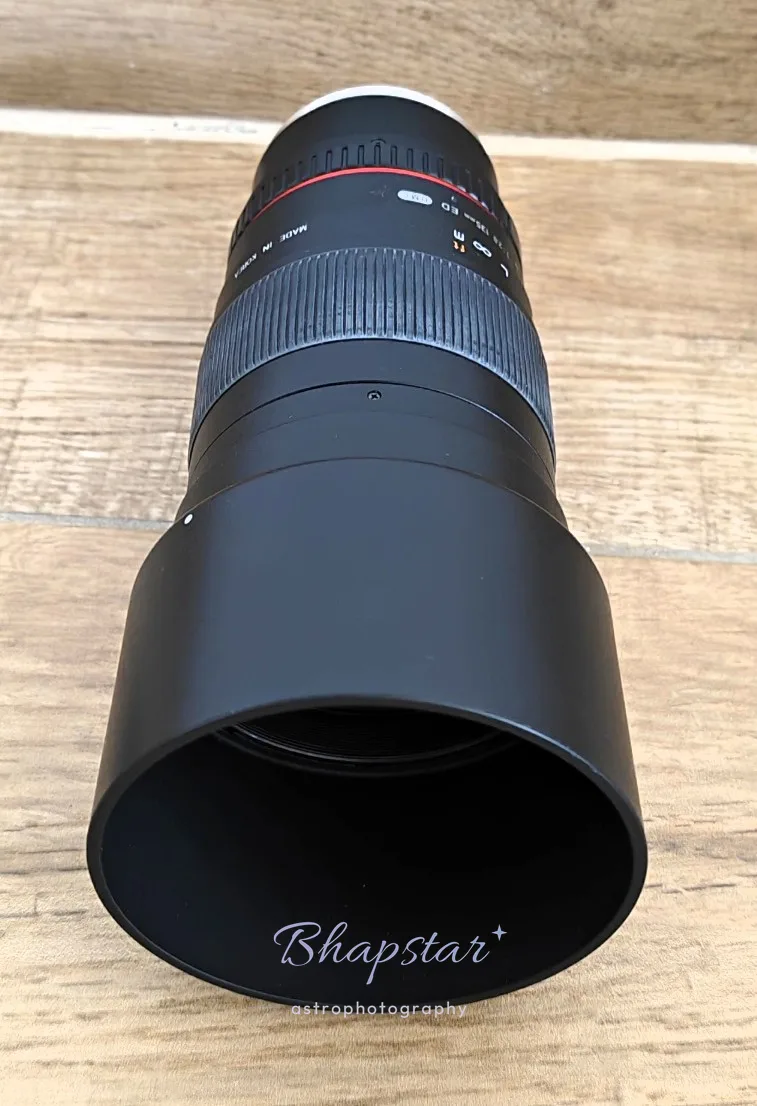
The focus ring itself is superb — long throw, heavy damping, and precise enough to find critical focus without fighting it. The lens is also heavy at around 830 grams, which is worth planning for: on a small star tracker it needs to be properly balanced, and a lens collar or a counterweightThe heavy block on the far end of a traditional mount's shaft. It balances the weight of the telescope so the motors are not fighting gravity. is not optional at this weight.
Practical notes
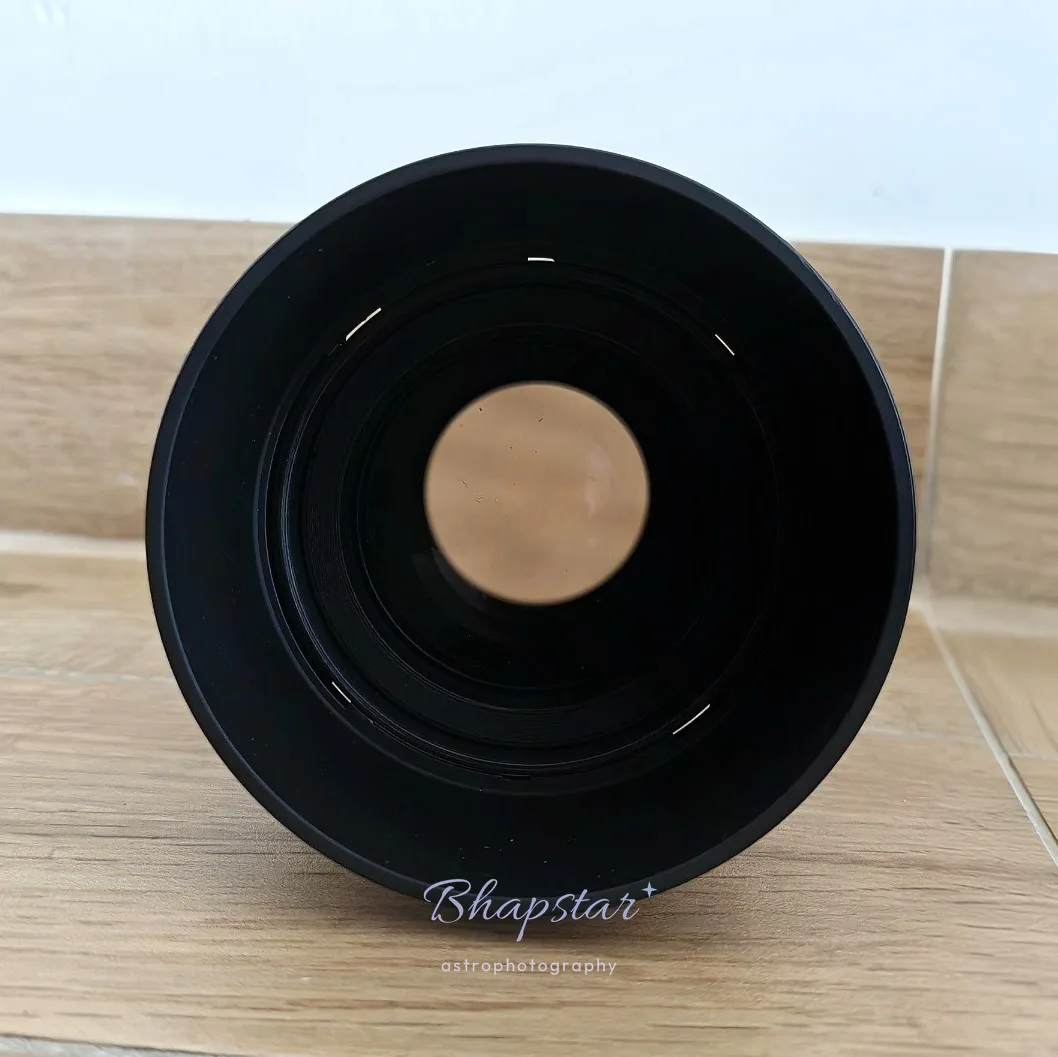
- DewWater that condenses out of the air onto cold glass overnight and quietly fogs everything. A small heater strip or a cloth hood keeps it off. is the enemy. The front element is large and recessed only slightly. A dew heaterA low-power heater strip wrapped round the front of the telescope. Holding the glass a degree or two above the air temperature is enough to stop dew ever forming on it. band and the supplied hood together will get you through a humid night; neither alone reliably will.
- 77mm filters fit. A light-pollution or dual-narrowband filter in this thread turns it into a genuinely capable suburban emission-nebula instrument.
- Focus shifts as it cools. Check it again an hour in. The shift is small but at f/2 the depth of focus is smaller.
- Flats still matter. VignettingThe corners of the frame coming out darker than the middle, because less light reaches the edges of the sensor. at f/2 on full frame is real. Take flats before the lens comes off the body.
By daylight
It is also, incidentally, a lovely portrait lens — the rendering wide open is creamy and the sharpness is there when you want it. Manual focus at f/2 on a moving subject is a skill rather than a convenience, so this is not the lens for photographing children, but for anything that stays still it is excellent.
Buying one
Sold as Samyang in most of the world and Rokinon in North America; the lens is identical. It exists in every common mount, and because it is fully manual the adapted versions behave exactly like the native ones — there is no electronic communication to lose in the adapter. That makes it one of the few lenses genuinely worth buying in a different mount if the price is right. Used copies are common and, with no autofocus motor and no electronics to fail, there is very little that can be wrong with one that looks clean.
Pair it with the A7 III and a tracker and you have a widefield deep-skyAnything beyond our own solar system: nebulae, galaxies and star clusters. Faint, far away, and the reason for long exposures. setup that fits in a small bag.
Where to buy
Some links above are affiliate links. If you buy through them I may earn a small commission, at no extra cost to you. It does not affect which gear I use or recommend. As an Amazon Associate I earn from qualifying purchases.