TeSeek Nano Light Adventurer Star Tracker
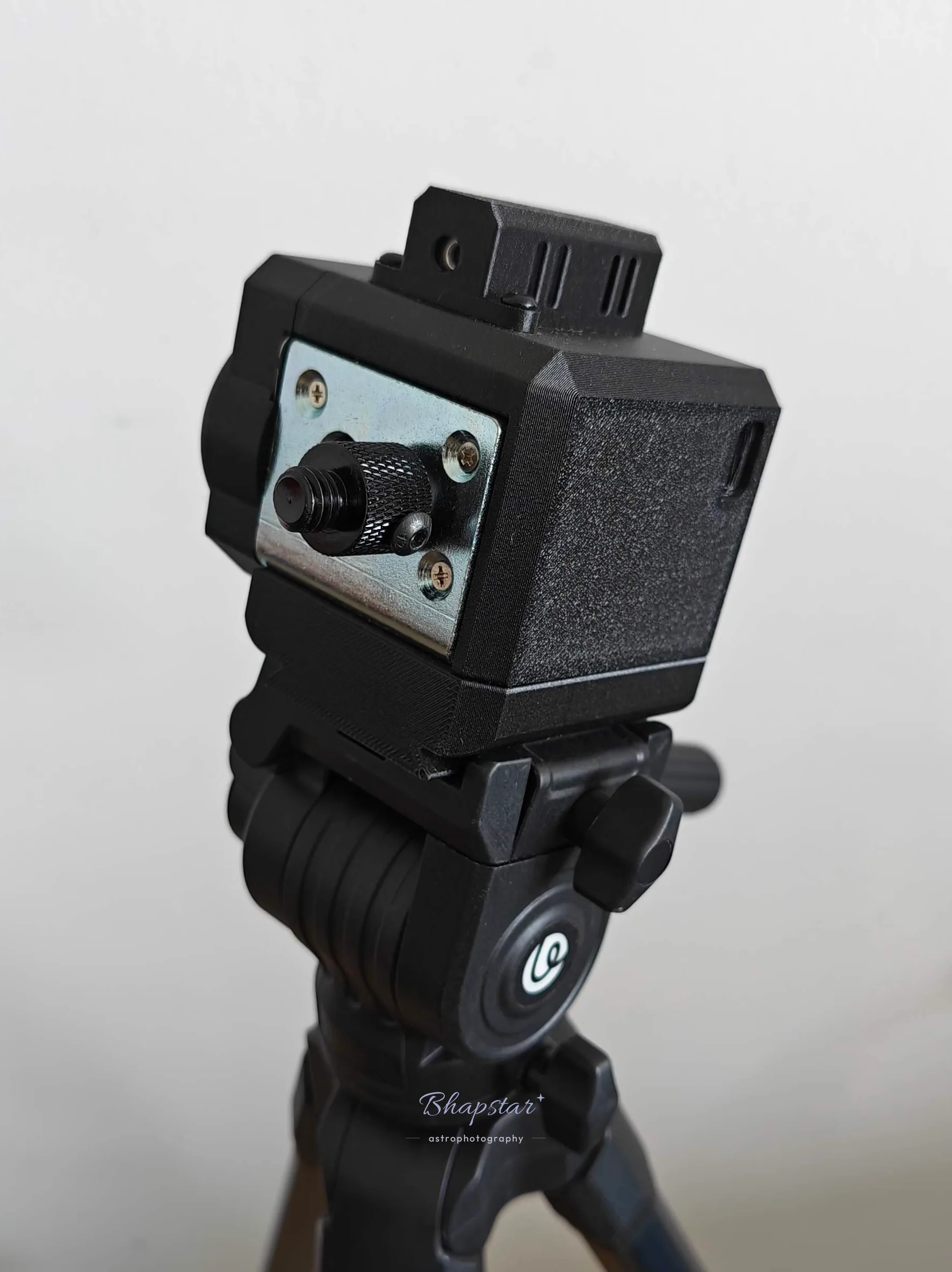
A half-kilo star trackerA small motorised mount that turns a camera slowly to follow the stars. Much lighter than a full mount and enough for a camera lens. in a carbon fibre filled PETG housing, with a green laser pointer built in for polar alignmentLining a mount's main axis up with the point the sky turns around. Get it right and one slow, steady turn follows the stars all night.. It turns the camera slowly with the sky, so a wide-angle lens can take exposures of minutes rather than seconds without the stars trailing.
What a star tracker does
The Earth turns, so the stars slowly drift across the sky. Leave a camera still for too long and every star becomes a short line. A star tracker fixes that by turning the camera at the same speed as the sky, in the opposite direction to the Earth's spin. The stars stay as points, and the exposure can run for minutes instead of seconds.
Longer exposures collect more light. That is what brings out the dust lanes and the faint glow of the Milky Way, and it means less noise once the frames are stackedCombining many frames of the same patch of sky into one. The random grain is different in every frame so it averages away, while the real detail is in the same place every time and stays..
The build
The Nano Light Adventurer is small and light. TeSeek list the weight as 0.5kg. The housing is PETG filled with carbon fibre, and inside it a 3000:1 reduction gear set turns the output very slowly and very steadily.
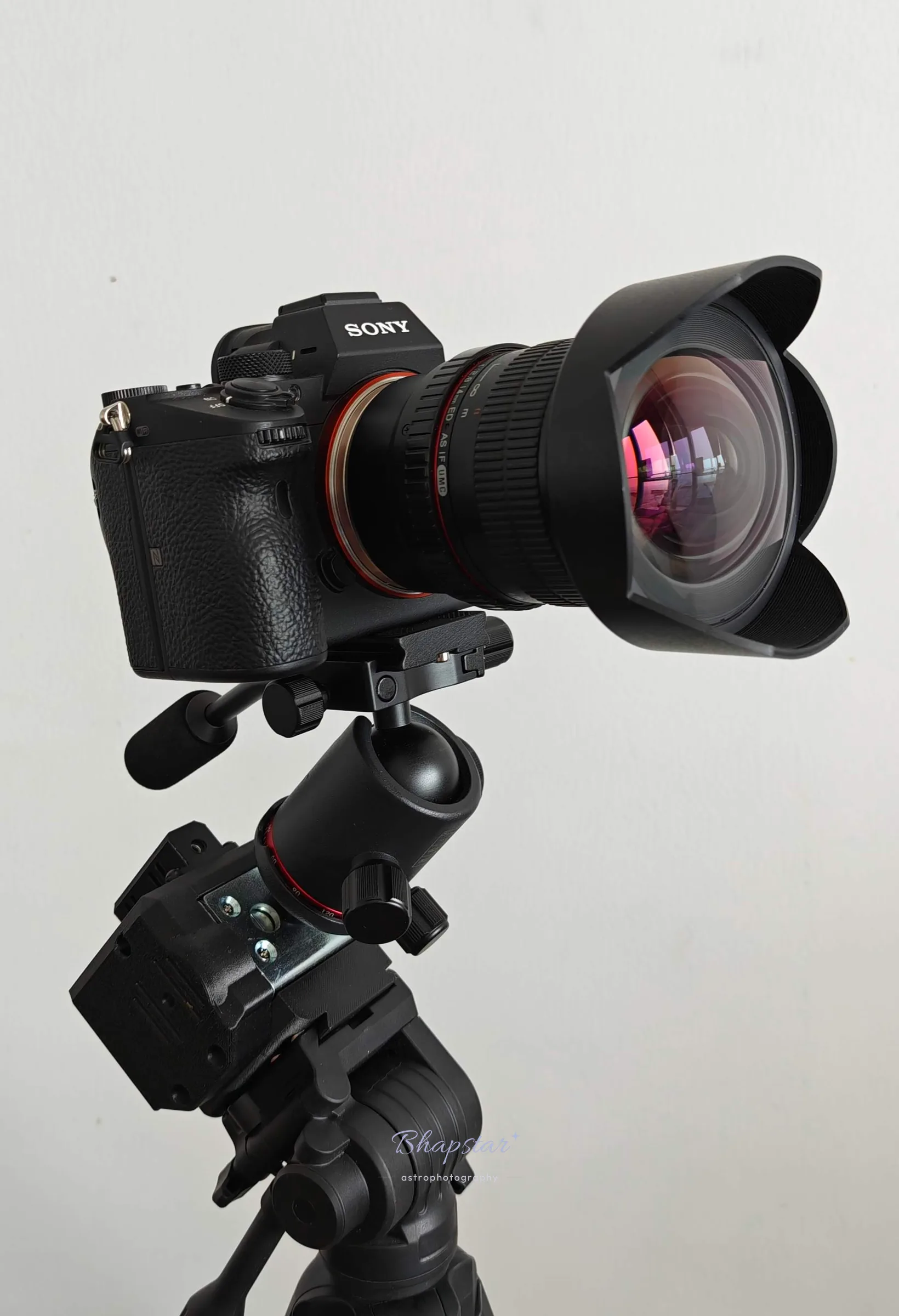
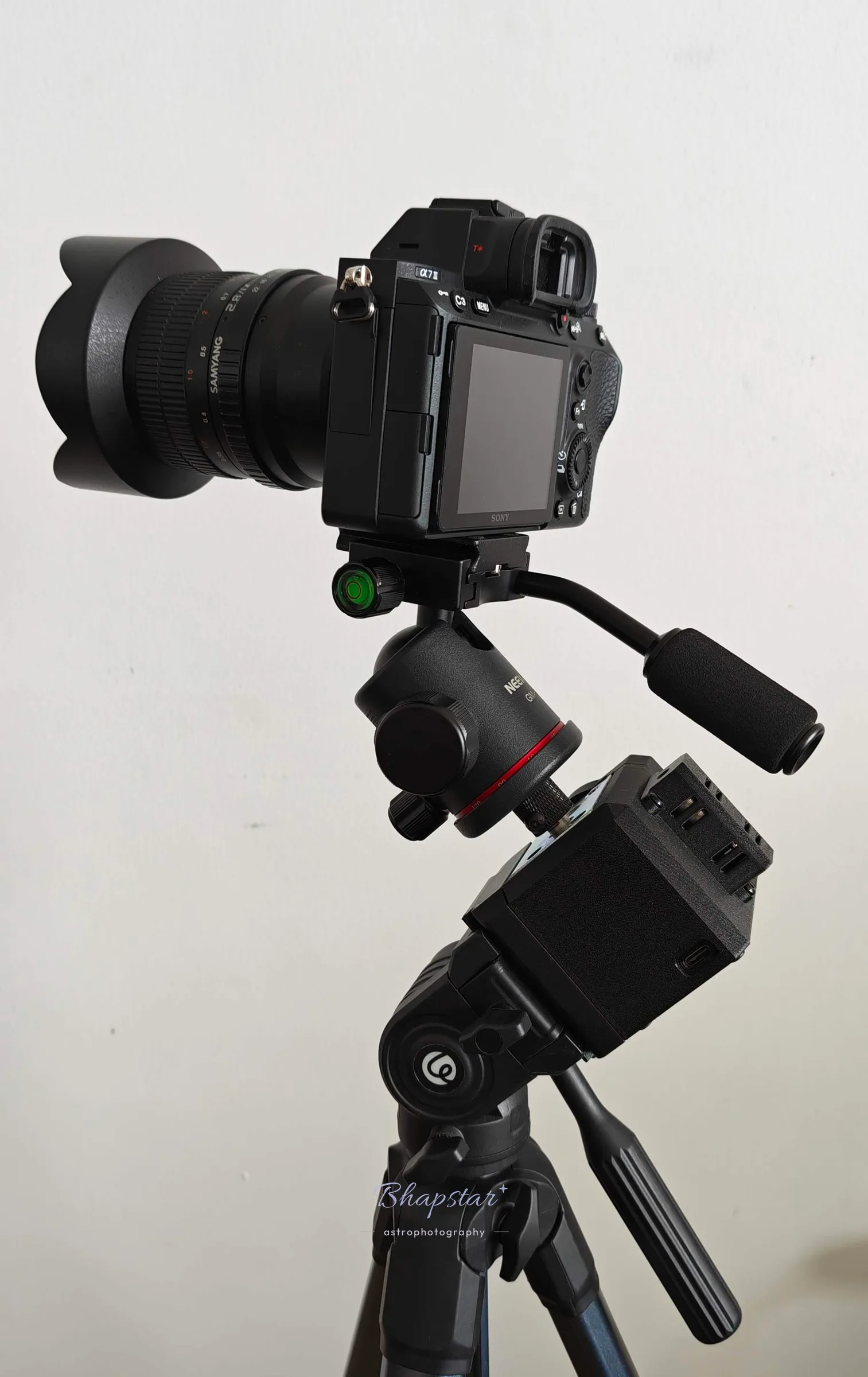
The base is a 38mm Arca-Swiss plate, so it clamps straight into most tripod heads. On top there is a standard 1/4 inch camera screw. A ball head goes on that screw and the camera goes on the ball head, which lets you aim the camera anywhere while the tracker does the turning. The ball head is not included. In the photos here it sits on a tripod pan head, with a ball head, the Sony A7 III and the Samyang 14mm on top.
There is no battery inside. Power comes in through a USB-C port, so it runs from an ordinary power bank.
Polar alignment with the laser
A tracker only works if its turning axis points at the celestial poleThe point the whole sky appears to turn around. In the north it sits very close to Polaris, and in the south nothing bright marks it., the point in the sky the stars appear to turn around. In the northern hemisphere that is very close to PolarisThe bright star that sits almost exactly above the Earth's northern axis. It barely moves all night, which is why polar alignment usually starts by pointing at it., the Pole Star.
The green laser on top is built in line with that axis. Point the laser at Polaris, lock the tripod head, and the tracker is aligned. TeSeek describe the laser as closely parallel to the main axis of the tracker.
Green lasers are bright and reach a long way. Keep the beam well clear of aircraft, and check the local rules before using one.
Setting it up
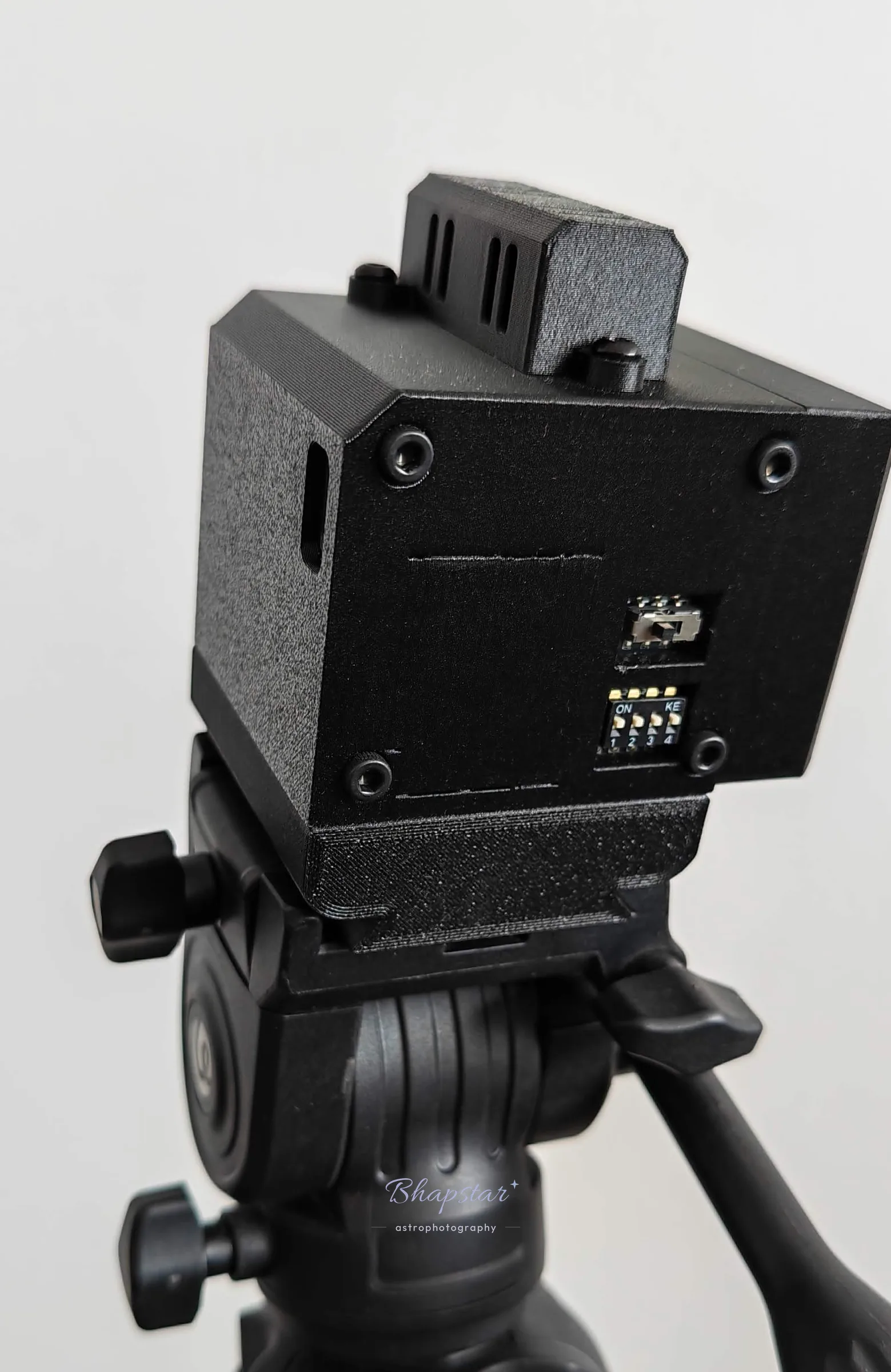
Four small DIP switches on the back choose the mode. With all four off it tracks at siderealThe speed the sky appears to turn, one full circle in just under twenty four hours. A tracking mount turns at exactly this rate. speed, the speed of the stars, for the northern hemisphere. Other settings give moon speed, the southern hemisphere, and speeds from half to a hundred times sidereal. With all four on, it switches to Wi-Fi, and it is controlled from a web page on your phone. No app is needed.
How long can each exposure be?
TeSeek's own figures, taken with the laser only roughly aligned:
| Focal lengthHow much a lens or telescope magnifies, measured in millimetres. A small number gives a wide view of the sky, a large number a narrow, closer one. | Exposure |
|---|---|
| 24mm | 5 minutes |
| 70mm | 4 minutes |
| 200mm | 1 minute |
| 450mm | 30 seconds |
The pattern is the useful part. The wider the lens, the more a small error is forgiven. A tracker like this is at its best with wide lenses such as the 14mm, and it gets harder to use as the focal length grows. Wind, a wobbly tripod and rough alignment all shorten these times.
Where it has been used
The sky in Stardust with a Due Date was tracked on this, with the Samyang 14mm on the A7 III at Al Qudra. Tracking blurs the ground, because the camera is moving with the stars, so the desert and the foreground came from a separate single frame that was blended in afterwards. That is the usual way to use a tracker when the picture has a landscape in it.
The settings for the camera side of that are in the camera Milky Way guide.
Good to know
- Bring a ball head. The tracker has a 1/4 inch screw on top and nothing else. A small ball head is the simplest way to aim the camera.
- Charge the power bank. There is no battery inside, so the power bank is what keeps it running. Bring one with enough charge for the whole night.
- Leave the screws alone. TeSeek fit every screw with thread locker, and taking it apart can damage it.
Where to buy
Some links above are affiliate links. If you buy through them I may earn a small commission, at no extra cost to you. It does not affect which gear I use or recommend.