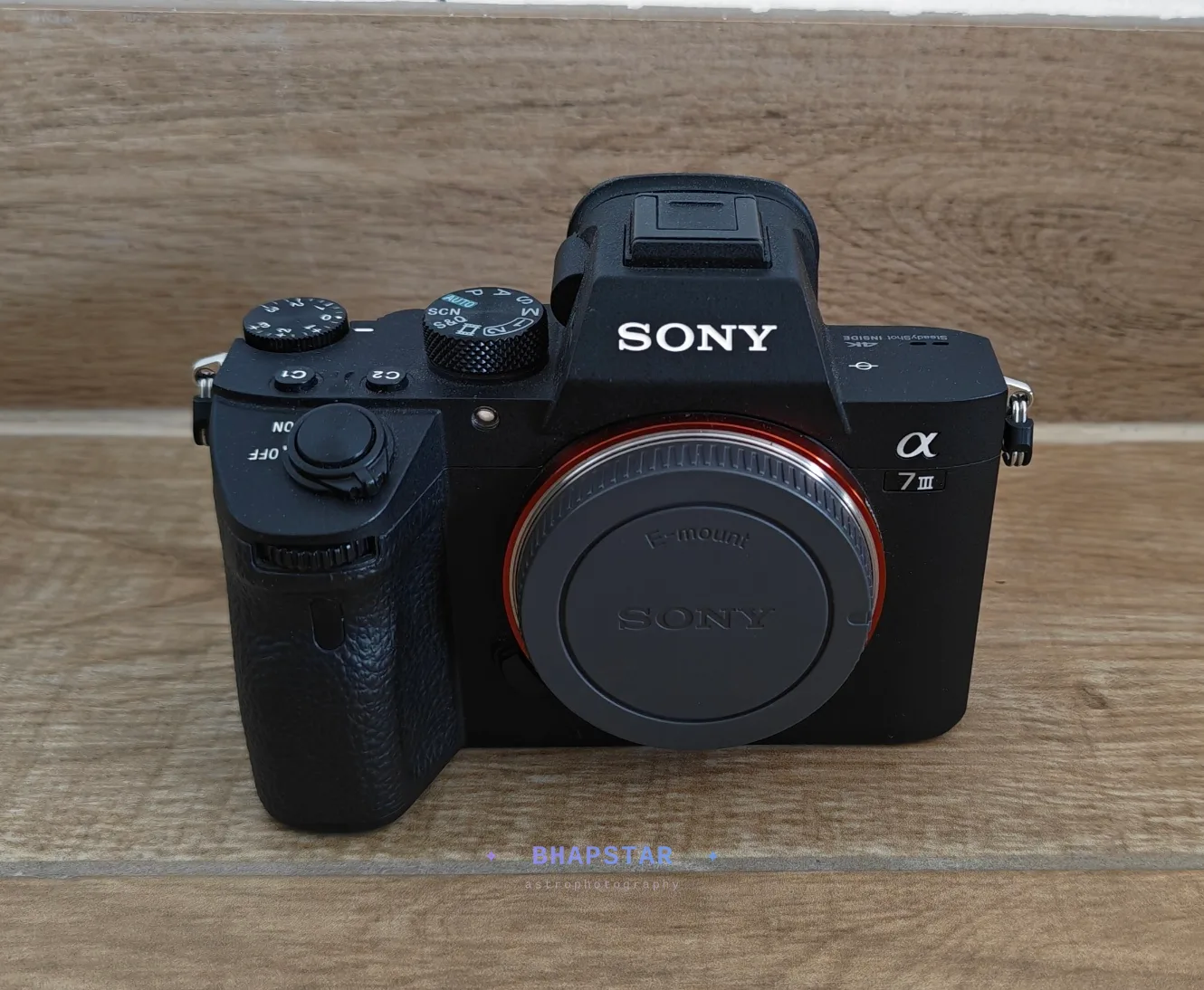
Sony A7 III
The camera I got started in astrophotography with, paired with the Samyang 135mm, the Samyang 14mm and the Rokinon 18mm. A 24-megapixel full-frameA camera whose sensor is the size of an old 35mm film frame. Bigger sensors gather more light, which is why they cope better in the dark. mirrorless body that has aged into one of the best-value low-light cameras available. Clean at ISOHow strongly the camera amplifies the light it has collected. A higher number makes a dark scene look brighter, but it also makes the picture grainier, so you use the lowest number that still shows the sky. 6400, dependable on long exposures, and the camera behind the Milky Way landscapes and the Geminids composite in the gallery.
Why this one, still
The A7 III arrived as the sensible middle child of Sony's full-frame range and quietly turned out to be the one that mattered. Years later it remains the camera I reach for when the target is bigger than a telescope can frame, and the reason is unglamorous: the sensor is very clean in the dark and nothing about the body gets in the way of a two-hour session of identical exposures.
The number that actually matters
24 megapixels across a full frame gives pixels around 6 micronsA thousandth of a millimetre. Sensor pixels and focus tolerances are both measured in them, and both are small enough that a few tens of microns matter. across. That is large by modern standards, and large pixels collect more light each before the read noiseA small amount of unavoidable grain added each time a frame is read off the sensor. Fewer, longer frames collect it fewer times. floor becomes the limiting factor. It is the whole reason a decade-old resolution figure still beats a newer, denser sensor on a moonless night.
The sensor is also dual gainA sensor with two amplifier settings built in. At the point it switches, the grain drops sharply, so one particular ISO is quieter than several lower ones.. There is a second base ISO at 640 where the read noise drops abruptly, which means ISO 640 is quieter in the shadows than several settings below it. For night work it is worth knowing: ISO 800 to 3200 is the useful band, and the bottom of that band is not the noisiest part of it the way intuition suggests.
In the field, at night
Set to manual, RAWThe camera's unprocessed file, holding everything the sensor recorded. A JPEG throws most of that away, and you need it when you come to brighten a very dark picture., long-exposure noise reduction off and stabilisation off, it will sit on a tripod and fire twenty-second frames for as long as the battery lasts — and the NP-FZ100 lasts a genuinely long time, comfortably a full night of intervalometerA timer that presses the camera's shutter over and over on its own, so you can take hundreds of frames without touching it. Many cameras have one built into the menus, and if yours does not, a small plug-in remote does the same job. work on one charge with a spare in the bag out of caution rather than necessity. That single change from the older Sony batteries is more significant for astrophotography than most of the spec sheet.
The things I actually use in the dark are the focus magnifier, which gets manual focus on a star exactly right where the infinity mark does not, and the customisable buttons, because scrolling menus with a red torch in your teeth is nobody's idea of a good time. The Milky Way and Me, Stardust with a Due Date and the Geminids composite in the gallery all came off this body.
Where it shows its age
The rear screen is low resolution and only tilts, the electronic viewfinder is dated, and the menu system is the old one — dense, deep and organised by no discoverable logic. None of that affects a frame at night, where the camera is on a tripod and set once. It matters more in daylight use, and it is the honest reason the camera is now inexpensive.
As a general-purpose camera
The autofocusA programmed routine through an Electronic Automatic Focuser that refocuses the telescope as the temperature drifts through the night, or at set timed intervals. is the part that has aged best. Eye detection was startling when it launched and it is still entirely adequate: it finds a face across a room, holds it while the subject moves, and does it without drama. Combined with 10 frames per second and a very deep buffer, it handles children and animals and street work without complaint.
Five-axis in-body stabilisation makes handheld work at slow shutterHow long the camera collects light for one frame. Twenty seconds means the sensor is gathering light for twenty seconds before the frame is saved. speeds practical, and dual card slots mean a night's work is never on one card. It is, still, the least compromised camera you can buy for the money.
What to pair it with
For night sky work, fast manual glass earns its place over expensive autofocus lenses. The 14mm and 18mm ultra-wides cover the Milky Way and meteor showers, and the 135mm turns the same body into a widefield deep-skyAnything beyond our own solar system: nebulae, galaxies and star clusters. Faint, far away, and the reason for long exposures. instrument. Two of the three focus by hand, and at night that is not the limitation it sounds like — you set infinity once on a bright star and never touch it again.
If you want the settings rather than the hardware, the camera Milky Way guide lists exactly what I set this camera to and why.
Buying one
The used market for this body is deep and the cameras are usually in good condition, because most of them were bought by people who did not shoot 200,000 frames with them. Check the shutter count, check the sensor for dust under a bright even surface, and confirm both card slots read. It is one of the few pieces of photographic equipment where buying used carries almost no penalty.
Where to buy
Some links above are affiliate links. If you buy through them I may earn a small commission, at no extra cost to you. It does not affect which gear I use or recommend. As an Amazon Associate I earn from qualifying purchases.