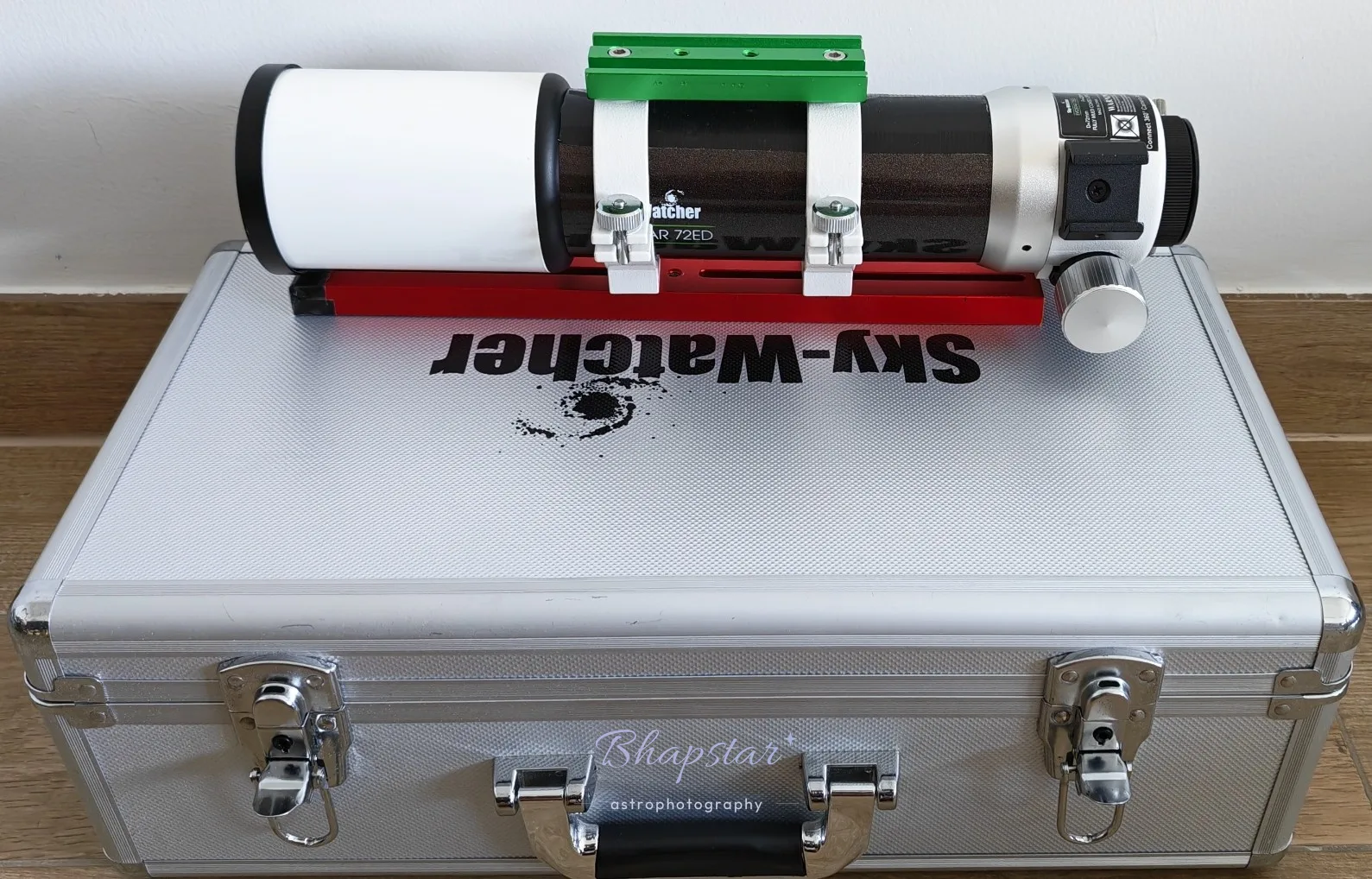
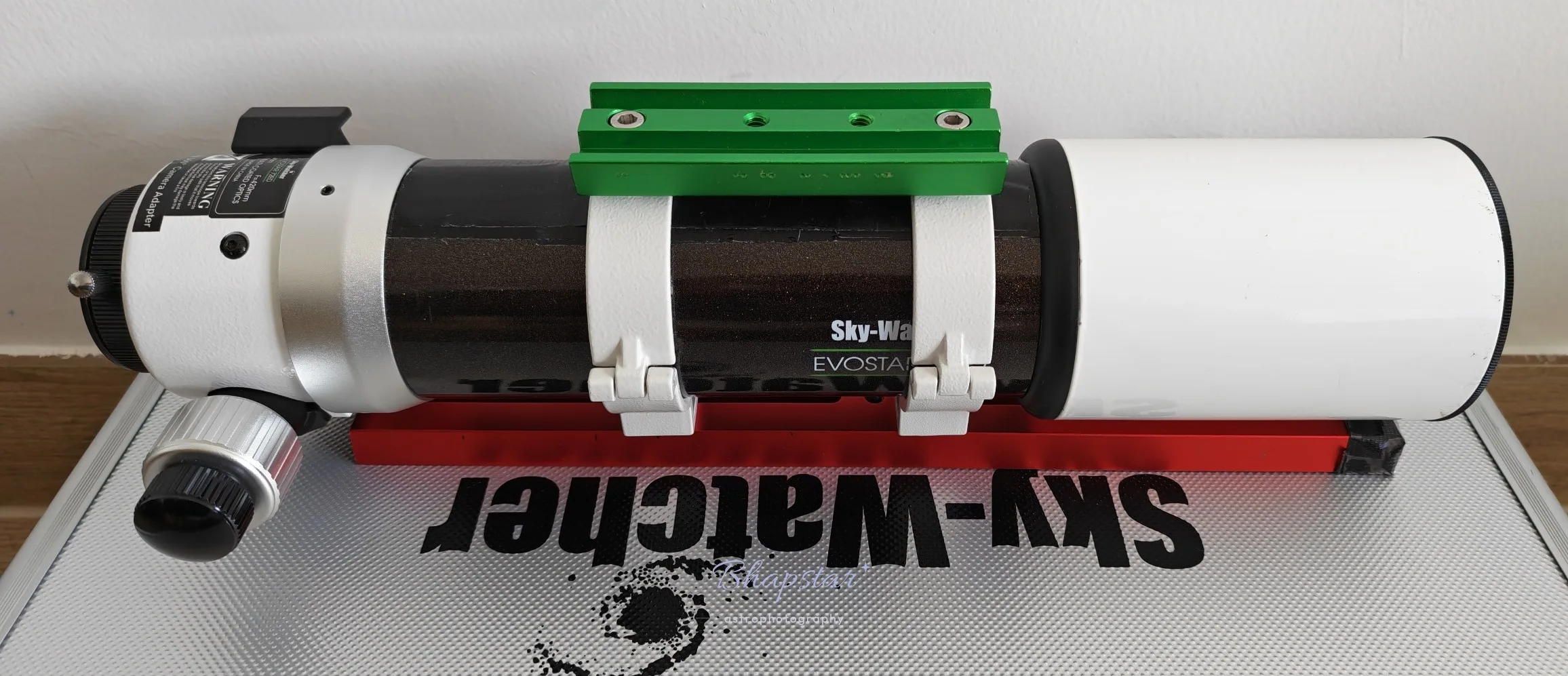
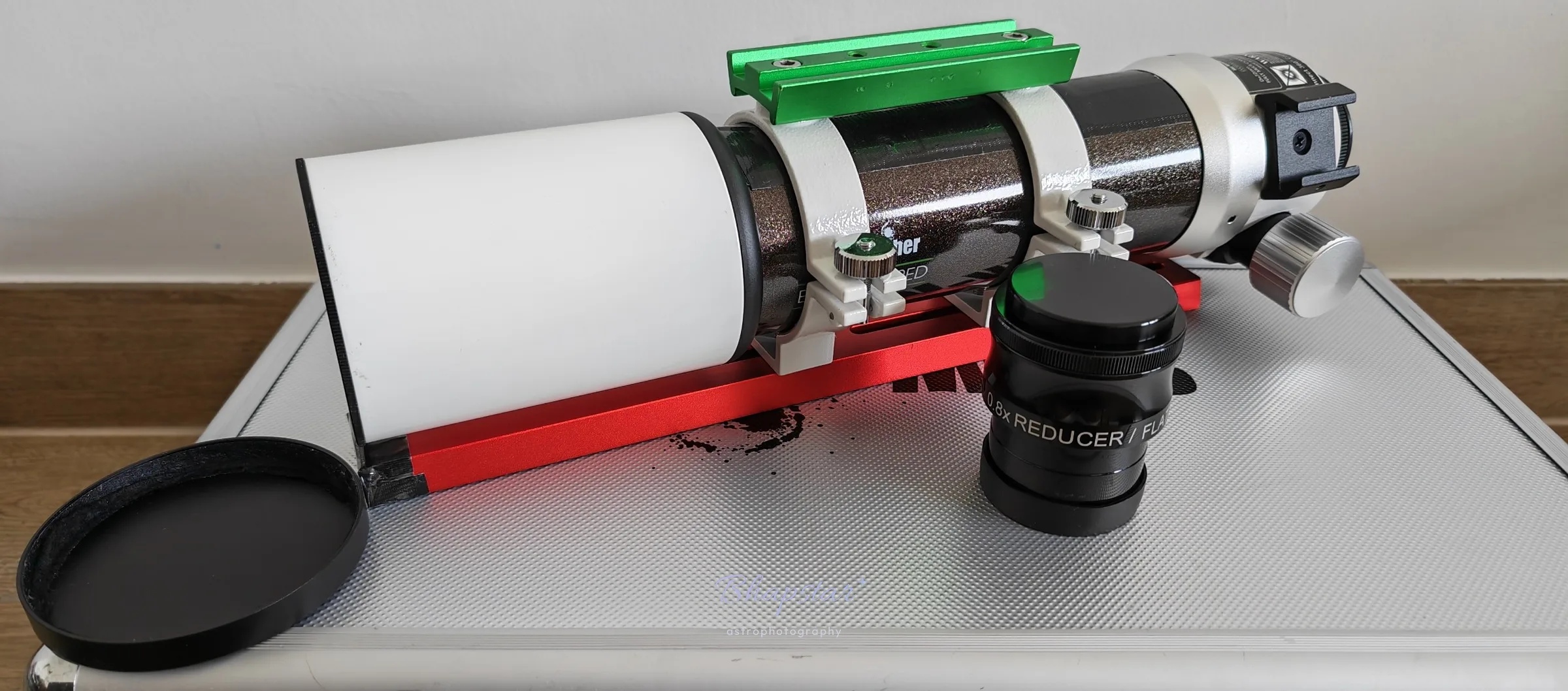
Skywatcher Evostar 72ED Refractor
My first ever telescope, and the one that started all of this. A 72mm EDExtra-low dispersion glass, a specific type of glass used in better lenses. It keeps the different colours of light travelling together, which is how a two-element lens gets close to the colour correction of a three-element one. doubletA lens made of two pieces of glass. Cheaper and lighter than three, at the cost of slightly less perfect colour correction. apochromatA lens design that brings the red, green and blue parts of light to the same point of focus. Without it, bright stars pick up a purple halo. at 420mm focal lengthHow much a lens or telescope magnifies, measured in millimetres. A small number gives a wide view of the sky, a large number a narrow, closer one., f/5.8. Light enough to sit on a small mount without complaint, and short enough to frame large nebulae. Doubles as a guidescopeThe small telescope the guide camera looks through, riding alongside the main one. and as a grab-and-go visual instrument.
Recommended constantly, for unglamorous reasons
The Evostar 72ED appears in more "first serious telescope" recommendations than almost anything else, and the reasons are all practical. Seventy-two millimetres at 420mm focal length, f/5.8, using an air-spaced doublet with an ED element, and a tube weighing around two kilograms.
That combination lands somewhere useful. 420mm frames most large nebulae comfortably on a small sensor. f/5.8 gathers signal well without demanding the tolerances a faster system does. Two kilograms sits within the comfortable range of even modest mounts, so the mount you already own can probably carry it. The Monkey Head from Al Qudra is this telescope's work, through the L-eXtreme.
Doublet rather than triplet
Two elements instead of three means less glass, less weight, lower cost and slightly less complete colour correction. At f/5.8 a good ED doublet controls false colourA coloured fringe, usually purple, around bright stars. It happens when a lens cannot quite bring every colour of light to the same point of focus. well enough that it is not the limiting factor in a deep-skyAnything beyond our own solar system: nebulae, galaxies and star clusters. Faint, far away, and the reason for long exposures. image, with any residual showing first around bright stars. The money not spent on a third element is money available for the mount, which will affect your results more.
The reducer and flattener, and why it matters
I bought mine with a StellaMira 2 inch 0.8x reducer and field flattener, and it is worth explaining what that piece of glass actually does, because the name describes two separate jobs.
The flattenerA small lens that corrects the naturally curved focus of a telescope, so the stars in the corners are as round as the ones in the middle. half. A lens does not bring light to focus on a flat surface. It focuses onto a gently curved one, a little like the inside of a very shallow bowl. Your eye copes with that without noticing. A camera sensor cannot, because a sensor is rigidly flat. Put a flat sensor against a curved focal surface and the centre can be sharp while the corners are not, which shows up as stars that smear outwards towards the edges of the frame. The flattener adds glass that bends the outer light back into line, so the surface the telescope focuses onto matches the surface the sensor occupies.
The reducerAn extra lens that shortens the focal length, giving a wider view and gathering light faster. The picture covers more sky and needs less time. half. The same glass also shortens the effective focal length, in this case to eight tenths of the original. That has two consequences worth knowing.
First, the field of viewHow much sky fits inside one frame. A wide field shows a whole constellation, a narrow one a single small galaxy. widens by a quarter, so 420mm becomes an effective 336mm. Targets that were tight in the frame get room around them.
Second, the focal ratioThe focal length divided by the width of the lens, written like f/5.8 and often called the f-number. Smaller numbers gather light faster, so you need less time on the target, but focus becomes more critical. drops from f/5.8 to about f/4.7. Because light gathering scales with the square of that ratio, the system collects signal roughly one and a half times faster, so a given amount of signal arrives in about a third less time. On a night with a narrow window before the target sets, or from a balcony where every extra minute of sky glowThe glow of that scattered artificial light coming back down at you. It is what makes a city sky look washed out rather than black. works against you, that is a real difference rather than a specification.
What you give up is a little resolution, since the same detail now falls on fewer pixels. On a small sensor at 420mm, that trade usually favours the reducer.
Getting the spacing right
The number that matters is 55mm. That is the distance the StellaMira needs between the back of the reducer and the sensor itself, and it is not a suggestion. Too long or too short by a couple of millimetres and stars in the corners start to stretch, which looks exactly like the problem the flattener was bought to fix. Camera, adapters and spacer rings all count towards that 55mm, so it is worth working the arithmetic out on paper before ordering anything.
Two details make this easier on the 72ED specifically. The reducer carries an integrated M48 camera thread, and removing its 2 inch nosepiece reveals an M54 female thread, which matches the M54 output on the Evostar's focuserThe part that slides the camera in and out until the stars are sharp. An electronic one does it with a small motor, on command.. Threaded connections hold spacing far more reliably than a compression fit, and they do not let anything rotate slightly during a long session.
What else you will want
The supplied focuser is a 2 inch dual-speed CrayfordA focuser design that grips the tube against a smooth rod rather than a toothed rack. It is smooth and it does not shift the image sideways as it moves. with 10:1 fine focus, genuinely good at this price, and it takes the EAF without complaint. Plan the filter drawer into the spacing arithmetic from the start rather than adding it afterwards, since it sits in the same 55mm and changes the sums.
At 420mm and two kilograms it also makes a pleasant grab-and-go visual instrument, which is easier to justify than a telescope that only ever does one job.
Getting one in the UAE
Mine came from Amazon.ae, which makes this one of the easier telescopes to acquire here: local stock, local delivery, no forwarder and no import charges. For a telescope that is a real advantage, since shipping something this size and weight internationally can add a substantial fraction of its price.
Where to buy
Some links above are affiliate links. If you buy through them I may earn a small commission, at no extra cost to you. It does not affect which gear I use or recommend. As an Amazon Associate I earn from qualifying purchases.