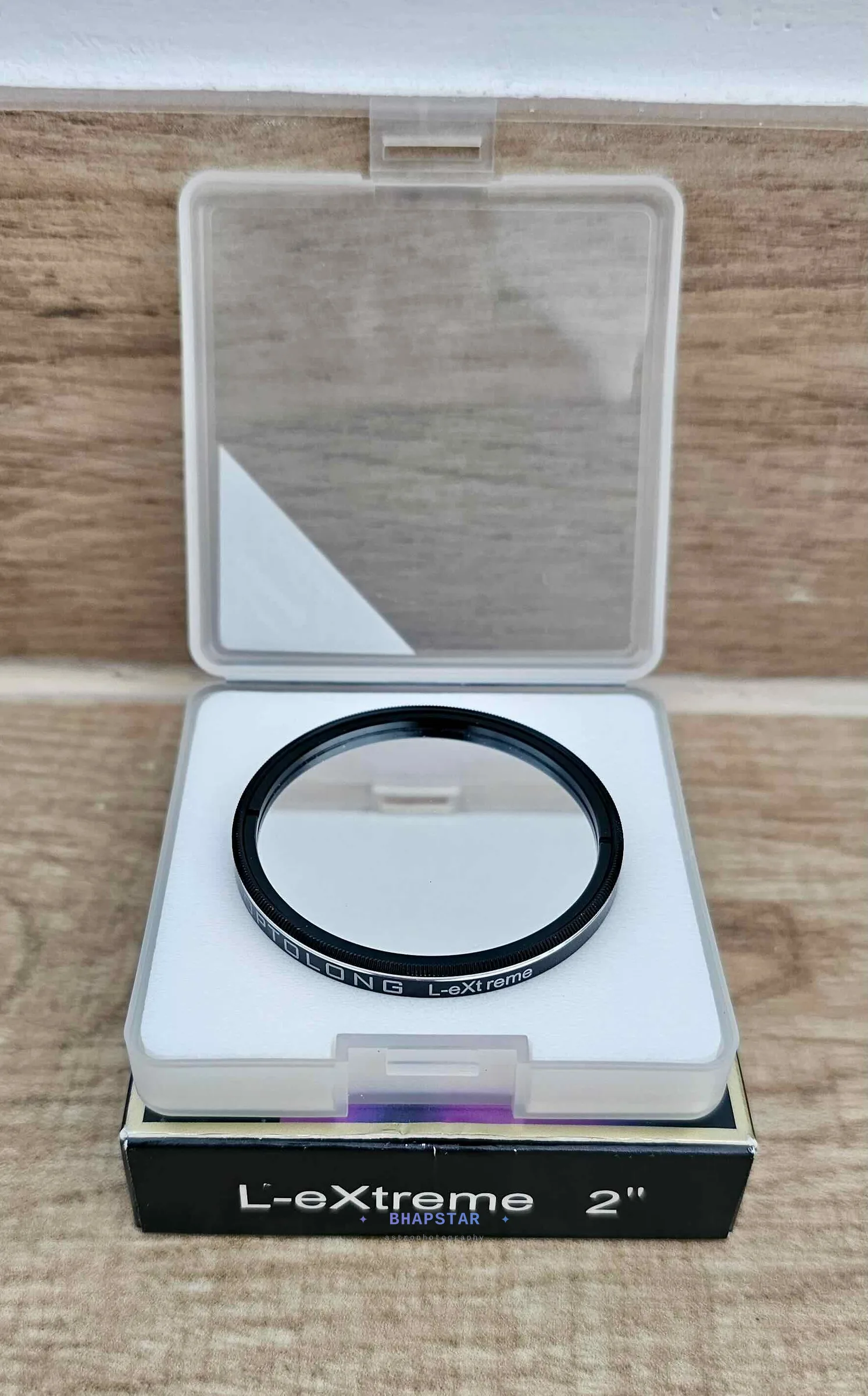
Optolong L-eXtreme Filter
A dual narrowbandOne filter with two windows open at the same time, usually the red light from hydrogen and the blue-green light from oxygen. It suits a colour camera, which records both at once. filter passing 7nm bands at Hydrogen-alphaThe deep red light given off by hydrogen, at a wavelength of 656 nanometres. It is the single most common thing being photographed in a glowing gas cloud. and Oxygen-III, and blocking nearly everything else, including most city skyglowThe glow of that scattered artificial light coming back down at you. It is what makes a city sky look washed out rather than black.. That is what makes emission nebulaeA cloud of gas that glows with its own light, in a few exact colours, because nearby stars are energising it. This is the kind that narrowband filters are built for. workable from a BortleA scale from 1 to 9 for how dark a sky is. Class 1 is a truly dark desert sky and class 9 is the middle of a bright city. 8 balcony. The trade is exposure time, because rejecting that much light means much longer sub-exposuresOne single exposure out of the many that get stacked together. Sixty subs of one minute each make one hour of data..
Why it works from a bright sky
Emission nebulae do not glow across the spectrumThe full spread of colours light can be, from deep blue through to deep red and beyond at both ends.. They emit at particular wavelengthsWhat colour a piece of light is, written as a number in nanometres. Around 400 is deep blue, around 700 is deep red., mainly hydrogen-alpha at 656.3nm and doubly-ionised oxygen at 500.7nm. Streetlighting is spread much more broadly. That asymmetry is the whole opportunity, and the L-eXtreme exploits it by opening two 7nm windows on those lines and closing everything else.
Look at how much of the bar is shut. The sodium line at 589nm, which is a large part of what a city throws upward, falls neatly in the gap between the two windows. From my balcony this is the difference between a target being possible and not, and it is why almost every emission nebula in the gallery was shot through it, including the Rosette, the Eagle, the Jellyfish, the Christmas Tree, Thor's Helmet, the Monkey Head and the Cat's Paw, the last of those from the balcony rather than the desert.
Living with it
Rejecting that much light means less of it arrives, so sub-exposures get longer and total integrationThe total time of every frame added together. Three hours of integration might be one hundred and eighty frames of one minute. has to grow. It is a trade of time for contrast, and from a bright site it is a trade well worth making. Star colour also largely disappears, since only two narrow slices of the spectrum are getting through, which is expected rather than a fault and is dealt with in processing.
7nm is the forgiving width. It tolerates faster optics better than a 3nm filter does, and it needs less integration to get there. If you are choosing a first dual narrowbandA filter that only lets through the few exact colours that glowing gas clouds give off, and blocks nearly everything else. Streetlight is mostly blocked, the nebula is not. filter, this is the one I would start with.
Where it will not help
Galaxies, star clusters and reflection nebulaeA cloud of dust that has no light of its own and simply reflects the light of nearby stars, usually a soft blue. A narrowband filter blocks it almost completely. shine by broadbandA filter that keeps most of the spectrum and blocks only a slice of it. It suits galaxies and star clusters, which shine in every colour rather than a few. starlight, so this filter throws away almost everything you came for. For those, the L-Quad Enhance is the right tool, and the Pleiades went unfiltered entirely.
Getting one
Filters are one of the few things in this hobby that genuinely do not wear out. There are no moving parts, no electronics and no consumables, so a coating in good condition performs exactly as it did new. That makes the used market a reasonable place to buy one: inspect for scratches and coating damage, and check it is the model and size you think it is. New, Optolong sell through the usual dealers and shipping to Dubai has not been a problem.
Where to buy
Some links above are affiliate links. If you buy through them I may earn a small commission, at no extra cost to you. It does not affect which gear I use or recommend. As an Amazon Associate I earn from qualifying purchases.