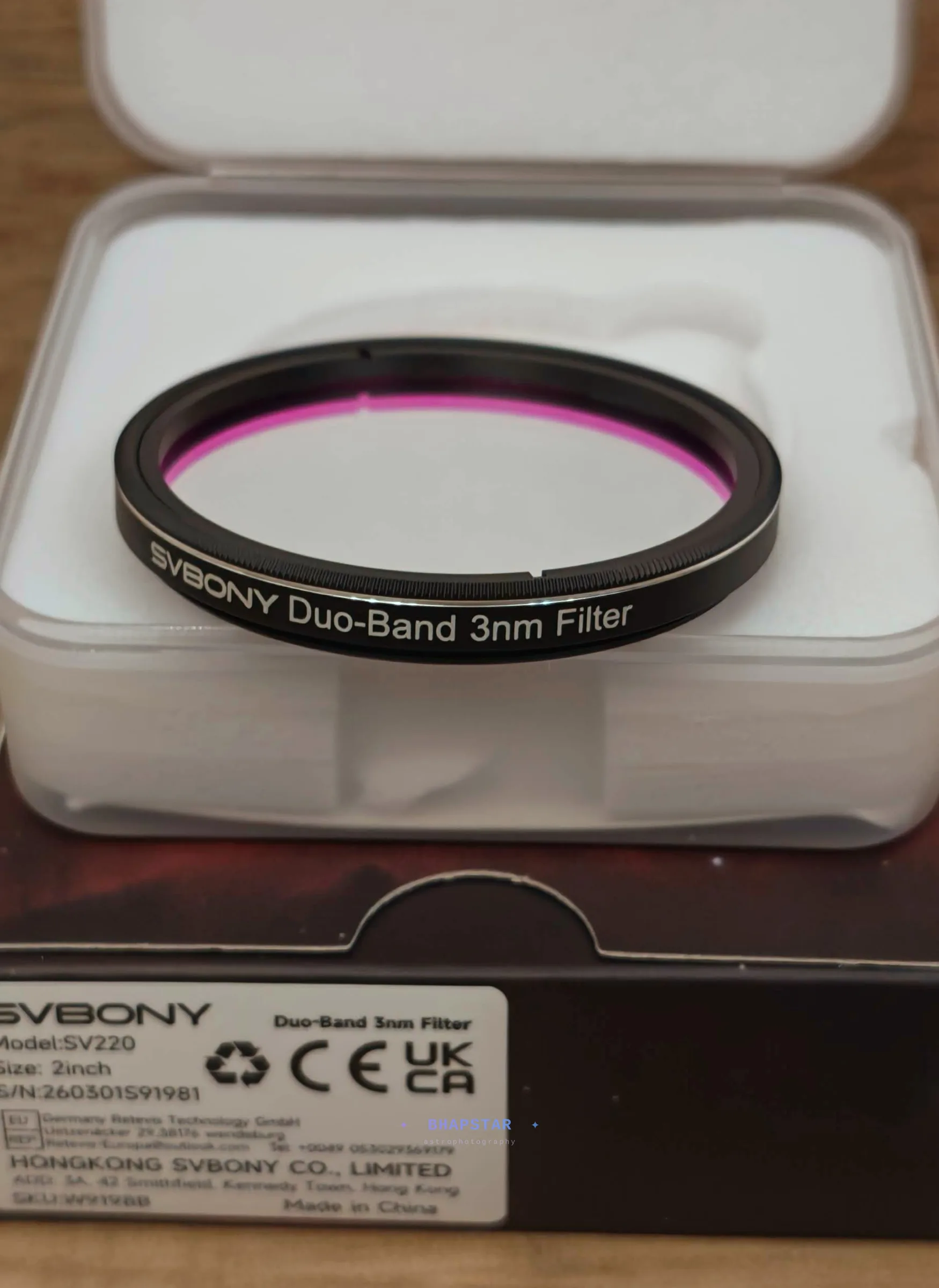
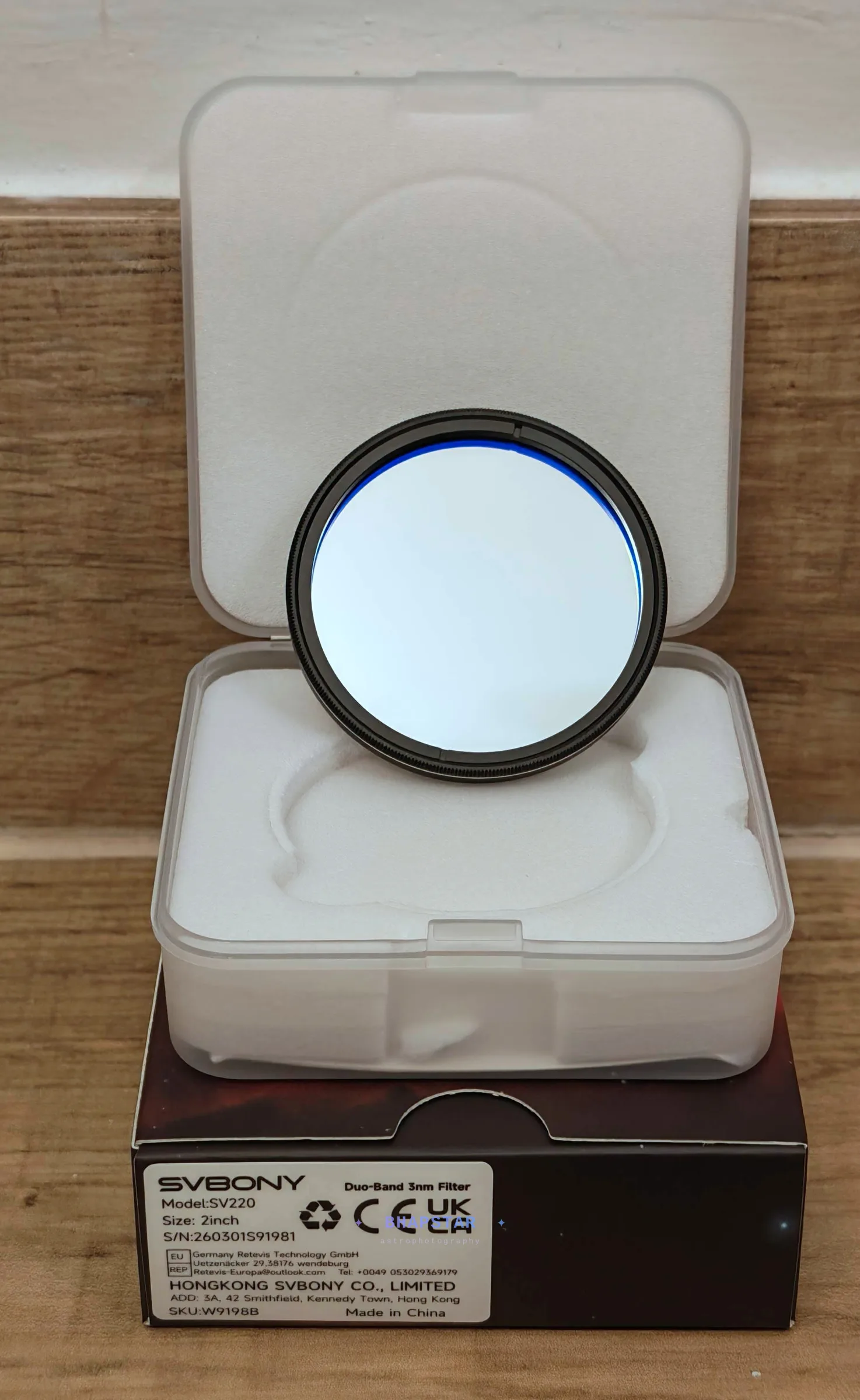
Svbony SV220 3nm Filter
A 3nm dual narrowbandOne filter with two windows open at the same time, usually the red light from hydrogen and the blue-green light from oxygen. It suits a colour camera, which records both at once. filter, tighter than the 7nm L-eXtreme on both the Hydrogen-alphaThe deep red light given off by hydrogen, at a wavelength of 656 nanometres. It is the single most common thing being photographed in a glowing gas cloud. and Oxygen-III bands. Narrower passbandsThe window of colours a filter lets through. A narrow passband blocks more streetlight, but leaves less margin if anything shifts. mean better contrast against skyglowThe glow of that scattered artificial light coming back down at you. It is what makes a city sky look washed out rather than black. and a heavier penalty in signal, so it suits slower optics and longer integrations.
Half the width of a 7nm filter
The SV220 does the same job as the L-eXtreme, through windows less than half as wide: 3nm at hydrogen-alpha and 3nm at doubly-ionised oxygen, against the L-eXtreme's 7nm. Drawn to scale the difference is obvious.
Narrowing the window rejects proportionally more skyglow while the emission lineOne exact colour that a glowing gas gives off. Hydrogen produces a strong red one, oxygen a blue-green one, and filters are built around their positions. itself, which is genuinely narrow, passes more or less untouched. Svbony quote better than 85% peak transmissionHow much of the light a filter is meant to pass actually gets through. Ninety per cent transmission means a tenth is lost even in the window it is designed for. and OD5 blocking, meaning roughly 99.999% of everything outside those two slots is stopped.
What it asks in return
Less total light arrives, so integrationThe total time of every frame added together. Three hours of integration might be one hundred and eighty frames of one minute. has to grow. If your limiting factor is available hours rather than sky brightness, a 3nm filter can finish a session behind a 7nm one simply because you gathered less. It also cares more about focal ratioThe focal length divided by the width of the lens, written like f/5.8 and often called the f-number. Smaller numbers gather light faster, so you need less time on the target, but focus becomes more critical.: in a fast light cone the rays strike the coating at an angle and the effective passband shifts, and a narrower band has less margin before the emission line drifts outside it. Independent testing found this filter's oxygen performance in line with rival 3nm filters and its hydrogen-alpha band rather more sensitive to fast opticsA telescope or lens with a small f number, which gathers light quickly. It is more demanding: focus is more critical and narrow filters work less well., so it suits f/5 and slower most comfortably.
Where it shines
Bright emission nebulaeA cloud of gas that glows with its own light, in a few exact colours, because nearby stars are energising it. This is the kind that narrowband filters are built for. with long integration behind them, from the most light-polluted sites. On paper that is where it should pull ahead of the 7nm L-eXtreme rather than merely match it.
The Lobster Nebula is that case exactly: four hours from home in Dubai under a BortleA scale from 1 to 9 for how dark a sky is. Class 1 is a truly dark desert sky and class 9 is the middle of a bright city. 8 sky, with the hydrogen structure coming through cleanly.
It earns its place at a darker site too. The Eastern Veil from Al Qudra sits in a crowded stretch of the Milky Way, and the narrow passband holds the background and the stars down so the filamentsA thin bright thread running through a nebula. Often it is not a thread at all but a sheet of gas seen edge-on: looking along the fold stacks the same faint material over a much longer path, so it brightens into a line while the face-on parts stay invisible. stand clear of them.
Getting one to the UAE
Mine came from Amazon's US site rather than the regional one, and arrived in Dubai without any complication. Worth knowing, because people often assume Amazon.com will not deliver here or will make it painful. For something small and light like a filter it is a straightforward route, and the shipping cost stays proportionate in a way it does not for a telescope.
Where to buy
Some links above are affiliate links. If you buy through them I may earn a small commission, at no extra cost to you. It does not affect which gear I use or recommend. As an Amazon Associate I earn from qualifying purchases.