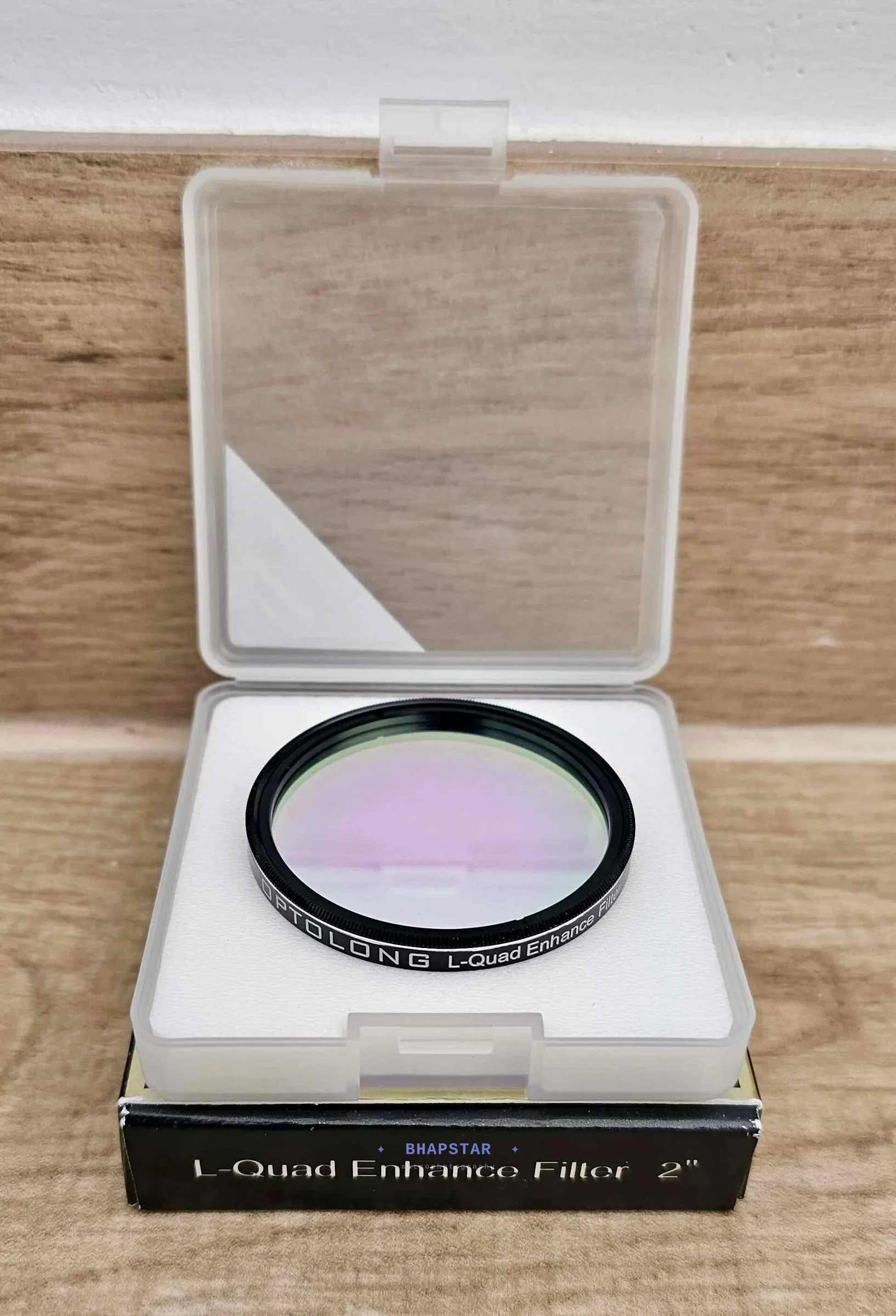
Optolong L-Quad Enhance Filter
A broadbandA filter that keeps most of the spectrum and blocks only a slice of it. It suits galaxies and star clusters, which shine in every colour rather than a few. light pollutionArtificial light from streets and buildings that scatters in the air and brightens the whole night sky, hiding everything faint. filter for one-shot-colour cameras, intended for galaxies, star clusters and reflection nebulaeA cloud of dust that has no light of its own and simply reflects the light of nearby stars, usually a soft blue. A narrowband filter blocks it almost completely., the targets where a dual narrowbandOne filter with two windows open at the same time, usually the red light from hydrogen and the blue-green light from oxygen. It suits a colour camera, which records both at once. filter is no help at all. Optolong themselves do not recommend it above BortleA scale from 1 to 9 for how dark a sky is. Class 1 is a truly dark desert sky and class 9 is the middle of a bright city. 7, which makes it an interesting thing to test from a Bortle 8 balcony.
The filter for everything narrowband cannot touch
A dual narrowbandA filter that only lets through the few exact colours that glowing gas clouds give off, and blocks nearly everything else. Streetlight is mostly blocked, the nebula is not. filter is transformative on emission nebulaeA cloud of gas that glows with its own light, in a few exact colours, because nearby stars are energising it. This is the kind that narrowband filters are built for. and no use at all on galaxies, clusters and reflection nebulae, which shine by broadband starlight. The L-Quad Enhance is the other half of that pair. Rather than opening two narrow windows, it keeps most of the spectrumThe full spread of colours light can be, from deep blue through to deep red and beyond at both ends. and removes the slice where sodium and mercury lighting sits.
This is the opposite approach to a narrowband filter, and worth being clear about because the "quad bandpass" name misleads people. It does not open four narrow slots. It keeps almost the whole spectrum and removes one slice, roughly 575 to 625nm, where sodium and mercury lighting sits. The four bands in the name are the emission lines that happen to fall in the kept regions, at better than 90% transmission each. Keeping the continuumLight spread smoothly across every colour, which is how stars and galaxies shine. Glowing gas clouds do the opposite and emit at a few exact colours. is what lets stars and galaxies hold their colour, which is exactly what a dual narrowband filter cannot do.
The interesting part
Optolong rate this filter for Bortle 1 to 7, and explicitly say Bortle 8 and 9 are not recommended, pointing you at their 3nm and 7nm narrowband filters instead. My balcony in Dubai is Bortle 8, so on the manufacturer's own advice this filter should be the wrong choice there.
That makes it worth testing properly rather than assuming. Broadband filters work by blocking what the local lighting emits, and a city running white LED puts out light across exactly the range you want to keep, while older sodium lighting produces a narrow spike that is easy to reject. A filter of this kind can therefore be effective in one city and marginal in another, which is why a glowing review written elsewhere tells you very little.
Where it earns its place
The darker sites are the obvious case. At Al Qudra and Al Quaa, where the sky is doing far less damage to begin with, broadband targets are the ones worth pointing at. M81 and M82 and the Needle Galaxy both came through this filter from Al Qudra.
The one that surprises me is Orion, which is an emission nebula and by the usual logic belongs to the L-eXtreme. M42 is bright enough, and has enough going on beyond the two narrowband lines, that keeping the continuum was the better call.
For fainter emission nebulae the L-eXtreme is still the right call. Expect a gain in contrast and easier colour calibration from this one rather than a transformation, since there is far less a broadband filter can safely block.
Getting one in the UAE
Mine came from Amazon.ae, which is the easy case: local stock, local delivery, no forwarding and no import paperwork. Optolong filters turn up on the regional Amazon reasonably often, and when they do it is worth taking, because the alternative routes all add either time or cost.
Where to buy
Some links above are affiliate links. If you buy through them I may earn a small commission, at no extra cost to you. It does not affect which gear I use or recommend. As an Amazon Associate I earn from qualifying purchases.