The Rosette Nebula (NGC 2244)
One of the most recognisable emission nebulaeA cloud of gas that glows with its own light, in a few exact colours, because nearby stars are energising it. This is the kind that narrowband filters are built for. in the winter sky, the Rosette Nebula is a vast cloud of ionised hydrogen surrounding a young open star cluster at its heart.
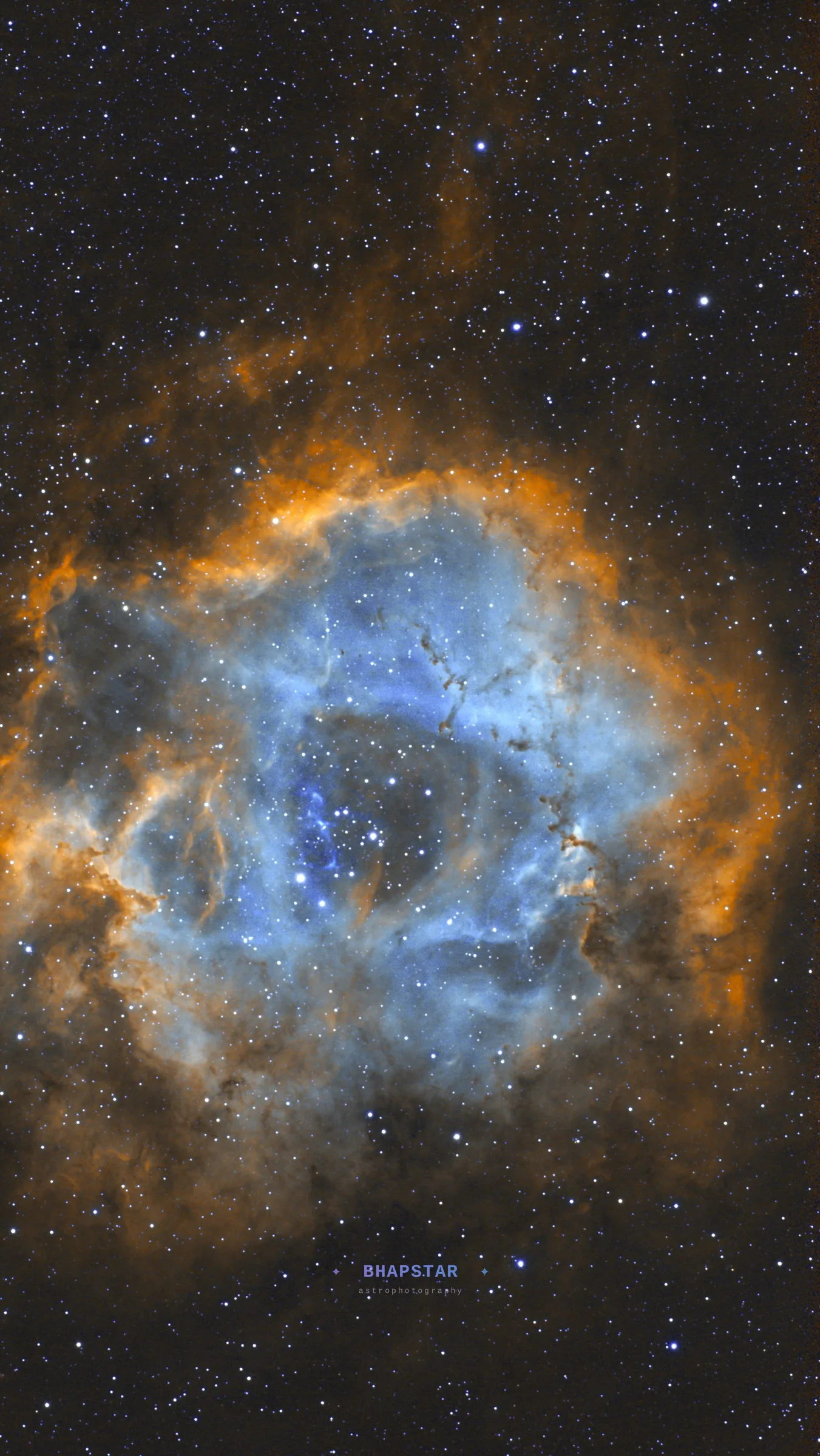
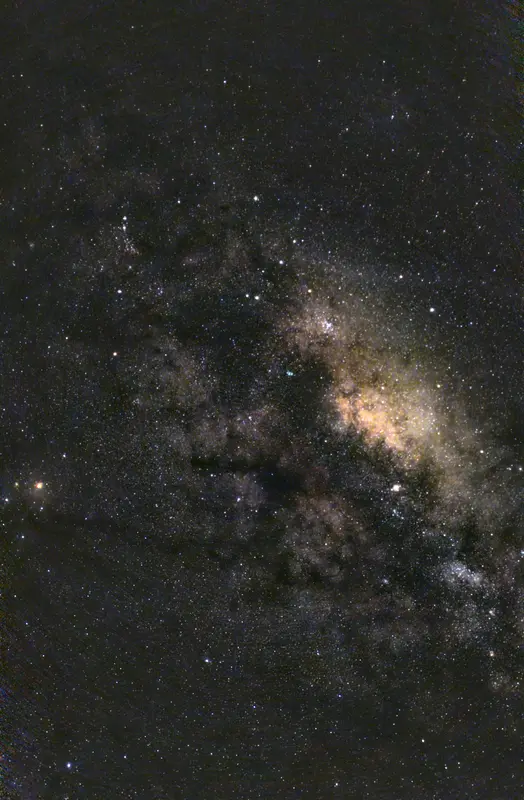
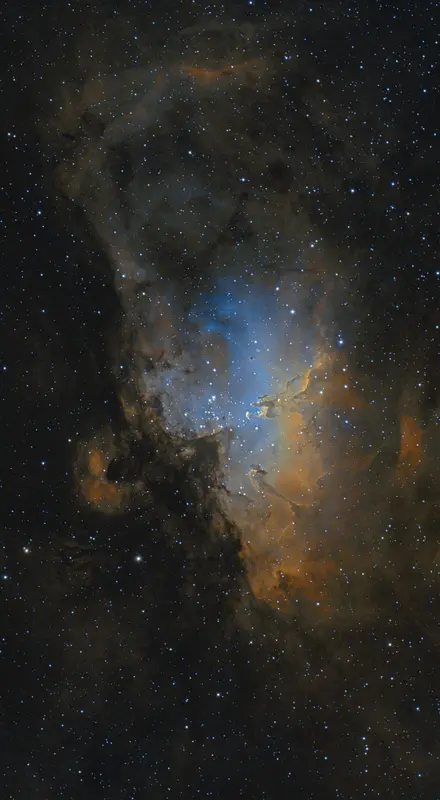
The Rosette Nebula (NGC 2237–2244) sits around 5,000 light-years away in the constellation Monoceros, and spans roughly 130 light-years across, making it one of the largest star-forming regions visible from Earth. The cluster of young, hot stars at its core (NGC 2244) is only a few million years old, yet the intense ultraviolet radiation they pour out is already carving enormous cavities into the surrounding gas and dust.
This is a target I had been planning for a while. The sheer scale of the nebula means it benefits from a shorter focal lengthHow much a lens or telescope magnifies, measured in millimetres. A small number gives a wide view of the sky, a large number a narrow, closer one., and getting the balance between the bright core and the delicate outer filamentsA thin bright thread running through a nebula. Often it is not a thread at all but a sheet of gas seen edge-on: looking along the fold stacks the same faint material over a much longer path, so it brightens into a line while the face-on parts stay invisible. right took some patience in processing.
The Rosette is a popular narrowbandA filter that only lets through the few exact colours that glowing gas clouds give off, and blocks nearly everything else. Streetlight is mostly blocked, the nebula is not. target - the hydrogen-alphaThe deep red light given off by hydrogen, at a wavelength of 656 nanometres. It is the single most common thing being photographed in a glowing gas cloud. signal is strong and rewards even modest integrationThe total time of every frame added together. Three hours of integration might be one hundred and eighty frames of one minute. times. If you image it in broadbandA filter that keeps most of the spectrum and blocks only a slice of it. It suits galaxies and star clusters, which shine in every colour rather than a few., the red emission can be tricky to balance without blowing out the core. Worth experimenting with both approaches.