ZWO TC20 Tripod + TH10 Fluid Head
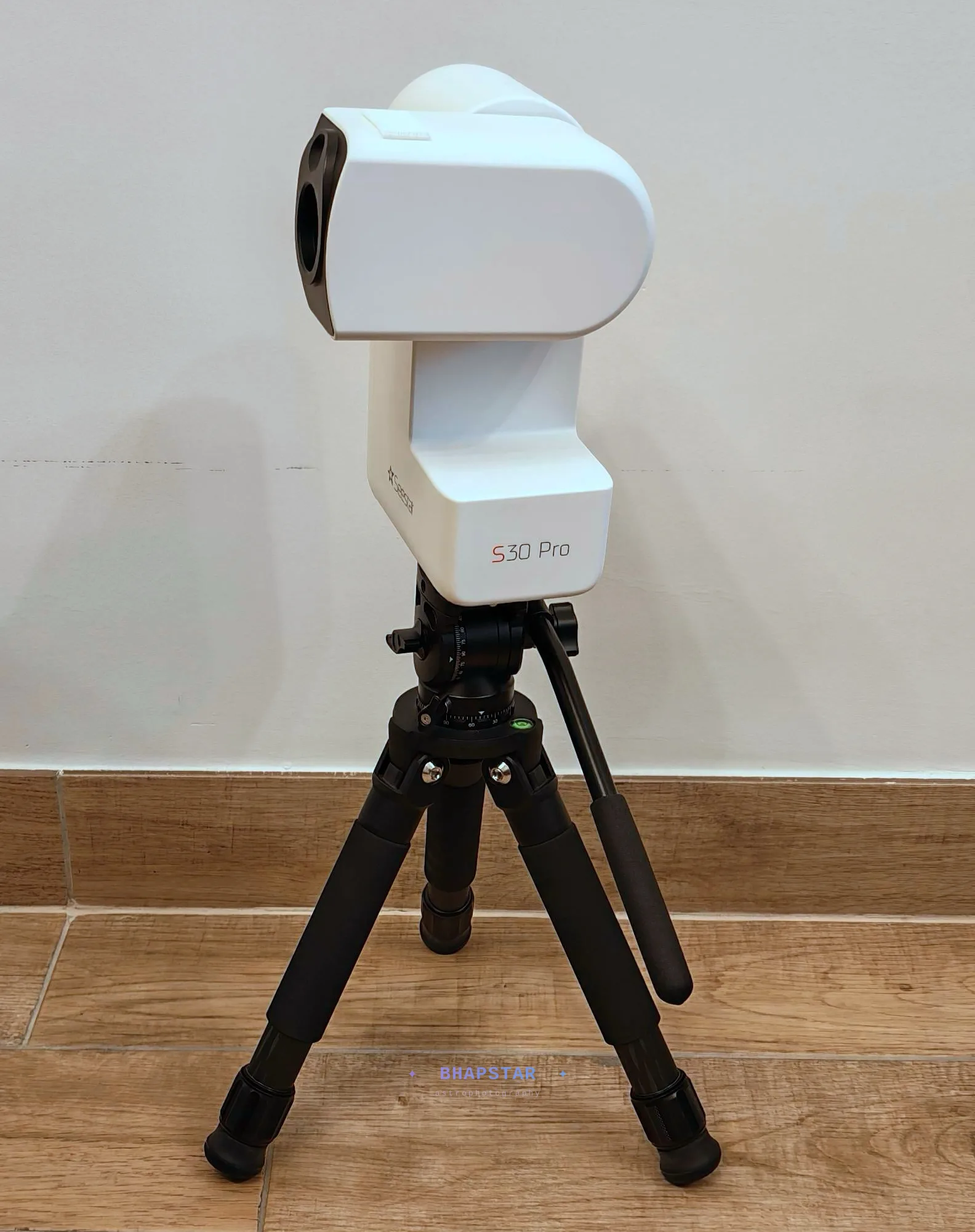
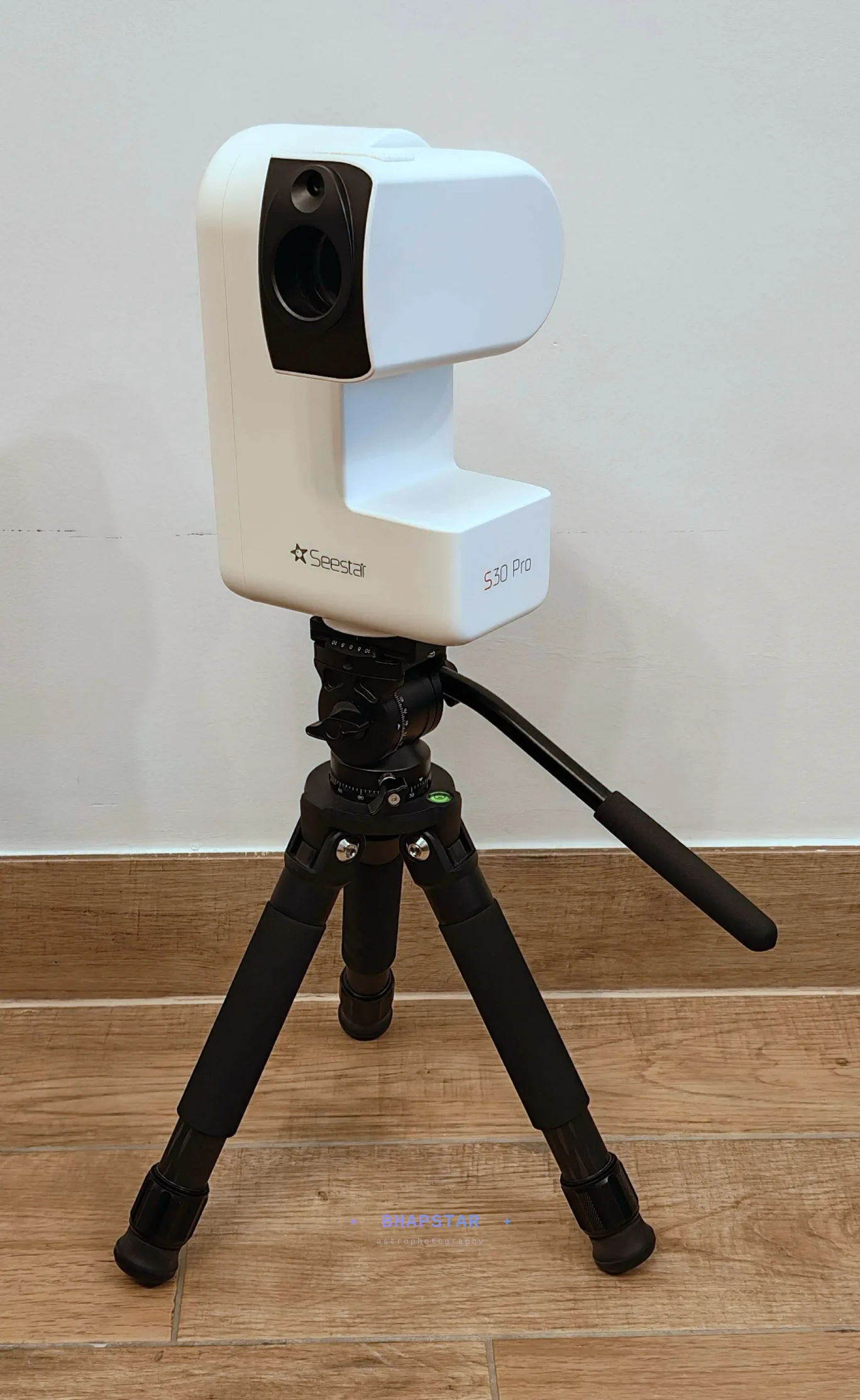
A tripod and fluid head pair that on a Seestar unlocks equatorial modeTilting an ordinary up-down, left-right telescope so one axis lines up with Earth's axis. The view then stops slowly rotating, which allows much longer exposures.: tilt the whole unit to the celestial poleThe point the whole sky appears to turn around. In the north it sits very close to Polaris, and in the south nothing bright marks it. and sub lengthOne single exposure out of the many that get stacked together. Sixty subs of one minute each make one hour of data. goes from a 10 to 30 second alt-azA mount that moves up and down and left and right, like a camera tripod. Simple to use, but the view slowly rotates during a long exposure. ceiling up to 60 seconds, with round stars into the corners. Off a Seestar, it works as a smooth, damped panning head for visual and casual imaging.
The part nobody thinks about
A tripod is the last thing people consider and often the first thing that limits them. One that flexes turns every gust into trailed stars, and no amount of guidingA second small camera watches one star and sends tiny corrections to the mount, keeping the target locked in place over long exposures. rescues a support that is moving. That alone would justify a page.
The TC20 and TH10 work as a pair. The tripod provides a stable base, the head provides smooth damped movement on top of it. But filing the TH10 under "accessory" undersells it badly, because on a Seestar it is the part that unlocks equatorial mode.
Equatorial mode is the reason to own the TH10
In alt-az mode the S30 and S30 Pro track perfectly well. The problem is not trackingThe mount turning slowly to cancel out Earth's rotation, so a star stays in the same spot on the sensor instead of drifting into a line., it is that the field slowly rotates during the exposure. That puts a ceiling on sub length: 10, 20 or 30 seconds depending on where the target sits and how much corner trailing you will accept. Push past it and the stars at the frame edges smear into arcs while the ones at the centre stay round, which is the signature of rotation rather than bad tracking.
Tilt the whole unit over so its azimuthThe compass direction of something, measured round the horizon from north. Due east is 90 degrees. axis points at the celestial pole, roughly 25 degrees above the horizon from Dubai, and the rotation stops. The Seestar is then turning on one axis at sidereal rateThe speed the sky appears to turn, one full circle in just under twenty four hours. A tracking mount turns at exactly this rate., the way an equatorial mountA mount with one axis tilted to line up with Earth's own axis. Once it is aligned, tracking the sky is one steady turn on that axis at a single constant rate. It still has a second motor for the other axis, but that one is for pointing and small guiding corrections rather than for keeping up with the stars, and the framing never rotates during an exposure. does. Sub length goes up to 60 seconds with round stars right into the corners.
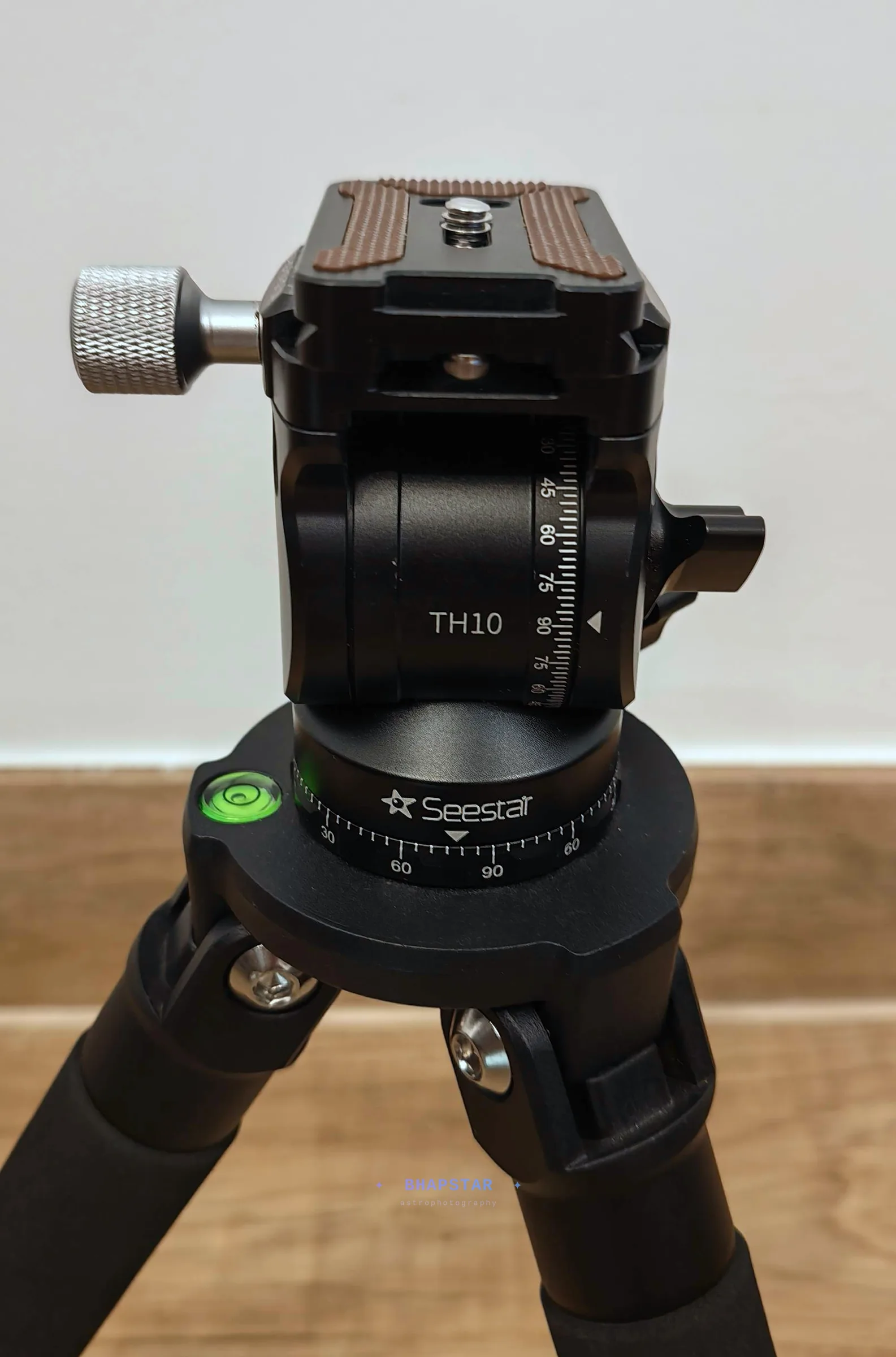
The TH10 is what makes that tilt practical rather than a fight. It has a graduated tilt scale, a bubble level, and fine geared adjustment that is damped rather than free, so a small correction holds where you put it instead of drifting back under the weight of the telescope. Any 3/8-16 head will bolt a Seestar on. Very few will let you dial in a latitude angle and trust it to stay there for three hours.
Sixty second subs are worth the setup. For the same total integrationThe total time of every frame added together. Three hours of integration might be one hundred and eighty frames of one minute. you stack fewer frames, so less read noiseA small amount of unavoidable grain added each time a frame is read off the sensor. Fewer, longer frames collect it fewer times. accumulates, less time is lost to readout between exposures, and faint signal in a nebula's outer structure has four to six times longer to build per frame than it does at 10 seconds. On a 30mm apertureThe size of the opening the light comes through, written as an f number such as f/2.8. Confusingly, a smaller f number means a bigger opening and more light. working from a bright city, that difference is the difference between a target being reachable and not.
Worth knowing before you buy: ZWO list EQ mode as a headline feature of the S30 Pro and then note in smaller print that additional accessories are required. This head is that accessory. There is more on how it works in practice in the S30 Pro walkthrough.
What else a fluid head is for
Smooth continuous motion. That suits visual sweeping, terrestrial and wildlife use, framing a landscape with a smart telescopeA sealed telescope with the mount, camera and processing built into one body, run from a phone. It finds the target, tracks it and stacks the frames on its own. on top, and any video work. In practice this also carries a camera for wide-field and star-trail work, and a small refractorA telescope that uses lenses to gather light, like a very good spotting scope. The other main type uses mirrors instead. for visual use.
None of that makes it an equatorial mount. The TH10 has no motors and does not track anything. It is a wedge with a damping mechanism: it sets the angle and holds it, and the Seestar does the tracking from there. Put a camera or the Askar V on top instead and the tracking has to come from somewhere else, which is what the harmonic mount is for.
Judging a tripod
Two things decide whether one is genuinely stable: how quickly vibration damps out after you touch it, and whether the leg locks hold under load without creeping. Both are easy to test at home with the payloadThe weight a mount is built to carry. Loading one near its limit works, but everything about it behaves worse than it does at half. mounted, and both tell you more than a load rating does.
The carbon legs matter for a duller reason than load capacity. A Seestar is light, and light instruments are the ones that move when a breeze comes through or when someone walks past on a balcony. Stiffness here is not about carrying weight, it is about not passing vibration into a lens that is midway through a 60 second sub.
Getting one
ZWO sell direct, and the parts have turned up on AliExpress. Both have delivered to Dubai without trouble for other items in this list. The head is the piece to prioritise if you are buying them separately, because a serviceable tripod you already own will get you most of the way, and nothing you already own replaces the tilt scale.
Where to buy
Some links above are affiliate links. If you buy through them I may earn a small commission, at no extra cost to you. It does not affect which gear I use or recommend. As an Amazon Associate I earn from qualifying purchases.