The short version
The rig that gets used beats the rig that stays in the boot.
A telescope, a camera, a focuserThe part that slides the camera in and out until the stars are sharp. An electronic one does it with a small motor, on command., a mount, a filter wheel and the computer that drives all of them, in a 1.65kg box the size of a lunchbox. Four minutes from bag to first frame, with nothing to assemble, nothing to balance, no polar alignmentLining a mount's main axis up with the point the sky turns around. Get it right and one slow, steady turn follows the stars all night. and one cable, which is the charger. It does not replace an 80mm refractorA telescope that uses lenses to gather light, like a very good spotting scope. The other main type uses mirrors instead. and nothing here pretends otherwise. What it removes is every reason not to go out.
The whole observatory is the size of a lunchbox
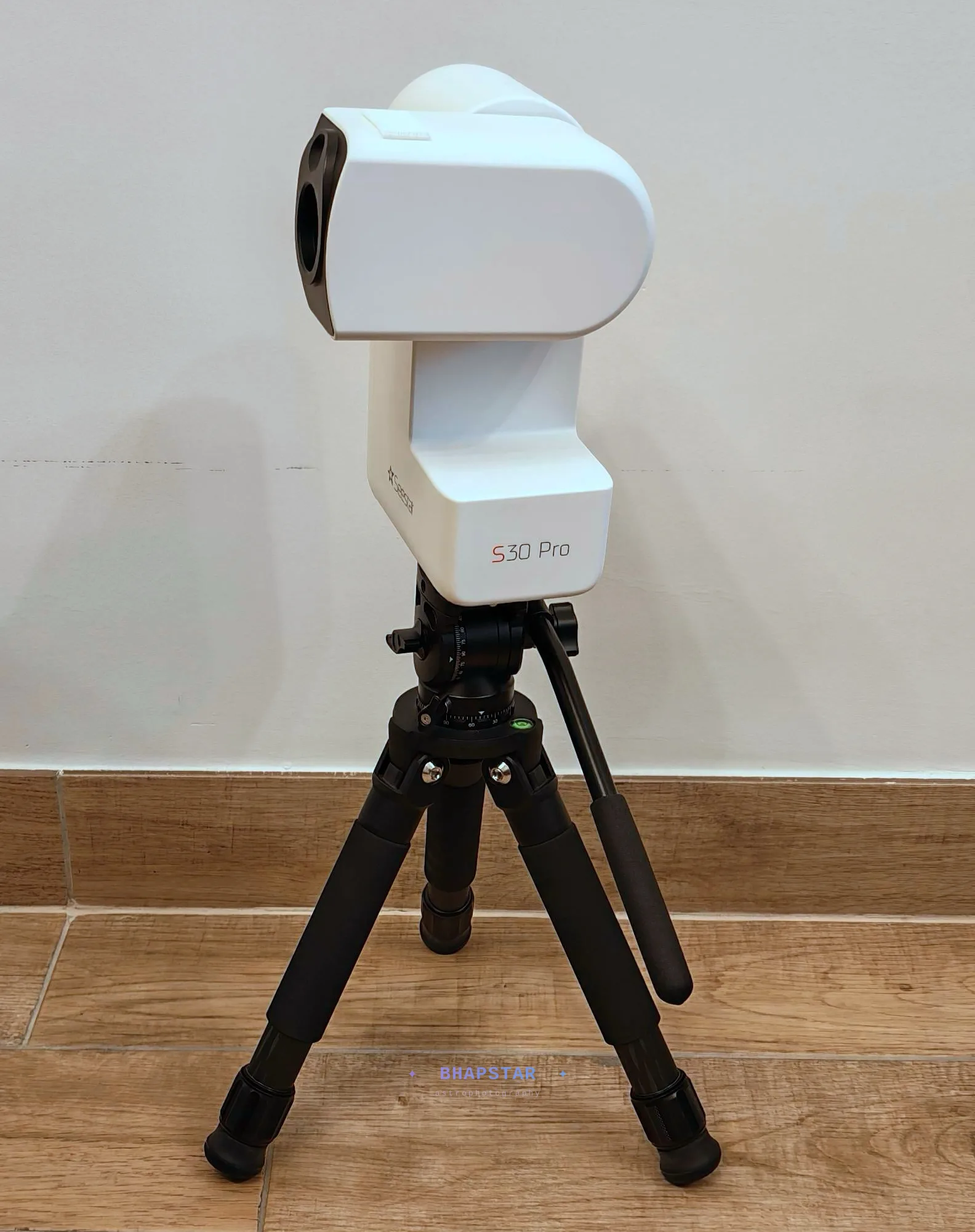
My main rig is a car rig. It lives in the boot, it needs a parking space near the setup spot, and getting it running takes the better part of half an hour. That is a fine trade when the forecast is good and I have the whole night. It is a terrible trade when there is one clear hour before the cloud comes back, or when the setup spot is a balcony.
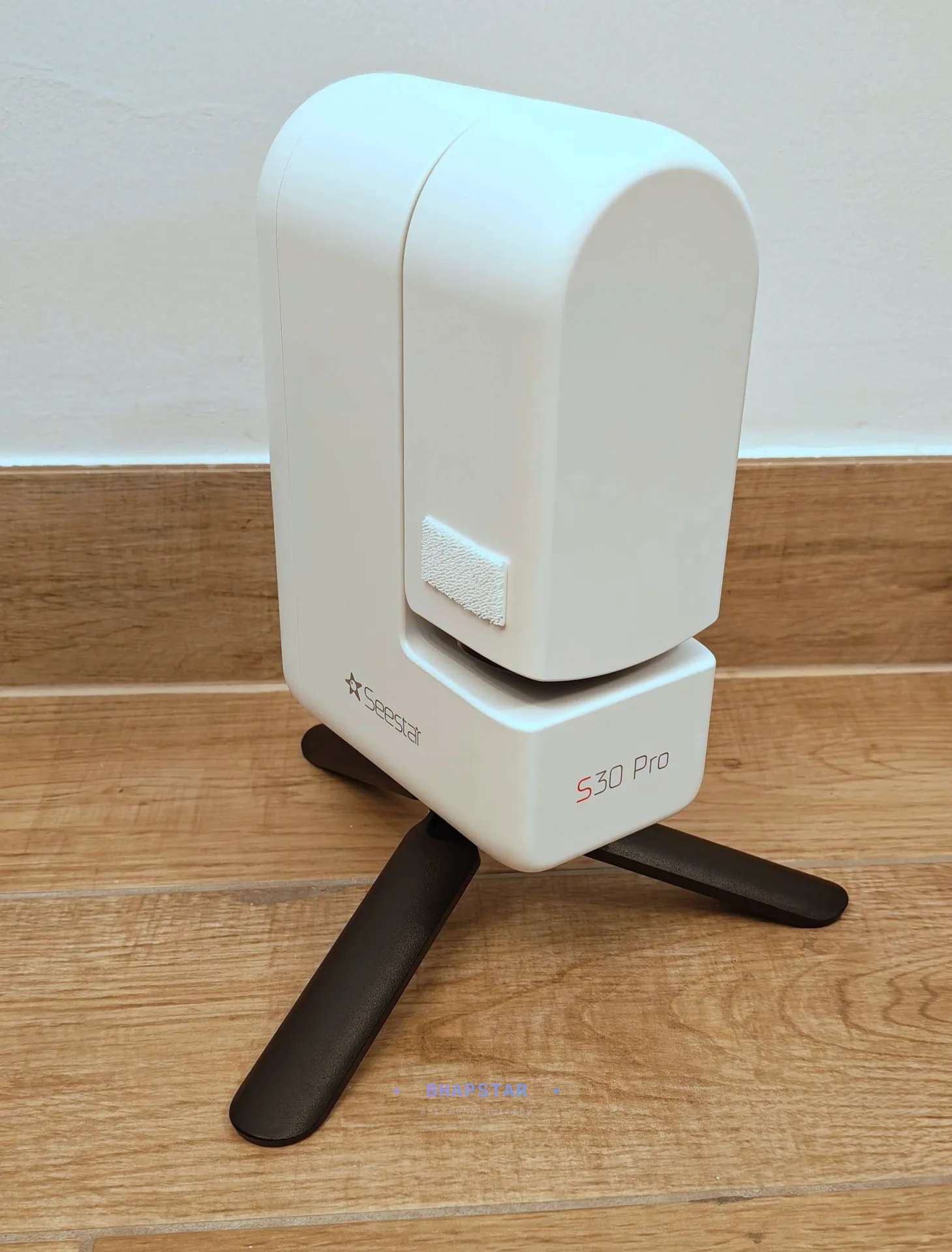
The Seestar S30 Pro is the answer to that. It weighs 1.65kg, it measures 210 x 140 x 80mm, and inside that box is a telescope, a camera, a focuser, an alt-azimuthA mount that moves up and down and left and right, like a camera tripod. Simple to use, but the view slowly rotates during a long exposure. mount, a filter wheel and the computer that drives all of it. There is nothing to assemble, nothing to balance, no polar alignment, and no cable except the one that charges it. It costs $699.
I want to be clear about what this is and is not. It does not replace the main rig, and anyone telling you a 30mm aperture competes with an 80mm refractor is selling something. What it does is remove every reason not to image. That turns out to matter more than aperture does, because the rig that gets used beats the rig that stays in the boot.
What is actually inside it
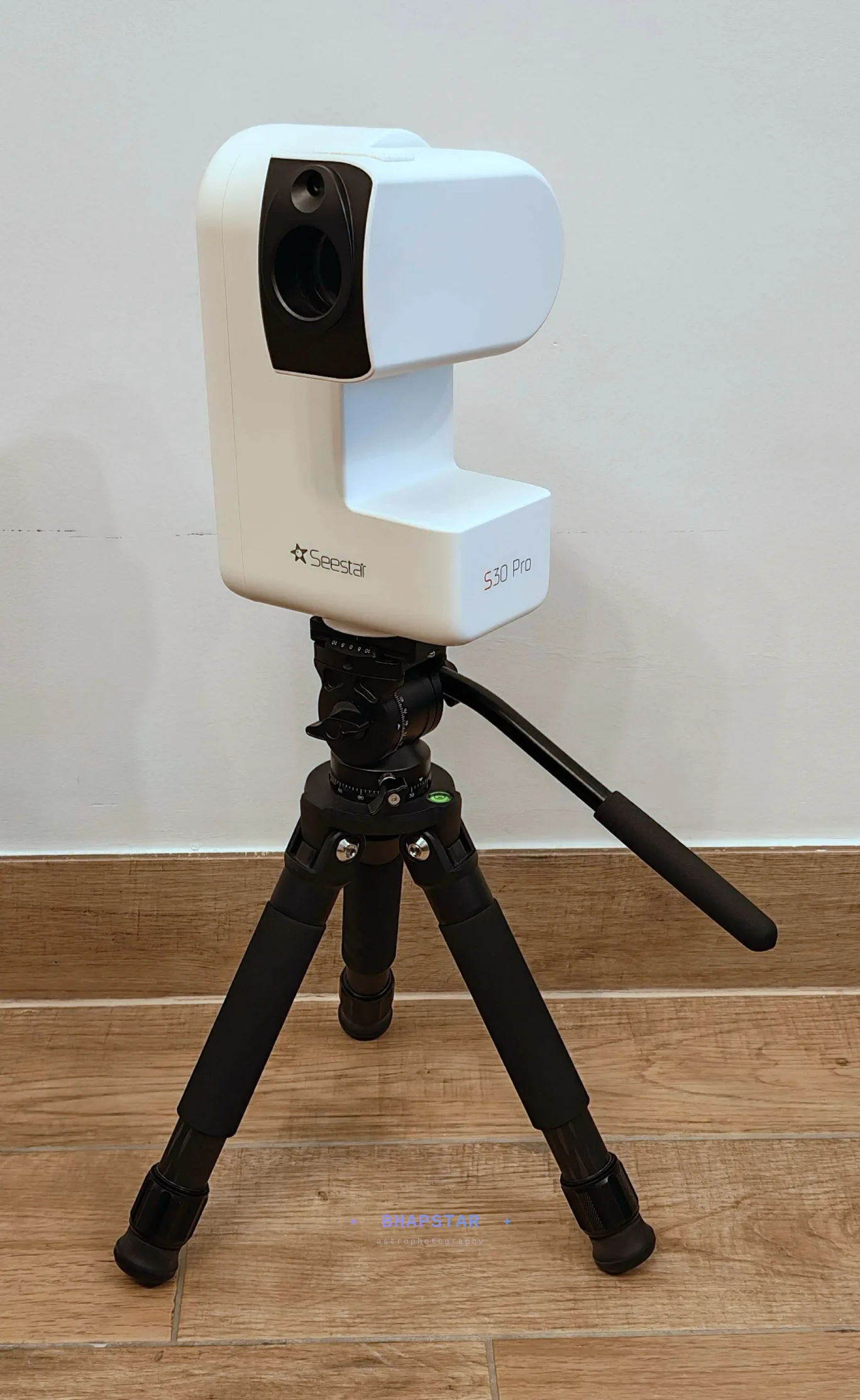
The telephoto side is a 30mm aperture, 160mm focal lengthHow much a lens or telescope magnifies, measured in millimetres. A small number gives a wide view of the sky, a large number a narrow, closer one., f/5.3 four-element apochromaticA lens design that brings the red, green and blue parts of light to the same point of focus. Without it, bright stars pick up a purple halo. lens with an EDExtra-low dispersion glass, a specific type of glass used in better lenses. It keeps the different colours of light travelling together, which is how a two-element lens gets close to the colour correction of a three-element one. element, feeding a Sony IMX585. That sensor is the detail worth pausing on, because it is the same one in the ASI585MC Air on my main rig. A 1/1.2 inch surface, roughly four times the area of the sensor in the original S30. Same silicon, very different glass in front of it.
The field of viewHow much sky fits inside one frame. A wide field shows a whole constellation, a narrow one a single small galaxy. is 4.6 degrees, which is wide. My Askar V at 495mm gives about 1.5 degrees. So the S30 Pro is not a detail instrument, it is a framing instrument. Andromeda fits. The Rosette fits with room around it. Small galaxies do not, and that is the honest limit.
The second lens is the new part. A 6mm f/1.75 wide angle on a Sony IMX586, covering 63 degrees. That is a Milky Way lens, and having it in the same body as the telephoto changes what a single night looks like.
Three filters are built in and switch automatically: a UV/IRUltraviolet and infrared, the light just outside what our eyes can see. Camera sensors pick it up, lenses cannot focus it properly, so a filter blocks it. cut, a dark field filter that handles long-exposure noise, and a light pollutionArtificial light from streets and buildings that scatters in the air and brightens the whole night sky, hiding everything faint. filter tuned for OIIIThe blue-green light given off by oxygen in a glowing gas cloud. It is one of the two colours most nebula filters are built around. at 30nm and HaThe deep red light given off by hydrogen, at a wavelength of 656 nanometres. It is the single most common thing being photographed in a glowing gas cloud. at 20nm. From a BortleA scale from 1 to 9 for how dark a sky is. Class 1 is a truly dark desert sky and class 9 is the middle of a bright city. 8 balcony in Dubai that third one is doing the heavy lifting, and it is doing it without me swapping anything in a drawer in the dark.
The rest of the spec sheet is unglamorous and matters more than it sounds. 128GB of onboard storage, so a session does not stop to make room. A 6000mAh battery good for about six hours, which covers a full night from a dark site and several nights from the balcony. Active anti-dew control that warms the lens, which in UAE humidity is not a luxury. Output is JPEG and FITSThe file format astronomy cameras and software use. As well as the picture it stores a record of how the frame was taken, such as the exposure and the temperature., so the stackedCombining many frames of the same patch of sky into one. The random grain is different in every frame so it averages away, while the real detail is in the same place every time and stays. result can go straight into Siril if I want to process it properly rather than accept the app's version.
Deep sky, in the time it takes to make a coffee
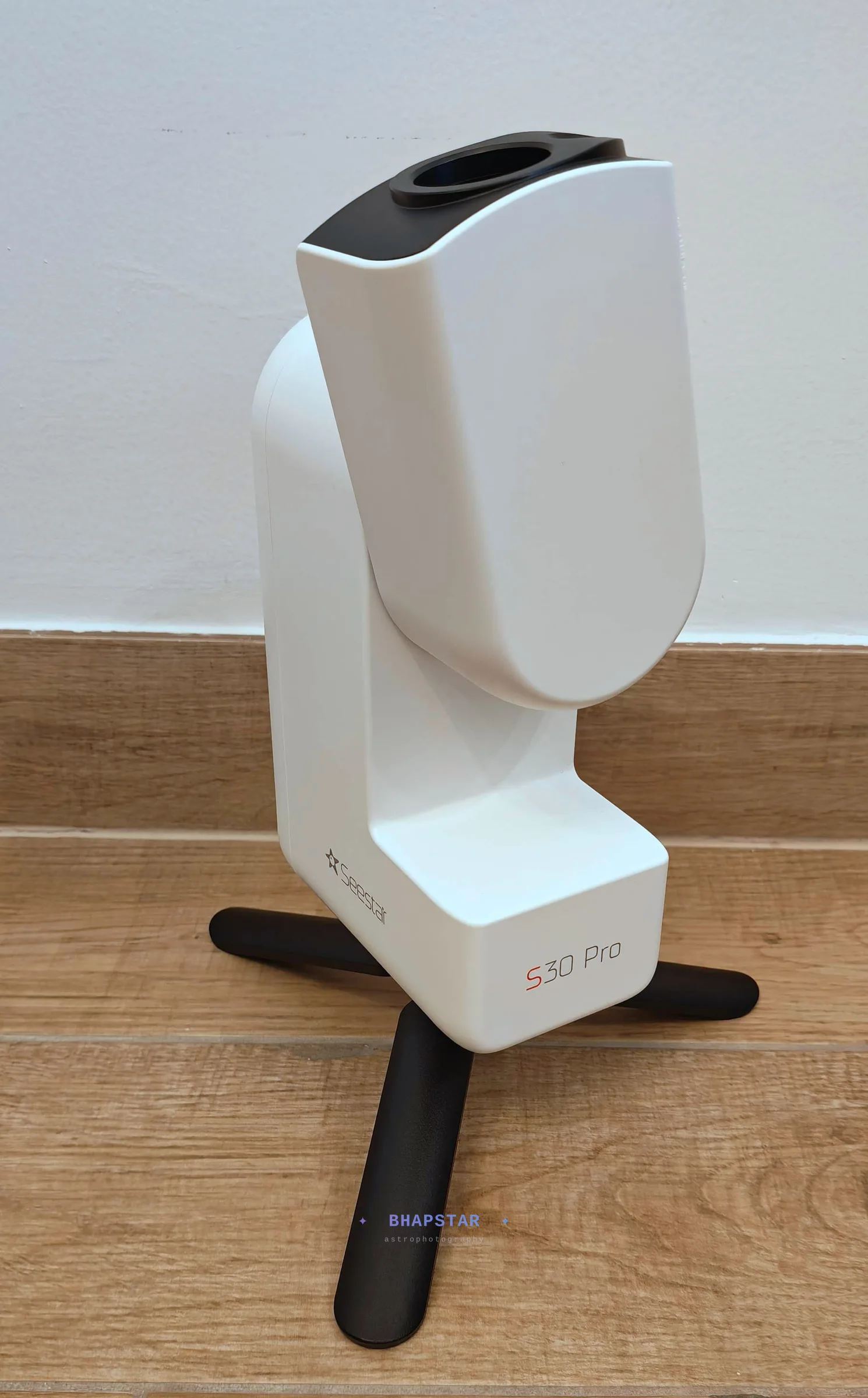
The workflow is genuinely three steps. Put it down roughly level, open the app, pick a target. It plate solvesThe software takes a quick test frame, matches the pattern of stars in it against a catalogue, and works out exactly where the telescope is really pointing. It then nudges the mount onto the target., slews, focuses, and starts stacking. The catalogue runs to more than 80,000 deep-sky objects and 600,000 stars, so the limit is what is above the horizon rather than what the app knows about.
Ten minutes of stacked exposure on a bright target gives you something worth keeping. Thirty gives you something good. An hour on Andromeda or the Leo Triplet is a real image, not a snapshot. The app also does a one-tap denoise and a dynamic background extractionThe processing step that measures that uneven glow across the frame and removes it, leaving an even sky behind the target., which is a reasonable approximation of what I would do manually in GraXpertA free tool that specialises in removing uneven background glow from an image, and in reducing grain. and SirilA free, open source program for turning a folder of raw frames into a finished astrophotograph. It does the stacking and most of the processing., and it is done before I have packed up.
Two features earn their place beyond the basics. MosaicSeveral overlapping frames joined together into one much wider picture, for targets too big to fit in a single view. mode shoots a planned grid and stitches it automatically, which pushes an 8K frame out of a 4.6 degree field and gets around the aperture limit by widening rather than deepening. And Plan mode lets you schedule a target and a duration in advance, so the thing runs on the balcony while I am asleep. That last one is the feature I use most and the one nobody mentions in reviews.
The wide lens, and why it changes the night
The original S30 was a deep-sky box. The Pro is a deep-sky box that also shoots the Milky Way, and that is the upgrade that justifies the name.
An f/1.75 lens over 63 degrees on a tracking mount is a proper wide-field setup. It will stitch a horizontal or vertical Milky Way mosaic in one tap, and it will run a star trailA picture where the stars are drawn as long arcs rather than points, made by leaving the shutter open, or by stacking a long run of frames end to end. or a timelapseHundreds of still frames played back one after another as a short video, so hours of sky movement pass in seconds. without me doing the arithmetic on interval and count. There is also a mode that separates the foreground from the sky, holding the landscape sharp while the stars are tracked out, which is the sort of thing that takes two exposures and a mask by hand.
What this means in practice is that one carry-out covers both jobs. Set the telephoto on a galaxy for an hour, and while that runs the wide lens is not sitting idle in a bag at home. Previously getting both meant bringing the main rig for the deep sky and a Sony body on a trackerA small motorised mount that turns a camera slowly to follow the stars. Much lighter than a full mount and enough for a camera lens. for the wide field. Now it is one box.
The 4.6 degree telephoto field also makes it a decent daytime instrument. 160mm on an 8.3MP sensor with autofocusA programmed routine through an Electronic Automatic Focuser that refocuses the telescope as the temperature drifts through the night, or at set timed intervals. and tracking is a long lens, and it is happy on birds and distant landscape. That is a side benefit rather than a reason to buy it, but it does mean the thing leaves the house more often than an astro-only device would.
The TC20 and TH10 are not optional
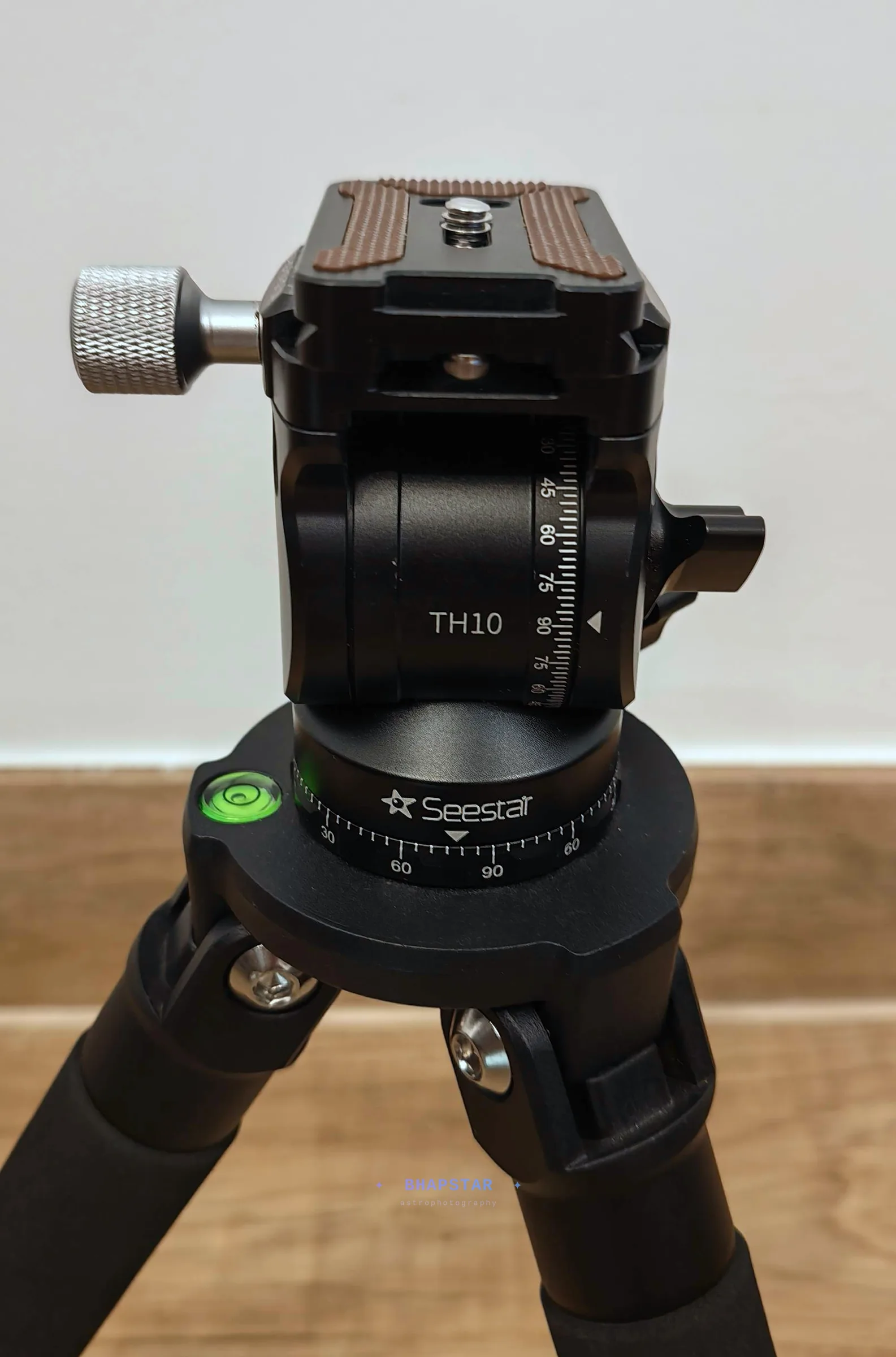
The little plastic tripod in the box is fine for a demonstration on a patio and not much else. The pairing that makes the S30 Pro into a real instrument is the TC20 carbon fibre tripod and TH10 fluid head.
The mounting thread is a standard 3/8-16, so in principle any decent tripod works. The reason to use ZWO's own is the TH10. It gives you fine, geared adjustment of the tilt, and that is what makes equatorial mode practical rather than a fight.
Here is what equatorial mode actually buys. In alt-az the S30 Pro tracks perfectly well, but the field slowly rotates during the exposure, and that puts a ceiling on sub lengthOne single exposure out of the many that get stacked together. Sixty subs of one minute each make one hour of data.: 10, 20 or 30 seconds depending on the target and how much corner trailing you will accept. Past that the stars at the frame edges smear into arcs while the middle stays sharp, which is rotation rather than bad tracking. Tilt the whole unit over so its azimuthThe compass direction of something, measured round the horizon from north. Due east is 90 degrees. axis points at the pole, about 25 degrees above the horizon from Dubai, and the rotation stops. Subs go up to 60 seconds with round stars into the corners.
That doubling matters more than it sounds. For the same total integrationThe total time of every frame added together. Three hours of integration might be one hundred and eighty frames of one minute. you stack fewer, longer frames, so less read noiseA small amount of unavoidable grain added each time a frame is read off the sensor. Fewer, longer frames collect it fewer times. piles up and less of the session is lost to readout between exposures. Faint outer structure in a nebula gets four to six times longer to build per frame than it does at 10 seconds. On a 30mm aperture under a Bortle 8 sky, that is often the difference between a target being reachable and not.
The TH10 is what makes the tilt hold. It has a graduated scale and a bubble level, and the movement is damped rather than free, so a latitude angle set at the start of the night is still there at the end of it instead of sagging back under the weight of the telescope. Any 3/8-16 head will bolt the Seestar on. Very few will let you dial in 25 degrees and trust it.
The carbon legs matter for a duller reason. This is a light instrument, and light instruments are the ones that move when a breeze comes through or when someone walks past on a balcony. A stiff tripod is not about carrying weight here, it is about not transmitting vibration into a 160mm lens taking ten second subs.
Packed, the S30 Pro and the TC20 go into one shoulder bag. That is the whole point. The main rig needs a car and a boot. This needs a shoulder.
Where it falls short
Aperture is 30mm. Faint, small targets are not going to happen, and no amount of stacking changes the physics. Anything under about half a degree across is going to be a smudge in the middle of a wide frame.
Wi-Fi range is quoted at 10m and Bluetooth at 5m, which in practice means you stay near it. It is not a device you drive home from and check on, unless you use the remote network feature, which needs a connection at the site.
The app is a closed system in the same way the ASIAir is. It supports ASCOMA shared language that lets astronomy software and hardware from different makers talk to each other, so a mount from one company works with software from another. Alpaca, so NINAA free Windows program that runs an imaging session from a laptop, controlling the mount, camera and focuser through the night. and similar can drive it, but the default experience is ZWO's way or nothing. If you like that, it is seamless. If you want to build your own sequence logic, expect friction.
And equatorial mode needs accessories that are not in the box. The marketing lists EQ mode as a headline feature and then adds a line saying additional accessories are required. That is the TH10, and it is a separate purchase. Given what EQ mode does to sub length, budget for it as part of the telescope rather than as an extra.
Why it always comes along
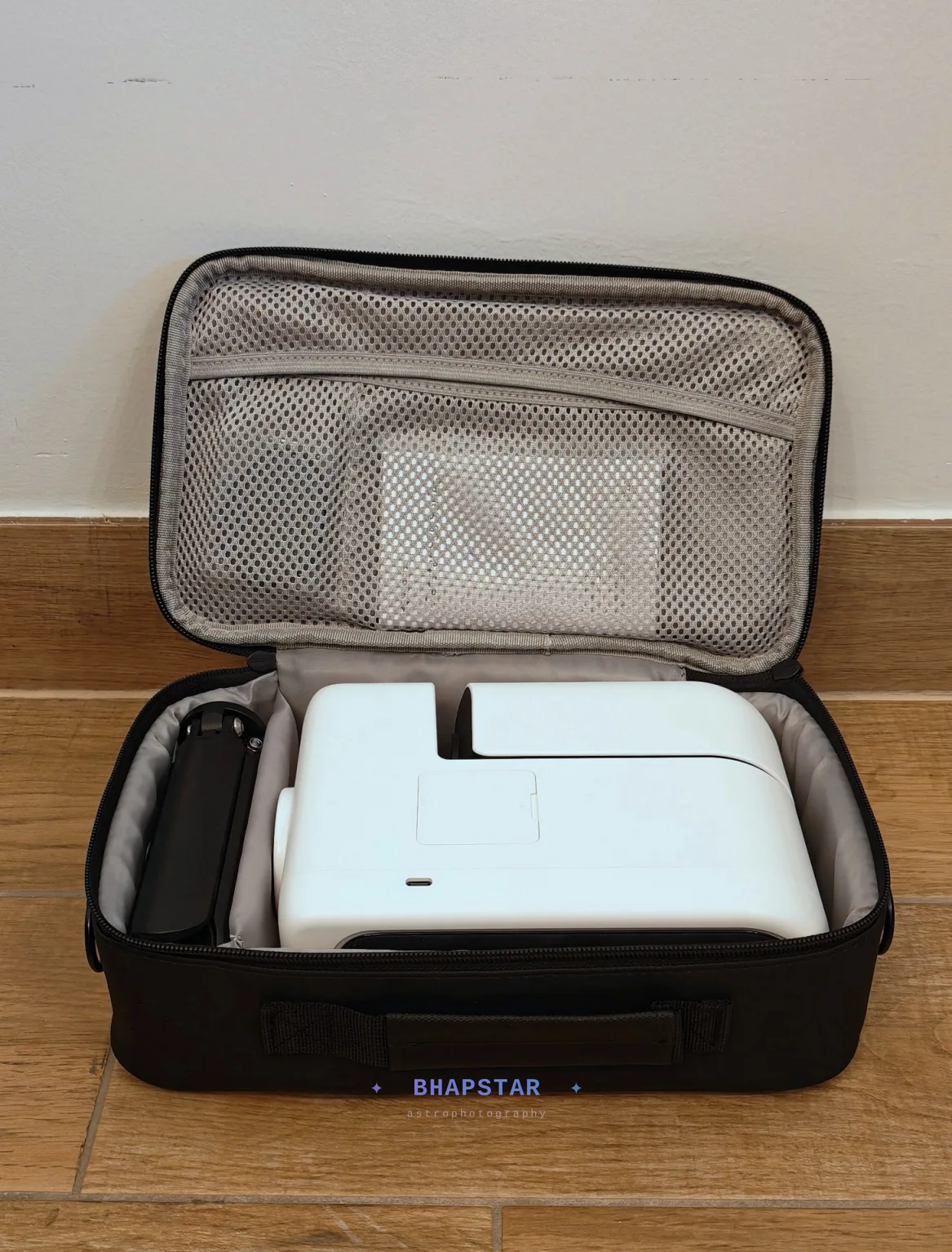
It does not live in the car. Dubai summers run past 45 degrees and a parked boot gets hotter still, which is no place to store sealed optics and a lithium battery. It lives indoors, and that turns out to be the more useful place for it. A gap in the cloud on a work night is a balcony session rather than a missed opportunity, because the decision is four minutes of setup instead of half an hour of packing.
When I do drive out with the main rig, it comes too, and that pairing is the point rather than a compromise. The Askar V works one deep-sky target for the night while the S30 Pro runs alongside it: the Milky Way through the season, deep sky for the other six months. Two instruments on one trip, and the small one costs almost nothing to bring.
The thing that surprised me is how much the wide lens changed the calculation. A deep-sky box that only does deep sky is a specialist tool, and specialist tools stay at home on the nights when you are not sure. A box that will shoot Andromeda, then the Milky Way, then a star trail over the same few hours is a box you bring. It has quietly become the instrument that takes the most frames, by a wide margin, purely on the strength of being the one I actually carry.