The short version
Four things that talk to each other, and nothing that does not need to be there.
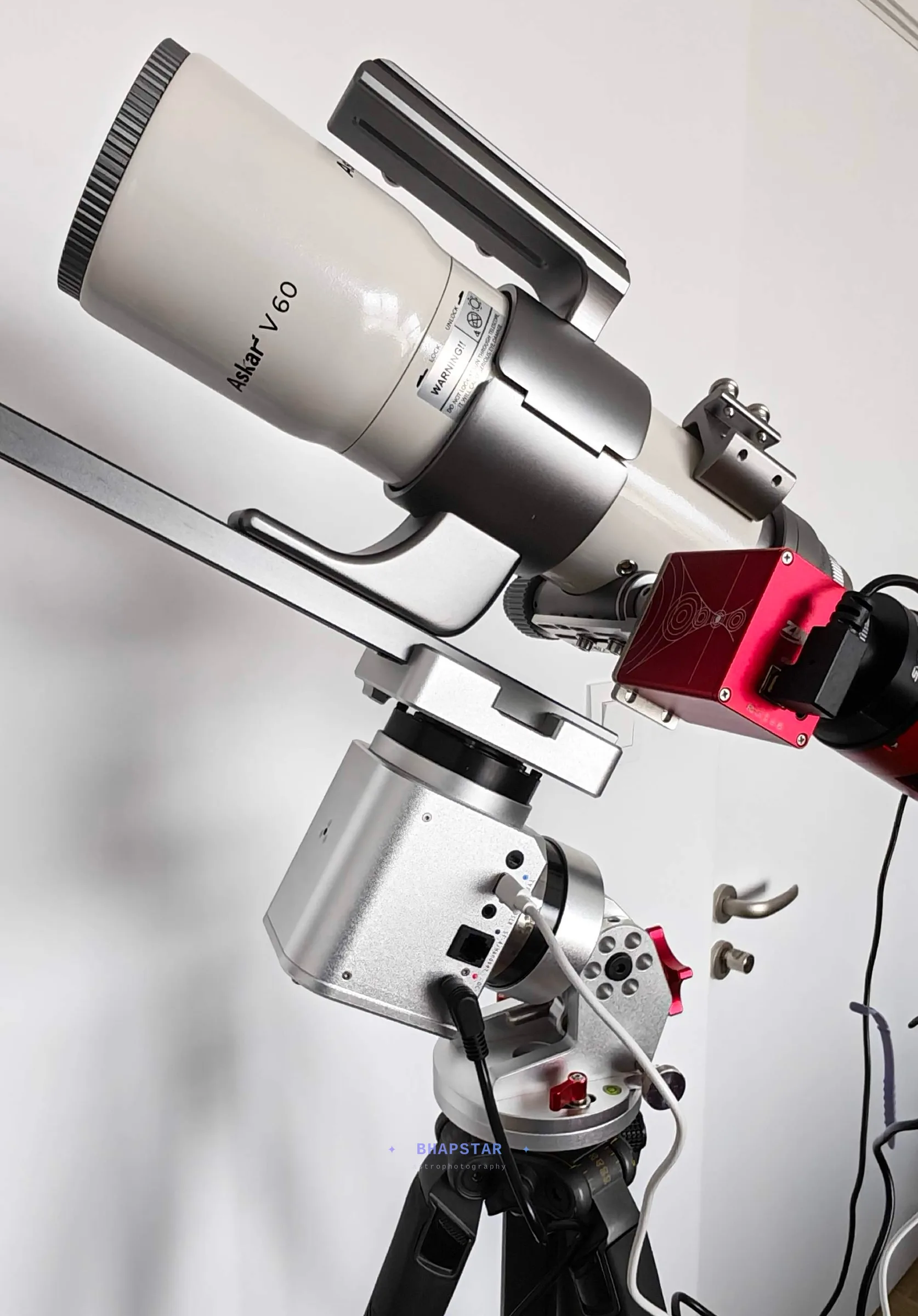
A harmonic mountA very compact gearbox that can hold a heavy telescope with no counterweight. It is the reason a mount this small can carry this much. that carries the scope with no counterweight, a modular refractorA telescope that uses lenses to gather light, like a very good spotting scope. The other main type uses mirrors instead. that changes focal lengthHow much a lens or telescope magnifies, measured in millimetres. A small number gives a wide view of the sky, a large number a narrow, closer one. without changing telescopes, a camera with the control computer built into it, and a filter drawer between the two. No laptop, no guide scopeThe small telescope the guide camera looks through, riding alongside the main one., no mains lead: the whole thing runs all night off a battery the size of a shoebox. The trade is that it is a car rig rather than a rucksack one.
One mount, one scope, one camera
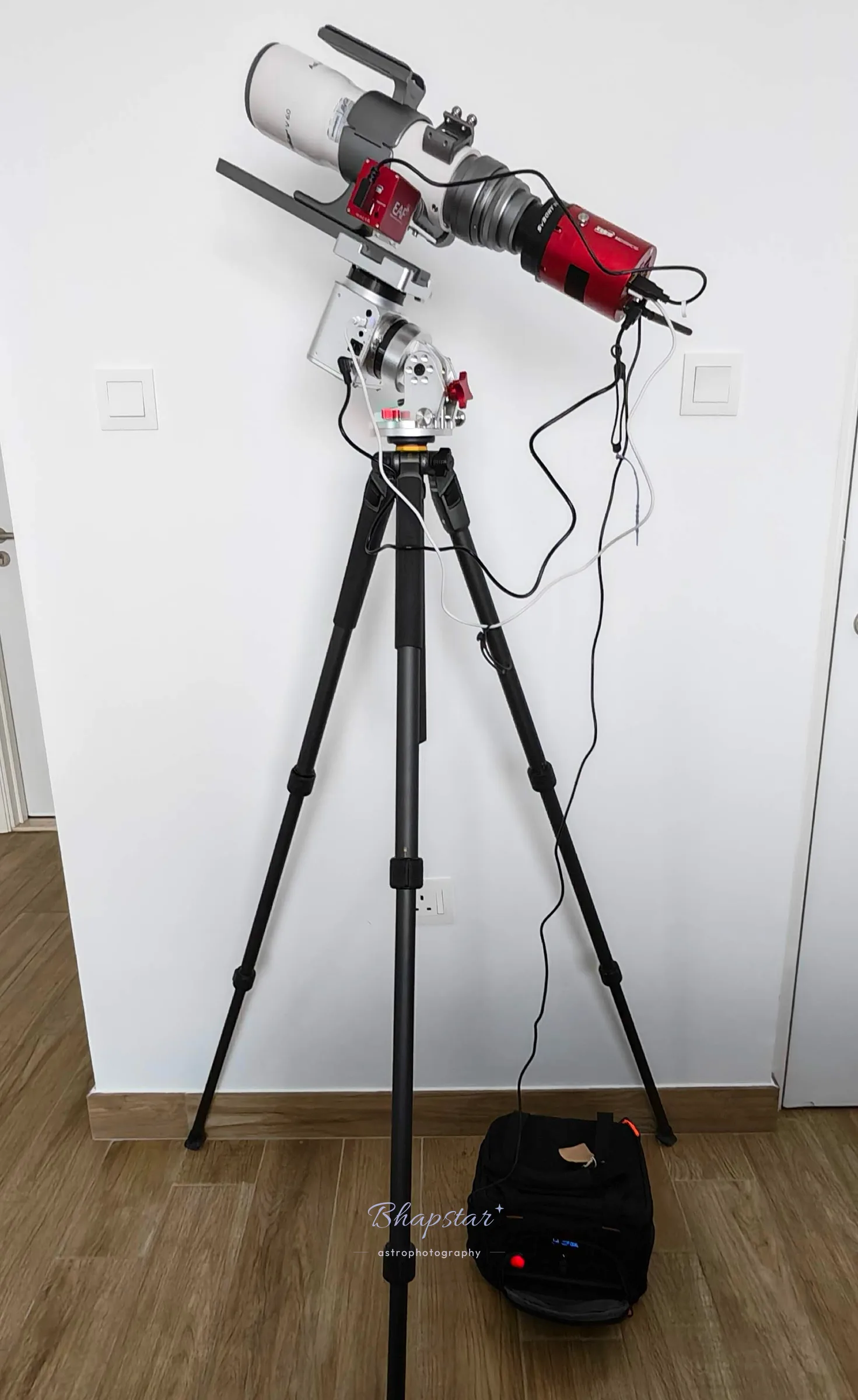
The rig has been through several shapes since I started. A Sony A7 III on a trackerA small motorised mount that turns a camera slowly to follow the stars. Much lighter than a full mount and enough for a camera lens., then an Evostar 72ED, then this. Each step has been bigger and heavier than the one before it, and that is the honest version. What has come down is the part count. There is no laptop, no guide scope, no separate controller, and far less cable than the last setup needed.
What is on the tripod now is four things that talk to each other and nothing that does not need to be there. A harmonic mount, a modular refractor, a camera with the control computer built into it, and a filter drawer sitting between the last two.
The thing worth saying before any of the parts is that this is a car rig, not a rucksack one. It travels in the boot, and a site gets chosen partly on whether I can park close enough to set up next to it. What it does do is run all night on a battery the size of a shoebox, with no mains lead and nothing to trip over. Ten years ago this capability came with a pier and an extension cable.
The mount: Juwei 14
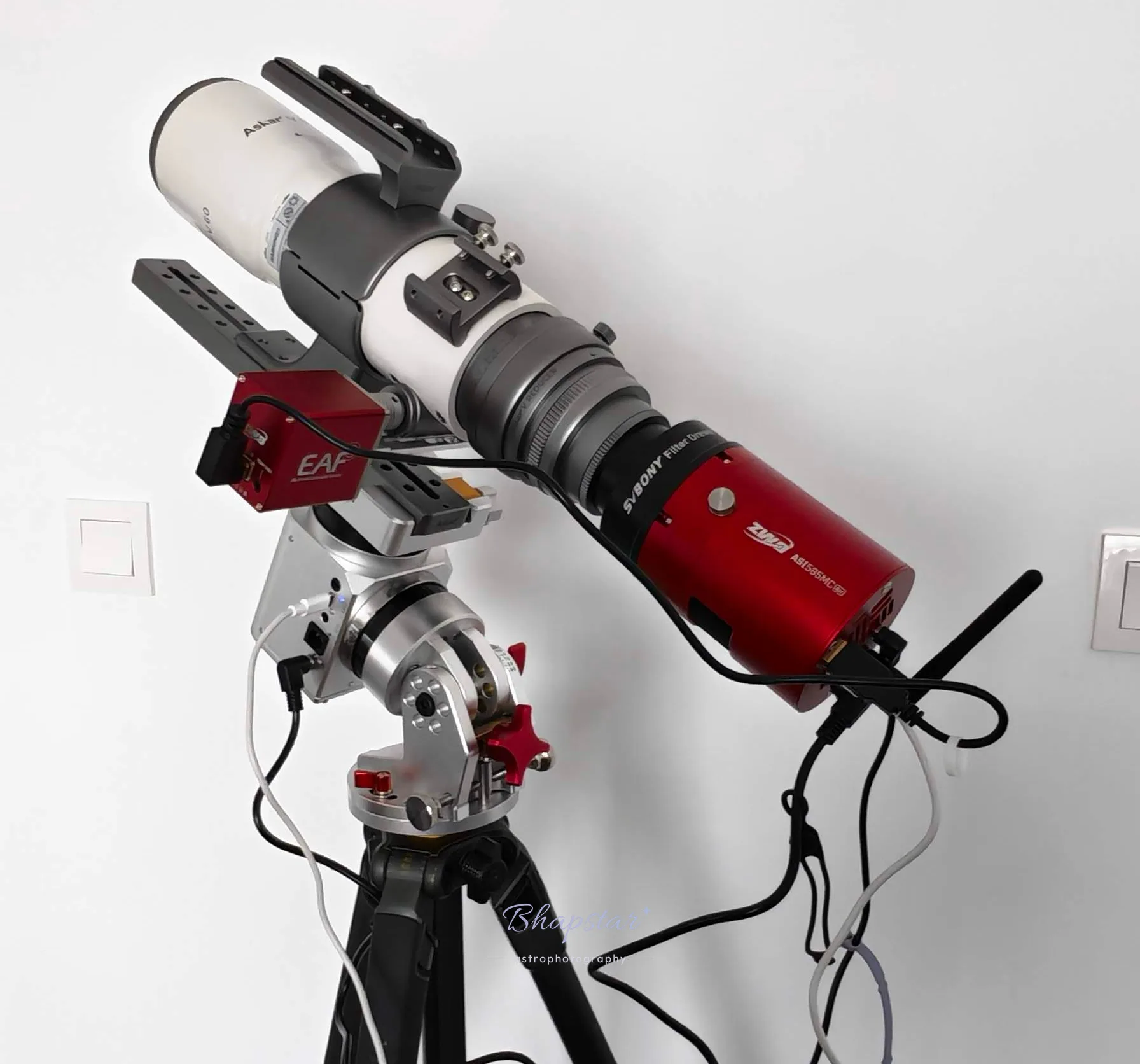
The mount is the part that decides whether a night produces data or a folder of streaks, and it is the part people underspend on. The Juwei 14 is a harmonic drive design, which means the strain waveThe gearing inside a harmonic drive. A flexible toothed cup is squeezed into an outer ring, which gives a huge reduction in a very small package. gearing holds its load without a counterweight for anything this rig will ever carry.
In practice that removes an entire ritual. No counterweight bar, no sliding weights along a shaft in the dark, and no rebalancing every time something is added to the back of the imaging trainThe chain of parts between the telescope and the sensor: flattener, spacers, filter drawer, camera. Every one of them takes up length, which is why the order and the spacing matter.. It goes on the tripod, the scope goes on it, and it is ready.
Everything the mount does is expressed in two numbers. Right ascensionThe sky's version of longitude. It is measured in hours rather than degrees, going all the way round from 0h to 24h. and declinationThe sky's version of latitude, measured in degrees north or south of the celestial equator. Straight above the North Pole is +90 degrees. are the sky's version of longitude and latitude: declination is how far north or south of the celestial equatorEarth's equator projected out onto the sky, exactly halfway between the two celestial poles. a target sits, measured in degrees, and right ascension is the east-west position, measured in hours because the sky turns. Every object has a fixed pair, so M42 is always at the same coordinates and the mount only has to be told where it is pointing now to work out how to get there.
Equatorial means one of the two axes is tilted to line up with the Earth's own axis of rotation. Once that is set, following a target for hours becomes a single slow turn of that one axis at the rate the Earth spins, rather than a constant correction in two directions at once. That is the whole reason equatorial mountsA mount with one axis tilted to line up with Earth's own axis. Once it is aligned, tracking the sky is one steady turn on that axis at a single constant rate. It still has a second motor for the other axis, but that one is for pointing and small guiding corrections rather than for keeping up with the stars, and the framing never rotates during an exposure. exist for astrophotography: it is what lets a five minute exposure record stars as points instead of arcs.
The optics: Askar V
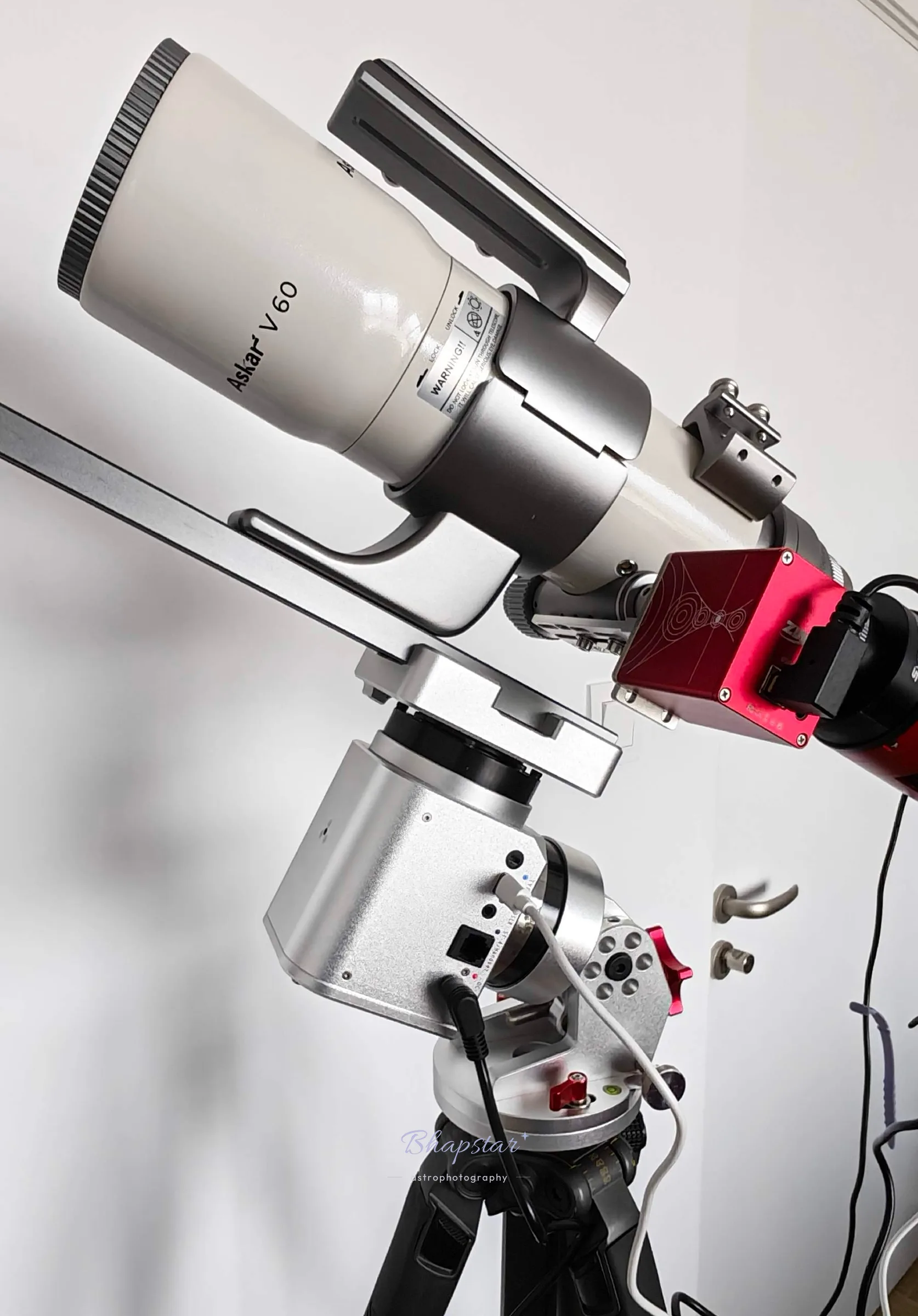
The Askar V is a modular apochromatA lens design that brings the red, green and blue parts of light to the same point of focus. Without it, bright stars pick up a purple halo., which is the reason it is here rather than a fixed refractor. The optical configuration changes with the module fitted, so one tube covers a range of focal lengths instead of committing to one framing forever.
That flexibility is what a single-scope setup needs. A wide nebula and a small galaxy want very different focal lengths, and owning both as separate telescopes means owning two of everything else as well.
The focuser: ZWO EAF
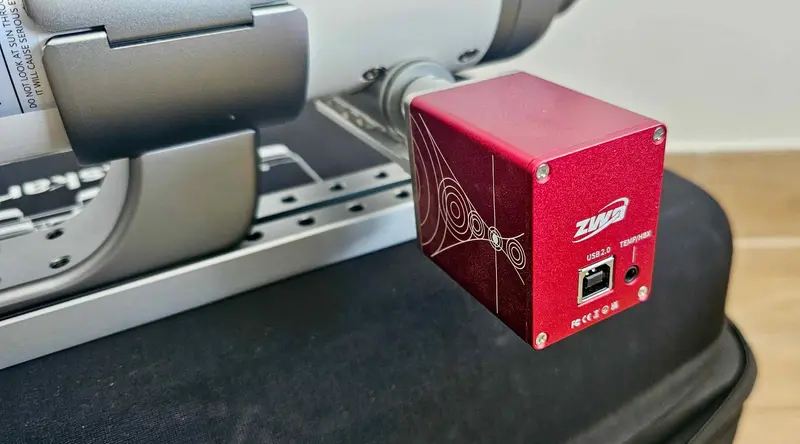
This is the part of the rig I would push hardest on anyone buying a telescope for astrophotography, and it is the one people leave until last. Buy the ZWO EAF at the same time as the scope, not two years later like I did.
The reason is that focus does not stay where you put it. A tube contracts as the temperature falls through the night, and the optical path changes with it. Something in focus at nine in the evening is not in focus at two in the morning, and nothing about the picture tells you at the time.
How much that costs you depends on the focal ratioThe focal length divided by the width of the lens, written like f/5.8 and often called the f-number. Smaller numbers gather light faster, so you need less time on the target, but focus becomes more critical., and it is worse than most people expect. The usable focus zone scales with the square of the f-number, so a fast instrument tolerates a small fraction of the error a slow one does. On something like this you are working inside a few tens of micronsA thousandth of a millimetre. Sensor pixels and focus tolerances are both measured in them, and both are small enough that a few tens of microns matter., which is comfortably less than a night's thermal drift moves the tube. The result is a folder where the first hour is sharp and the last two are quietly soft, and you find out in front of the stackingCombining many frames of the same patch of sky into one. The random grain is different in every frame so it averages away, while the real detail is in the same place every time and stays. software.
The EAFZWO's motorised focuser. A small motor takes the place of the focus knob, so focus can be set and corrected by software instead of by hand. replaces the focuserThe part that slides the camera in and out until the stars are sharp. An electronic one does it with a small motor, on command. knob with a stepper motor driven from the ASIAir. It runs an autofocusA programmed routine through an Electronic Automatic Focuser that refocuses the telescope as the temperature drifts through the night, or at set timed intervals. routine, stepping through positions and measuring star sizes to find the best one, and the part that actually changes results is that it repeats: on a timer, or whenever the temperature has moved by a set amount. The whole night stays usable instead of drifting away from you.
It also removes a source of vibration nobody counts. Focusing by hand means touching the telescope and waiting for it to settle, several times a night, on a mount that is trying to hold a target still to within an arcsecondA very small angle, one 3600th of a degree. The full Moon is about 1800 arcseconds across..
The camera: ASI585MC Air
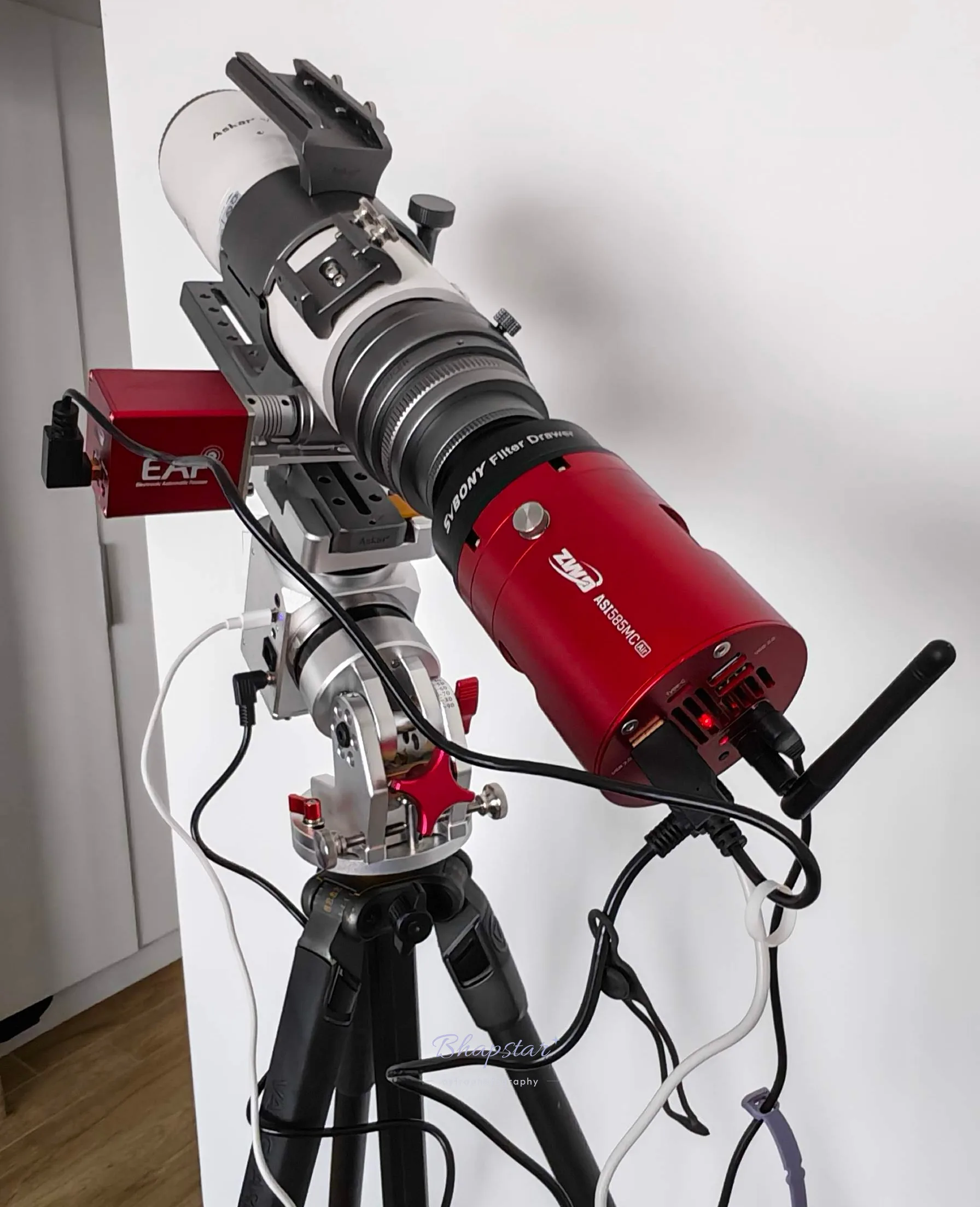
The ASI585MC Air is the piece that collapsed the rig down to its current size. It is a cooled colour camera, a guide sensorA small second camera that watches one star and reports any drift, so the mount can be corrected while the main camera keeps working. and a full ASIAIRA small controller from ZWO that runs the mount, camera and focuser from a phone or tablet. It replaces the laptop at the telescope. controller in one housing, which means the laptop, the guide scope and its camera, and most of the cabling all left at once.
What is left is one power lead into the camera and a phone in my pocket. Plate solvingThe software takes a quick test frame, matches the pattern of stars in it against a catalogue, and works out exactly where the telescope is really pointing. It then nudges the mount onto the target., focusing, guidingA second small camera watches one star and sends tiny corrections to the mount, keeping the target locked in place over long exposures. and the imaging plan all run from the handset, and the night can be left to itself once the first frame comes back clean.
The filter drawer
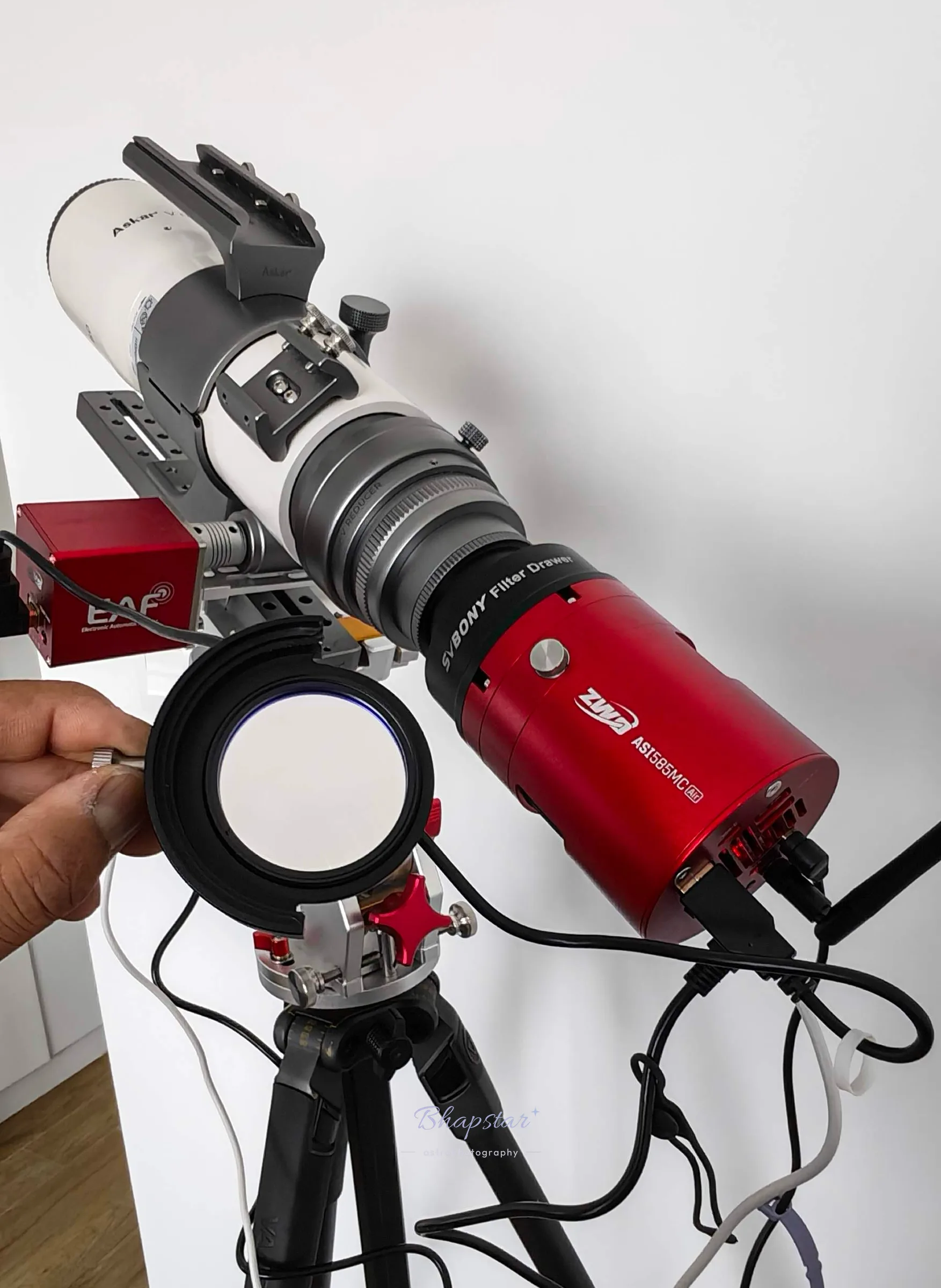
The SVBony filter drawer is the cheapest item on the rig and the one that saves the most time. It sits in the imaging train and lets a filter slide in or out without unthreading anything, which matters because breaking the train means refocusing and reframing.
On a night that starts under moonlight and ends without it, that is the difference between changing approach and giving up on the target.
The photo shows what that selectivity actually looks like. Light outside the passbandThe window of colours a filter lets through. A narrow passband blocks more streetlight, but leaves less margin if anything shifts. is reflected rather than absorbed, so under room lights the glass behaves like a mirror and the mount one foot behind it does not show through. The same rejection is what keeps streetlights out of a BortleA scale from 1 to 9 for how dark a sky is. Class 1 is a truly dark desert sky and class 9 is the middle of a bright city. 8 frame.
Read the articles here and see the gear reviews on what makes these filters so special
The Bortle Scale of Night-Sky Brightness and Light Pollution
The Svbony SV220 3nm Filter
The Optolong L-eXtreme Filter
The Optolong L-Quad Enhance Filter
Power
All of it runs from an EcoFlow River 2, taken from the 12V car socket on the front of the unit rather than the USB-C port. A 12V DC lead is what the mount and the camera actually want, and running it that way avoids the step-up and step-down losses of going out through USB and back down again. Measured with everything live, mount tracking and camera cooling, the rig draws around eleven watts. Against 256Wh that is the whole night with room spare, which is the point at which power stops being something you think about.
Why this is the rig I keep
The thing I like most about this setup is how everthing works in harmony. The mount holds the scope without a counterweight, the scope changes focal length without changing telescopes, the focuser holds focus without being touched, the camera runs the session without a laptop, and the drawer changes a filter without breaking the train. Every part removes a job that used to be mine.
That adds up to the only measure I care about, which is how much of the night is spent imaging rather than setting up. Twenty minutes from opening the boot to the first frame, and after that the phone tells me what is happening while I sit and look up. Most of my early sessions were the other way round, mostly fiddling with a bit of imaging at the end.
It is heavier than what I started with and it needs a car, and I would still choose it every time. A rig that quietly does its job all night is worth more than a light one that needs watching.