The short version
A balcony does not stop you imaging. It just decides what you image.
Three things change on a balcony. You usually cannot see Polaris, so the mount has to be aligned another way. You can only see a slice of sky, so the target picks itself. And the sky is bright, so a filter does the heavy lifting. None of these are dead ends. They are just a different set of rules, and once you know them a balcony becomes a place you can image from most clear nights of the year.
The problem nobody warns you about
Most advice about imaging under city light concentrates on light pollutionArtificial light from streets and buildings that scatters in the air and brightens the whole night sky, hiding everything faint. itself. Use a filter, pick bright targets, take more frames. All true, and I will come to it.
But that advice quietly assumes you are standing in a garden with the whole sky above you. On a balcony you are not. You are standing in a concrete box with one side missing, and that changes the practical side of a session far more than the sky glowThe glow of that scattered artificial light coming back down at you. It is what makes a city sky look washed out rather than black. does.
Here is what my balcony actually gives me. It faces south. A tower block stands to one side and another to the other, so anything east of south-east or west of south-west is behind concrete. The ceiling overhead cuts everything off above roughly thirty-five degrees. What is left is a letterbox of sky, and every single frame I have taken from home came through it.
Polar alignment when you cannot see Polaris
If your mount is going to follow the sky for hours, its axis has to be lined up with the axis the Earth turns on. The usual way to do that is to point it at Polaris, because Polaris happens to sit almost exactly on that line.
From a balcony, Polaris is very often behind a wall. Mine faces the wrong way for it. For a long time I assumed that was simply the end of the conversation, and if you search the forums you will find a steady stream of people arriving at the same conclusion and asking whether their balcony is useless. It is not.
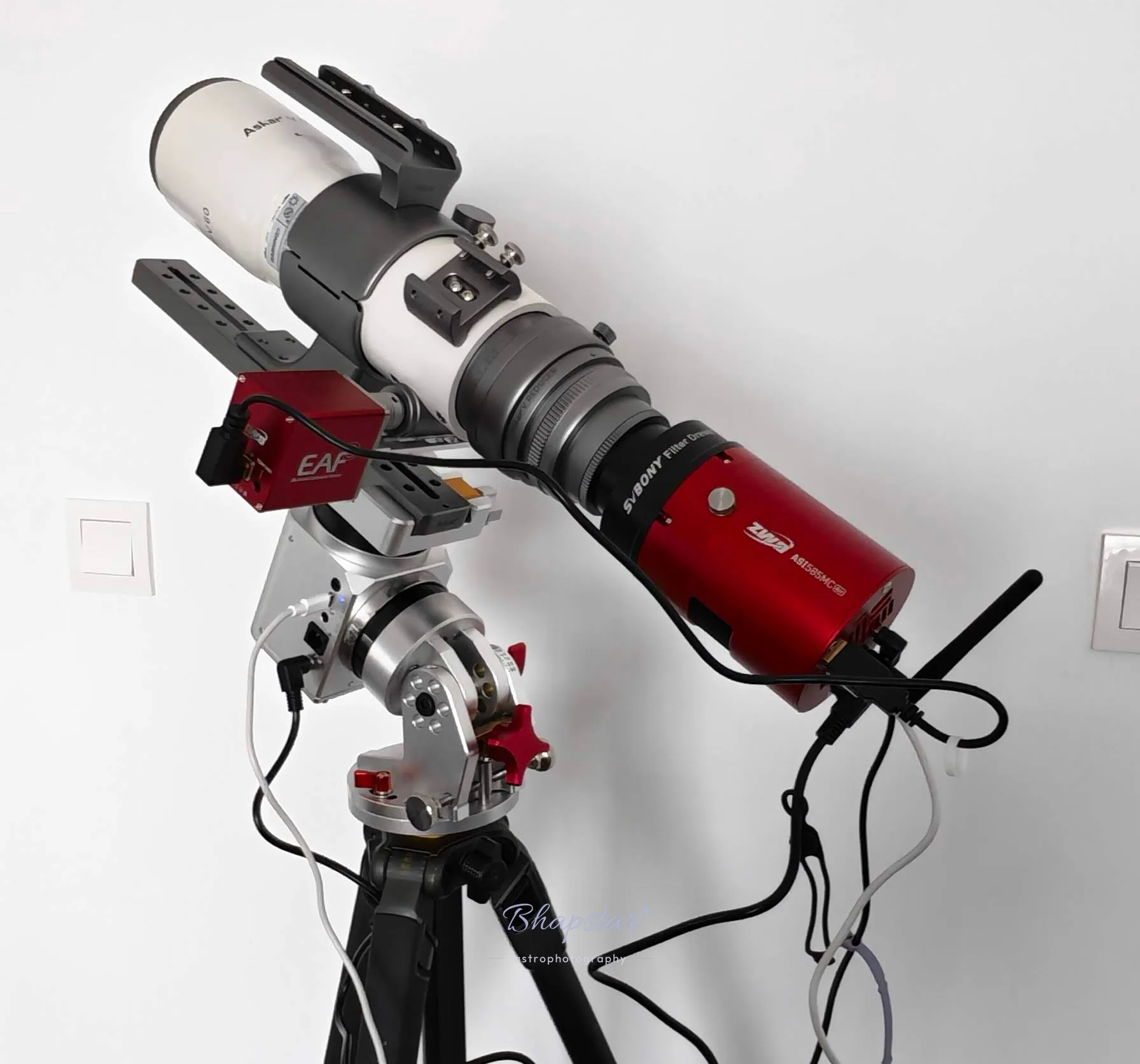
The way around it is a feature called all-sky polar alignmentLining a mount's main axis up with the point the sky turns around. Get it right and one slow, steady turn follows the stars all night.. On my setup that lives in the ASIAirA small controller from ZWO that runs the mount, camera and focuser from a phone or tablet. It replaces the laptop at the telescope., and the idea behind it is worth understanding even if you use something else, because it explains why the wall stops mattering.
In practice it takes a couple of minutes. Point the telescope at whatever clear sky you have, start the routine, and the mount swings itself between two positions while the software reads the star fields. Then it tells you how far out you are and in which direction, and you nudge the two adjustment bolts until the number comes down.
A word of honesty about it. This works because the software can recognise the stars it photographs, so it needs enough of them to get a match. Through a gap in tall buildings, or with a tree branch across half the frame, it can fail and want another try. Giving it the most open piece of sky you have, rather than the piece nearest your target, makes it far more reliable.
The sky window picks your target
In a garden you choose a target and then wait for it. On a balcony it works the other way round. You look at what is going to cross your opening of sky tonight, and you choose from that list.
This sounds like a restriction, and it is, but it turns planning into a much simpler job. Instead of the whole sky you are looking at a narrow strip, and the question becomes what is passing through it and for how long. Planning software makes short work of this, and I have written separately about how I work that out before a session.
The second half of it is time. A target crosses the gap, and when it reaches the wall the night is over for that object whether or not you have enough frames. From a dark site you might collect everything you need in one go. From a balcony you collect an hour or two, then come back the next clear night and add to it, and again after that. The total is what matters, not how it was gathered, and stackingCombining many frames of the same patch of sky into one. The random grain is different in every frame so it averages away, while the real detail is in the same place every time and stays. software does not care that the frames came from six different evenings.
This turns out to suit a balcony very well. The gear lives a few steps from where you sleep. There is no drive, no packing, and no decision about whether tonight is worth the trip. Twenty minutes of setup on a weeknight is a perfectly reasonable thing to do when the telescope is already on the other side of the door.
Now the light pollution
With the practical problems out of the way, the bright sky is the part left, and it is the part with the cleanest answer.
A nebula that glows sends down exactly as much light over a city as it does over a desert. Nothing dims it. What changes is the amount of other light arriving alongside it, and city light arrives in enormous quantities. The nebula is still there in your frames, sitting underneath a thick layer of orange glow.
Many glowing nebulae emit most of their light at just two specific colours. A narrowbandA filter that only lets through the few exact colours that glowing gas clouds give off, and blocks nearly everything else. Streetlight is mostly blocked, the nebula is not. filter opens a very narrow window at each of those two colours and blocks nearly everything else, which throws away most of the city glow while keeping most of what you came for. I use a 7nm dual-band filter for this and it is the single piece of kit that makes my balcony worth using.
The important honesty here is what it does not do. Galaxies and star clusters shine across all colours rather than at two, so a narrowband filter blocks their light along with everything else. From a bright balcony, glowing gas is your friend and faint galaxies are a fight you will probably lose. That is not a failure of technique. It is just where the line sits, and knowing where it sits saves a lot of wasted nights.
Two of the images on this site came off that balcony. The Cat's Paw Nebula is six hours of data collected across two separate nights, and the Lobster Nebula immediately next door to it is four. Both are clouds of glowing hydrogen, which is precisely what a dual-band filter is built for, and both came from a sky where I can count the visible stars on my fingers.
They also make the point about the sky window better than my diagram does. Both of them sit around thirty-five degrees south of the celestial equator, which from this latitude means they never climb high. They cross low, they cross briefly, and the whole time you are looking through far more atmosphere than you would choose to. That is the balcony question in miniature. Not whether the target is bright enough, but whether it passes through your gap for long enough to be worth setting up for.
Six hours over two nights is also the pattern rather than the exception. No single evening from that balcony was ever going to be enough. The frames simply went into the same pile until there were enough of them.
What I would tell someone starting on a balcony
Go outside tonight and look at what you can actually see. Which direction is open, how high the ceiling cuts you off, and whether the pole is visible. Ten minutes of this tells you more about what your setup should be than any amount of reading.
Then take the constraints seriously rather than fighting them. A balcony is not a compromised dark site. It is its own kind of place, with its own list of things that work, and the list is longer than most people expect.
I have imaged from proper dark desert skies, and there is no argument about which produces better data. But the desert is a planned trip a couple of times a month, and the balcony is available on a Tuesday. Over a year, the place you can reach in thirty seconds collects a surprising amount.