The short version
Ten minutes of planning is what makes a clear night count.
Stellarium shows you the sky from your own balcony, on any date, at any time, running as fast or as slow as you like. Ten minutes with it tells you what is up tonight, how high it gets, when it is highest, where the Moon will be, and whether the thing you want will fit inside your camera frame. All of that happens indoors, in the warm, before anything comes out of the bag.
The best nights are decided indoors
There are a handful of things worth knowing before the gear comes out. How high your target will climb. How much of the frame it will fill. When the sky goes properly dark, and where the Moon will be while you are working.
Every one of those is knowable in advance, and checking them takes minutes. That is the whole trick. It is not a skill you build at the telescope, it is a habit you build at a desk, and it pays back on the first clear night you use it.
I open Stellarium before every session. Not sometimes. Before every one, whether I am shooting from the balcony in Dubai or driving out to Al Quaa. It is the first thing I open and it is the reason I know what the night is going to look like before I have set anything up.
Seeing exactly what will fit
The software can draw your actual camera and telescope onto the sky as a rectangle. Give it your focal lengthHow much a lens or telescope magnifies, measured in millimetres. A small number gives a wide view of the sky, a large number a narrow, closer one. and your sensor size and it works out the field of viewHow much sky fits inside one frame. A wide field shows a whole constellation, a narrow one a single small galaxy. for that pairing, then shows you, to scale, precisely what will land on the chip. No arithmetic, no comparing angular sizes on a web page and hoping.
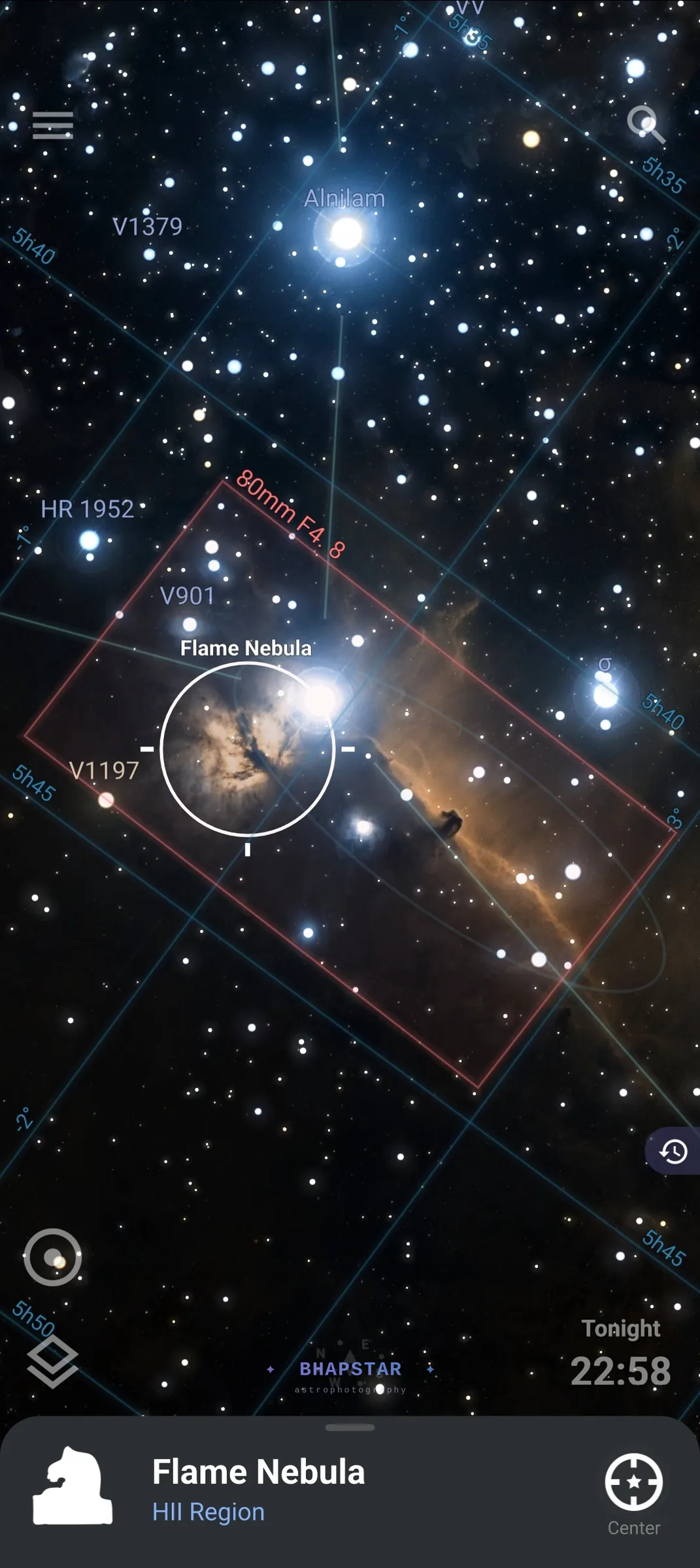
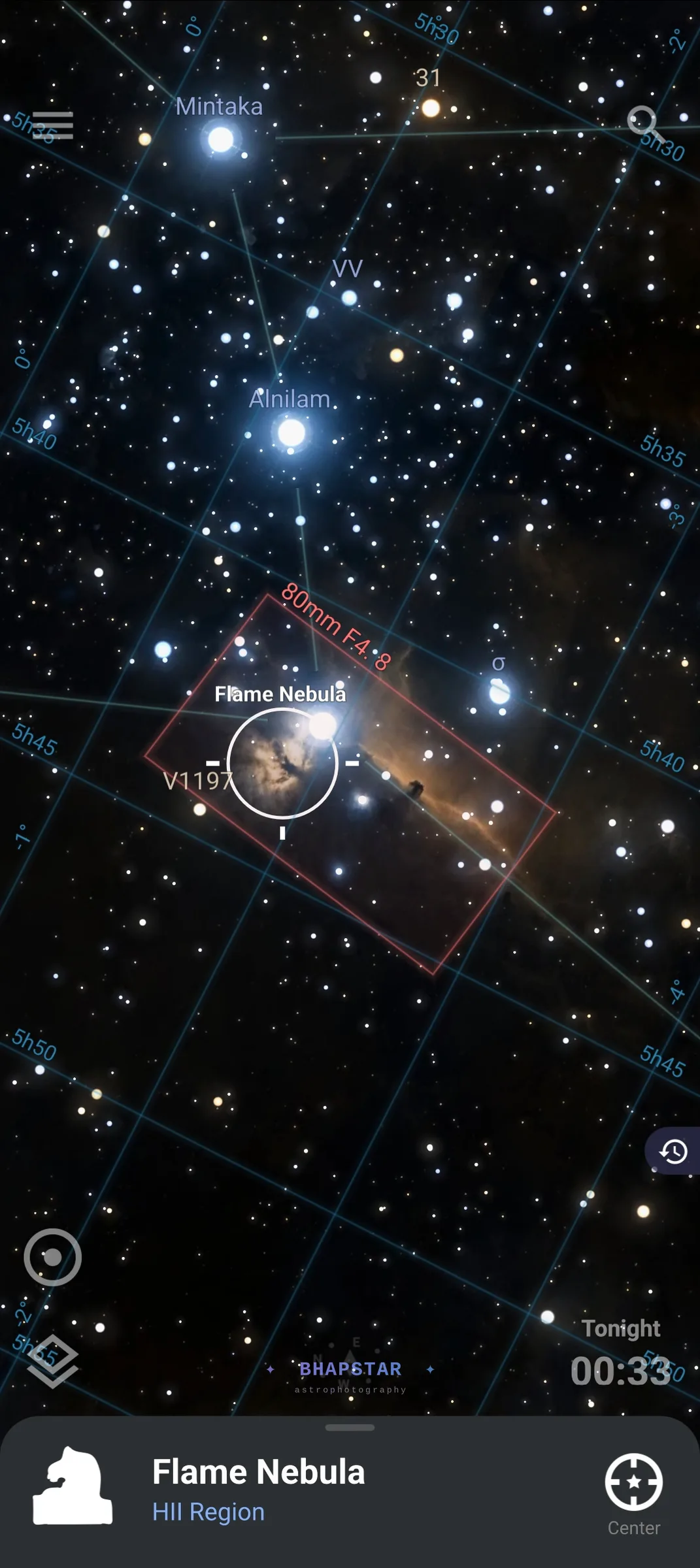
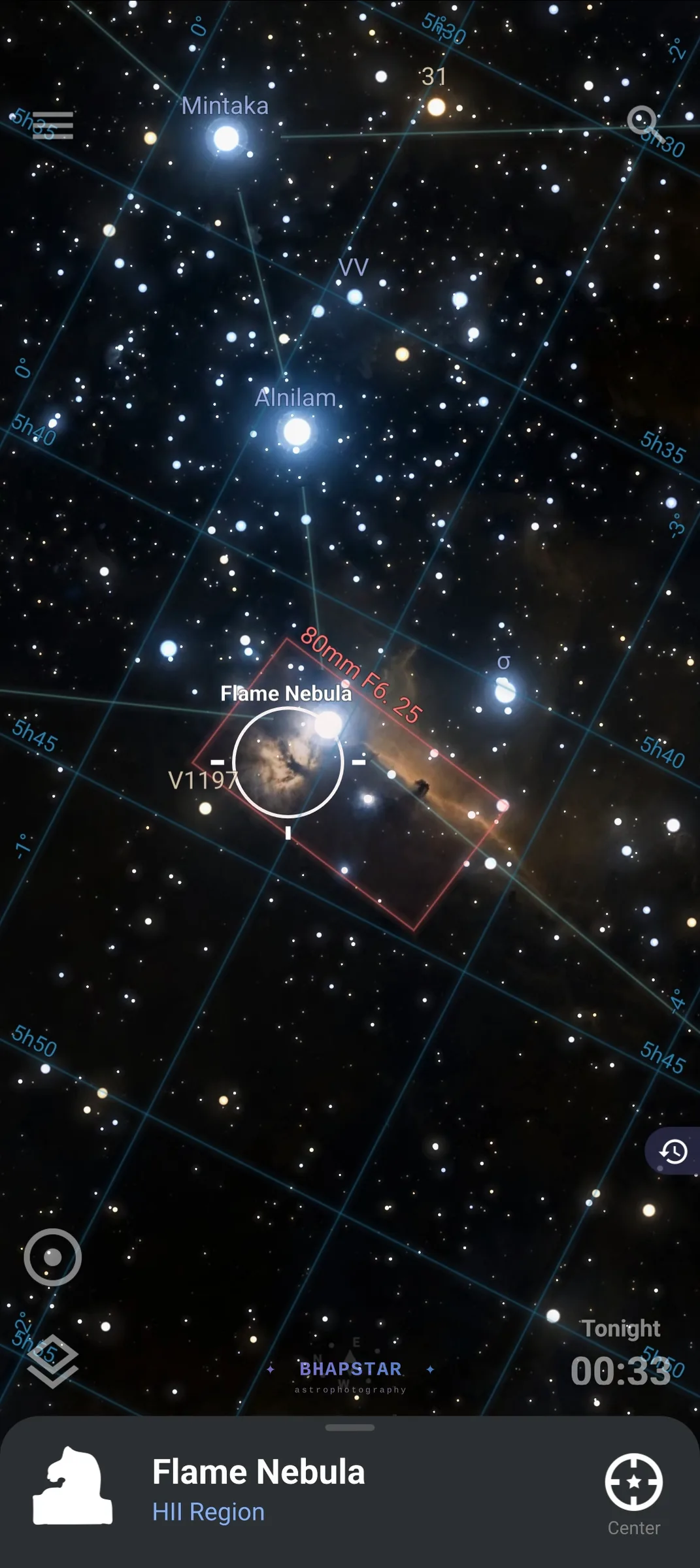
The picture at the top of this page is that tool doing its job. The red rectangle is my frame at 80mm f/4.8, dropped over the Flame Nebula. The Horsehead is in there too, the dark notch to the right of the bright star. Knowing both would fit in one exposure took about four seconds. My photograph of the pair is in the gallery.
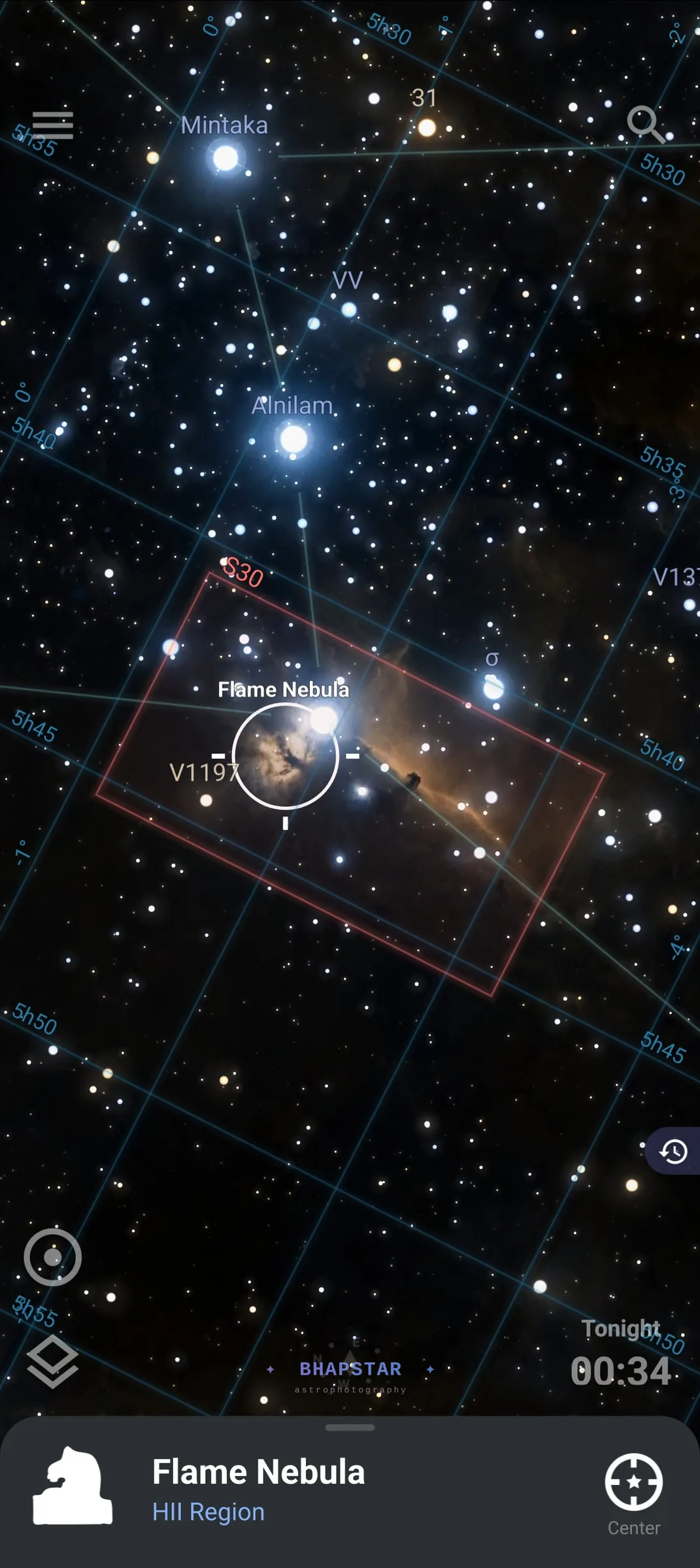
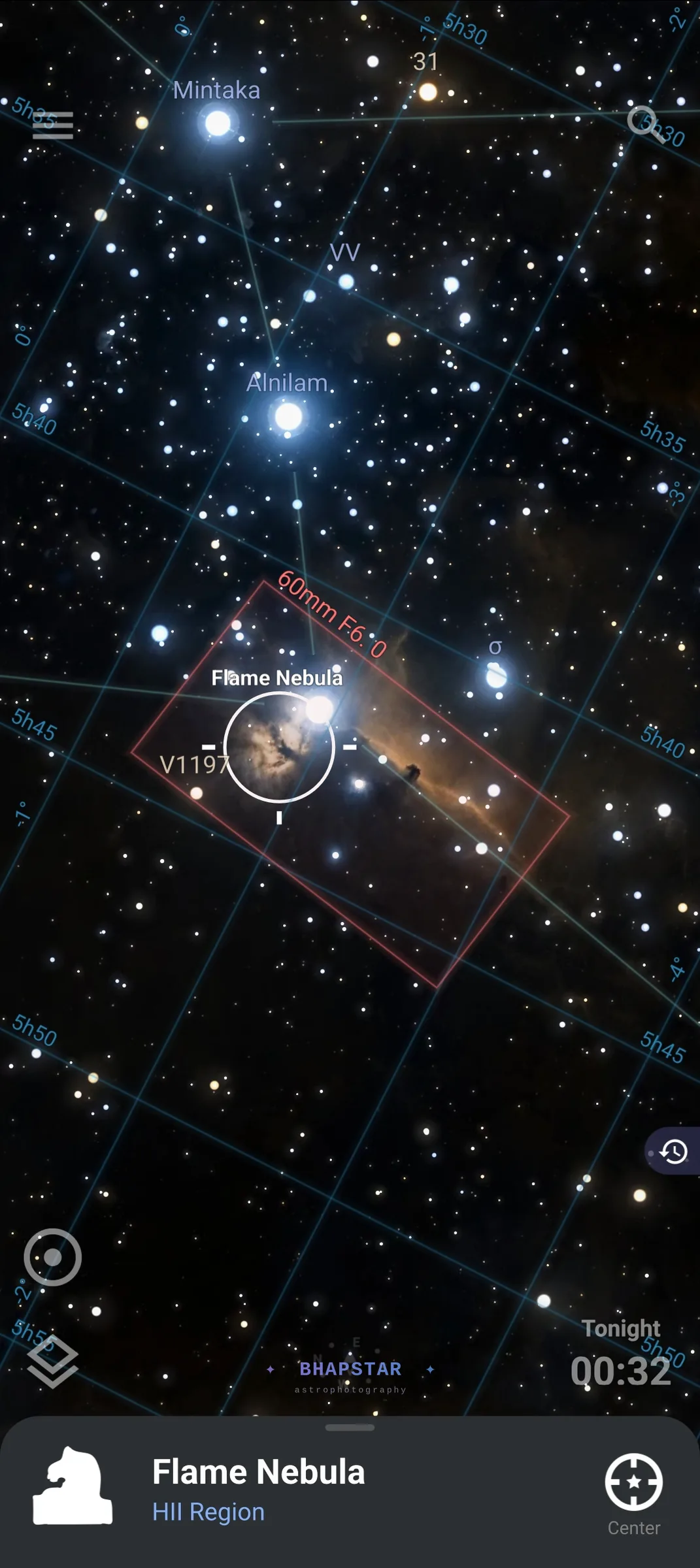
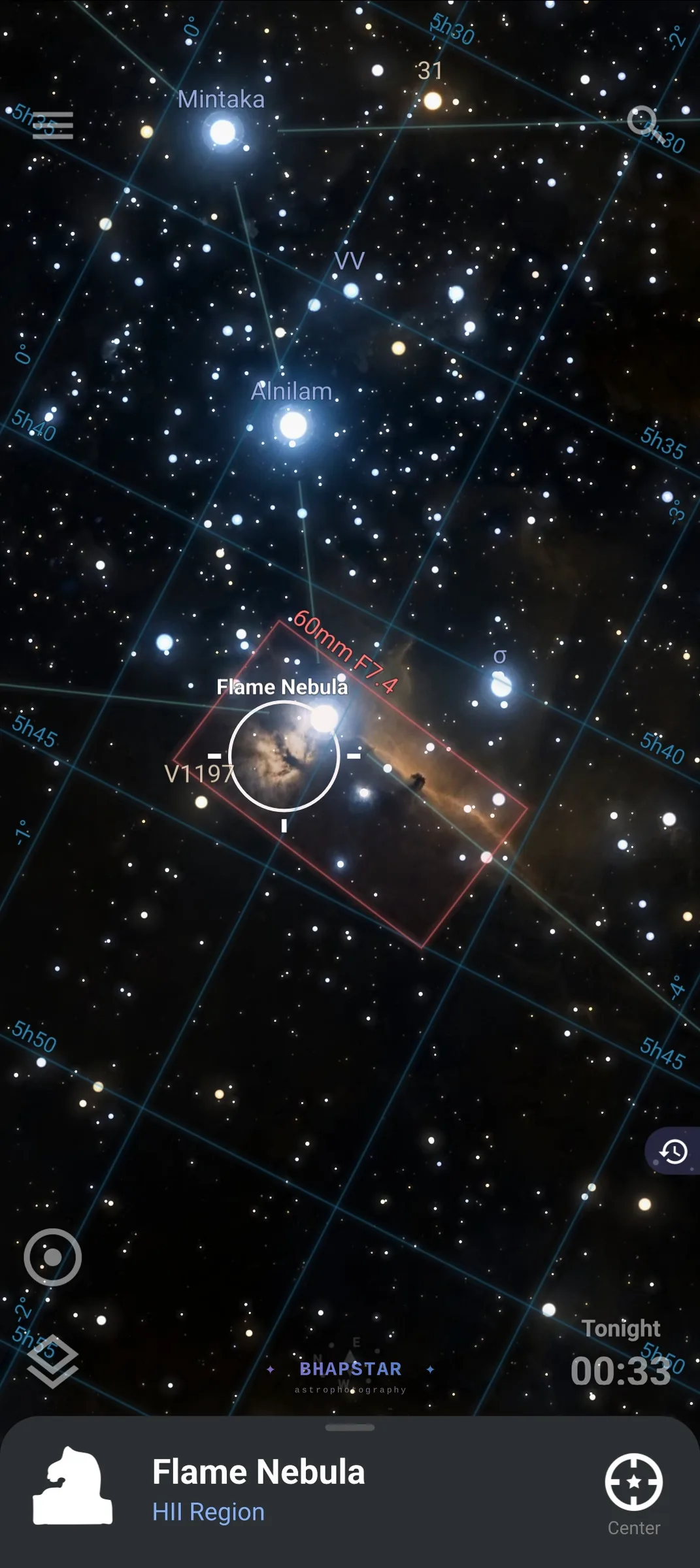
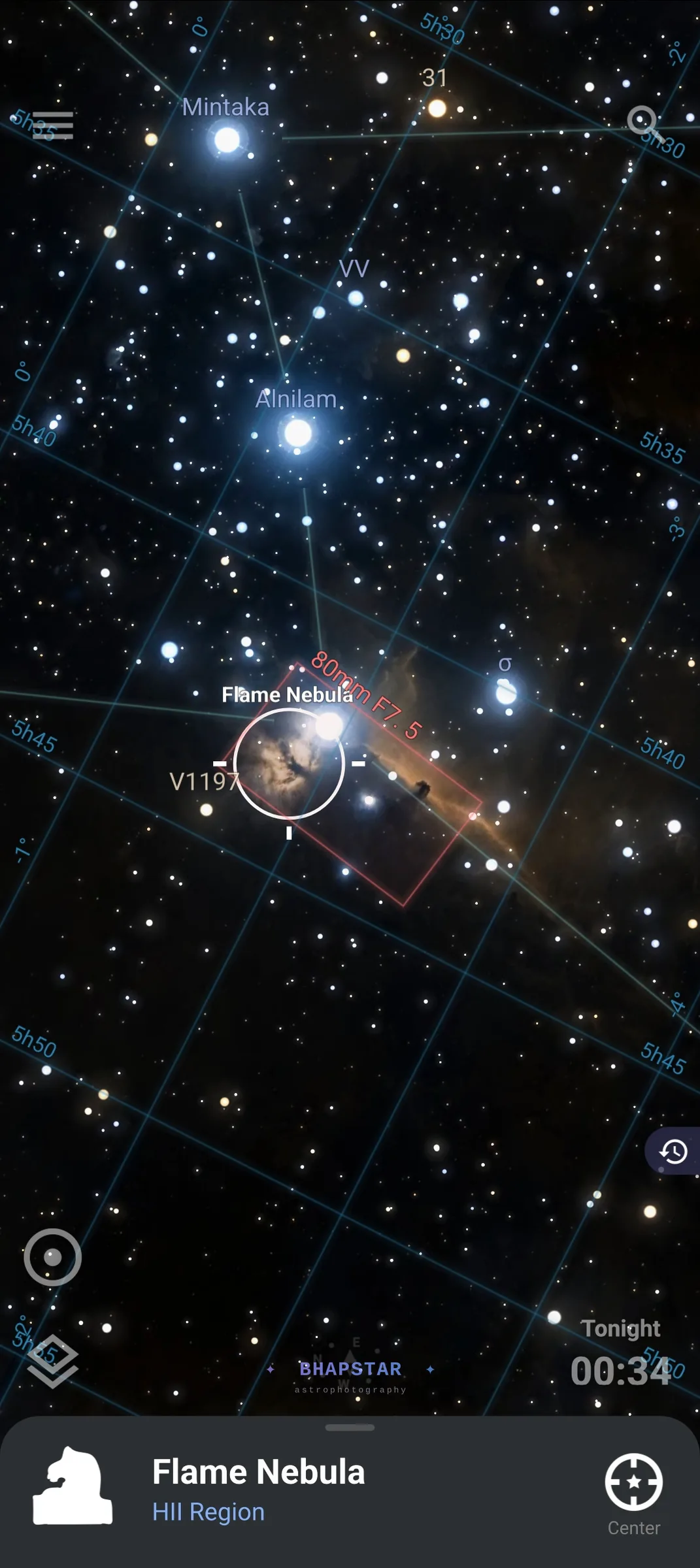
One frame is useful. Nine is a decision. Every combination I own, laid over the Flame and Horsehead in turn, which have to be kept together because they are a pair. Same target, same evening, so the only thing that really changes is the rectangle. The 135mm view is pulled back, because that frame covers far too much sky to show at the same zoom as the rest.
Ordered widest to tightest. It cycles on its own, and stops as soon as you pick a frame. Tap the picture to see it full size.
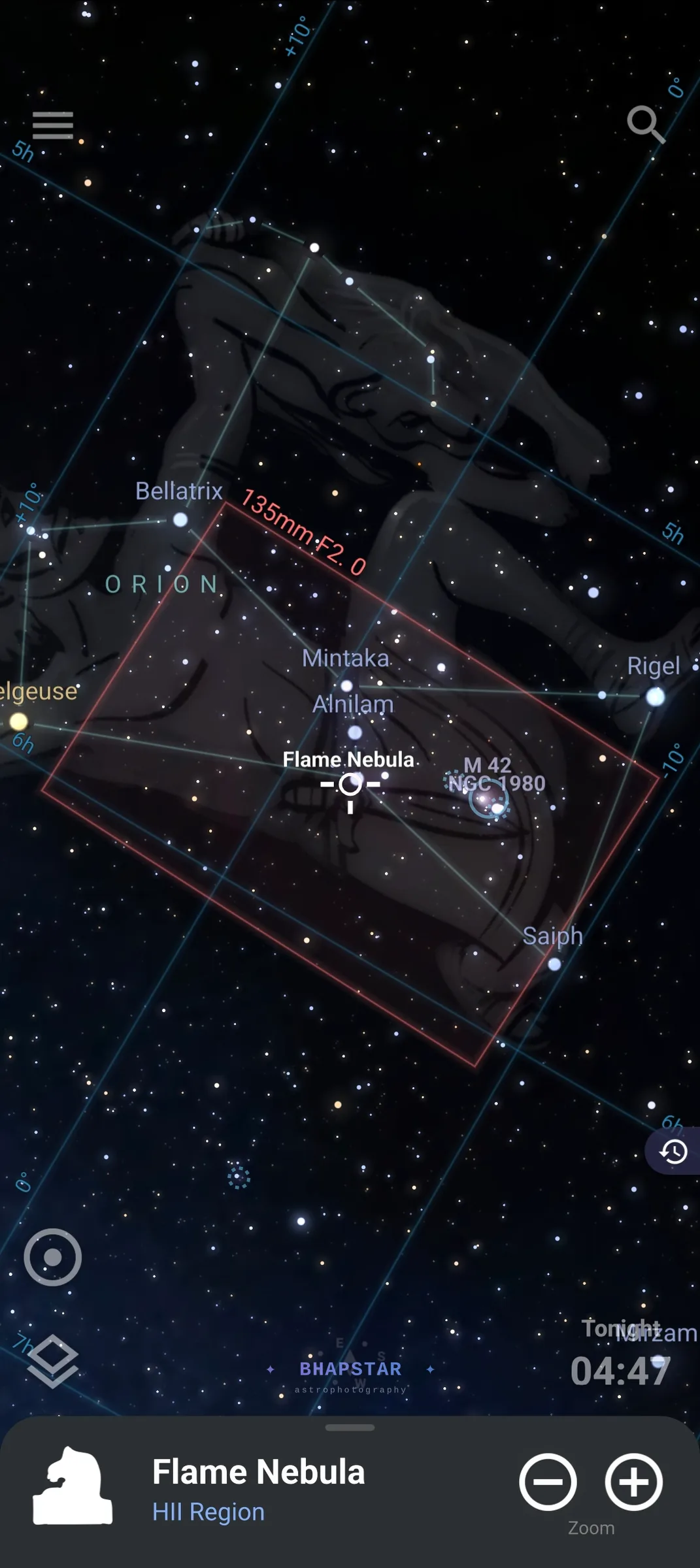
Samyang 135mm f/2 on the Sony A7 III
Almost the whole constellation. Betelgeuse sits off one corner, Rigel off the other, and the Flame is a speck beside the Belt. This is the frame for Orion as a subject in its own right, or for the enormous faint arcs that run across it. It is not the frame for the Horsehead.
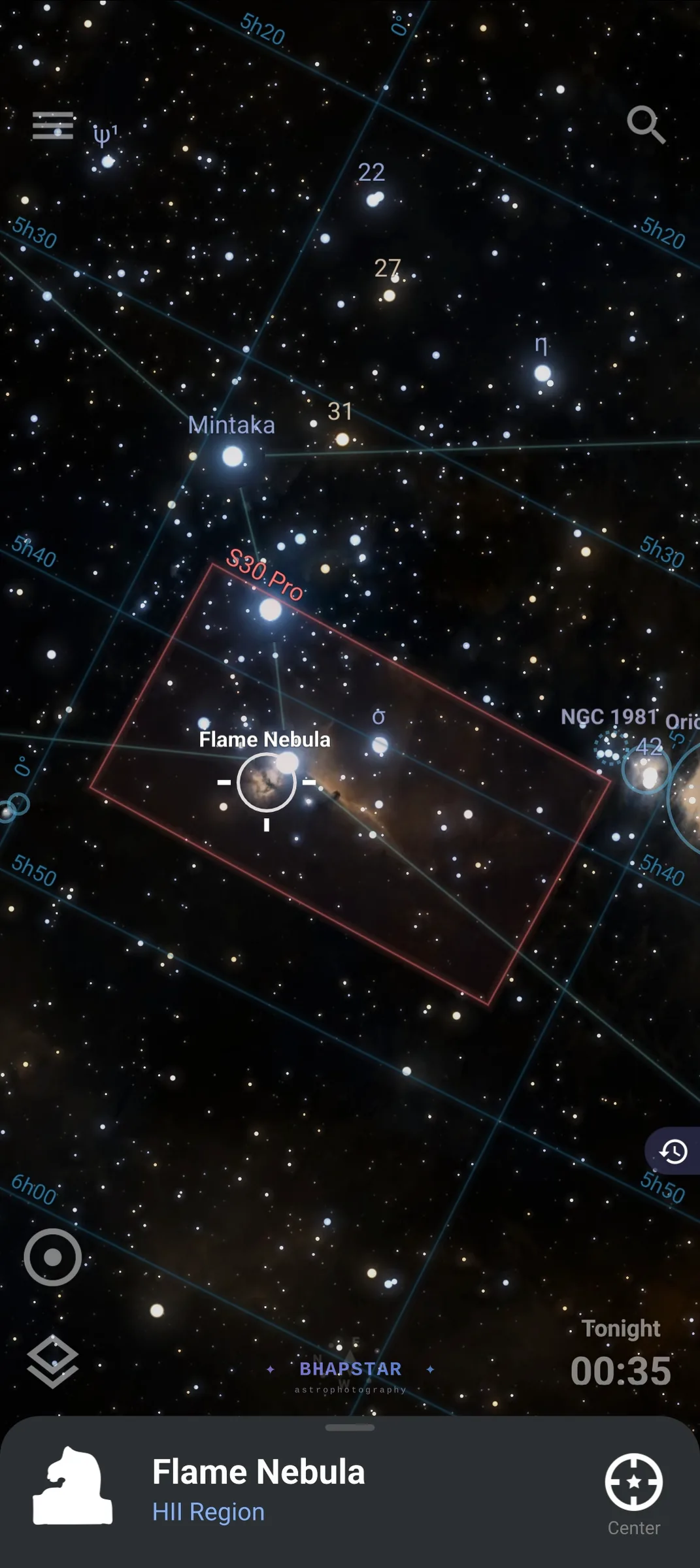
Seestar S30 Pro
Wide enough to hold the whole southern end of the Belt. The Flame and the Horsehead sit well inside, and the Orion Nebula crowds the far corner. A good frame when the subject is the region rather than one object.
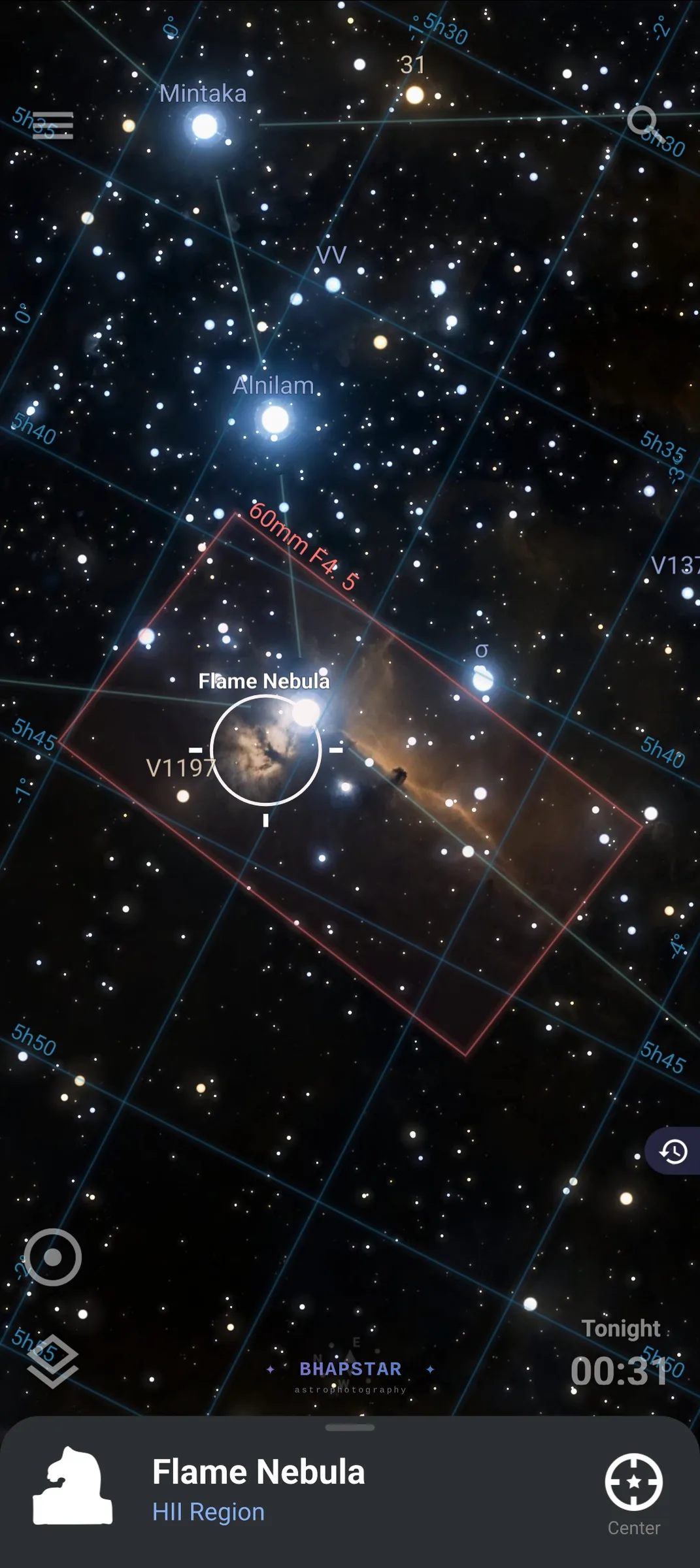
Askar V, 60mm with the reducerAn extra lens that shortens the focal length, giving a wider view and gathering light faster. The picture covers more sky and needs less time. (270mm)
The widest of the Askar frames. Both nebulae sit together with space on every side and Alnitak comfortably inside. This is the forgiving one: room for a framing error, and room for the fainter dust that surrounds the pair.
Seestar S30
Almost the same coverage as the 270mm frame. The whole region fits with a little to spare, which is a large part of why the S30 is such a good grab-and-go for this target.
Askar V, 60mm native (360mm)
Tighter. The pair still fits, but the surrounding space has gone. Worth choosing when the trackingThe mount turning slowly to cancel out Earth's rotation, so a star stays in the same spot on the sensor instead of drifting into a line. is behaving and the framing is deliberate.
Askar V, 80mm with the reducer (384mm)
Near enough the same coverage as the 360mm, but at f/4.8 rather than f/6, so it gathers light faster. When two configurations frame a target the same way, the faster one wins.
Askar V, 60mm with the extenderThe opposite of a reducer: an extra lens that lengthens the focal length, so you get a closer view of a smaller patch of sky. (444mm)
The pair now runs corner to corner. Nothing is cut off, but there is no margin left, so the centring has to be right on the night.
Askar V, 80mm native (500mm)
Both are still in, just. Over a few hours any drift starts pushing the Horsehead towards the edge, so this one asks more of the mount than it gives back on this particular target.
Askar V, 80mm with the extender (600mm)
The close-up. The Flame fills the frame and the Horsehead is pushed to the edge. This is the right choice for the Flame on its own, and the wrong one for the pair.
Watch them cycle and the decision makes itself. The 135mm is a different picture altogether, one of Orion rather than of the nebulae. The 600mm is a portrait of the Flame with the Horsehead half out of shot. Somewhere in between sit three or four frames that all hold the pair properly, and at that point the tie is broken on speed: the 80mm at f/4.8 covers the same sky as the 60mm at f/6 and collects light faster.
What it actually is
That is the payoff. The tool behind it is simpler than it looks.
Stellarium is planetarium softwareA program that draws the sky as it appears from a chosen place at a chosen time, and lets you run time forwards and backwards. Used for working out what is visible before going outside.. You tell it where you are, you give it a date and a time, and it draws the sky exactly as it will appear above you. Not an artist's impression. The real positions.
The part that makes it a planning tool rather than a pretty picture is that you can move time. Wind forward an hour and watch your target climb. Wind forward to next Tuesday. Wind forward to February and see what winter brings round. The sky in the software behaves the way the real one does, so anything you can work out in it will hold up outside.
Start with the free web version
If you have never used it, do not install anything yet. Open Stellarium Web in a browser, put in your town, and have a look around. It costs nothing and there is nothing to set up.
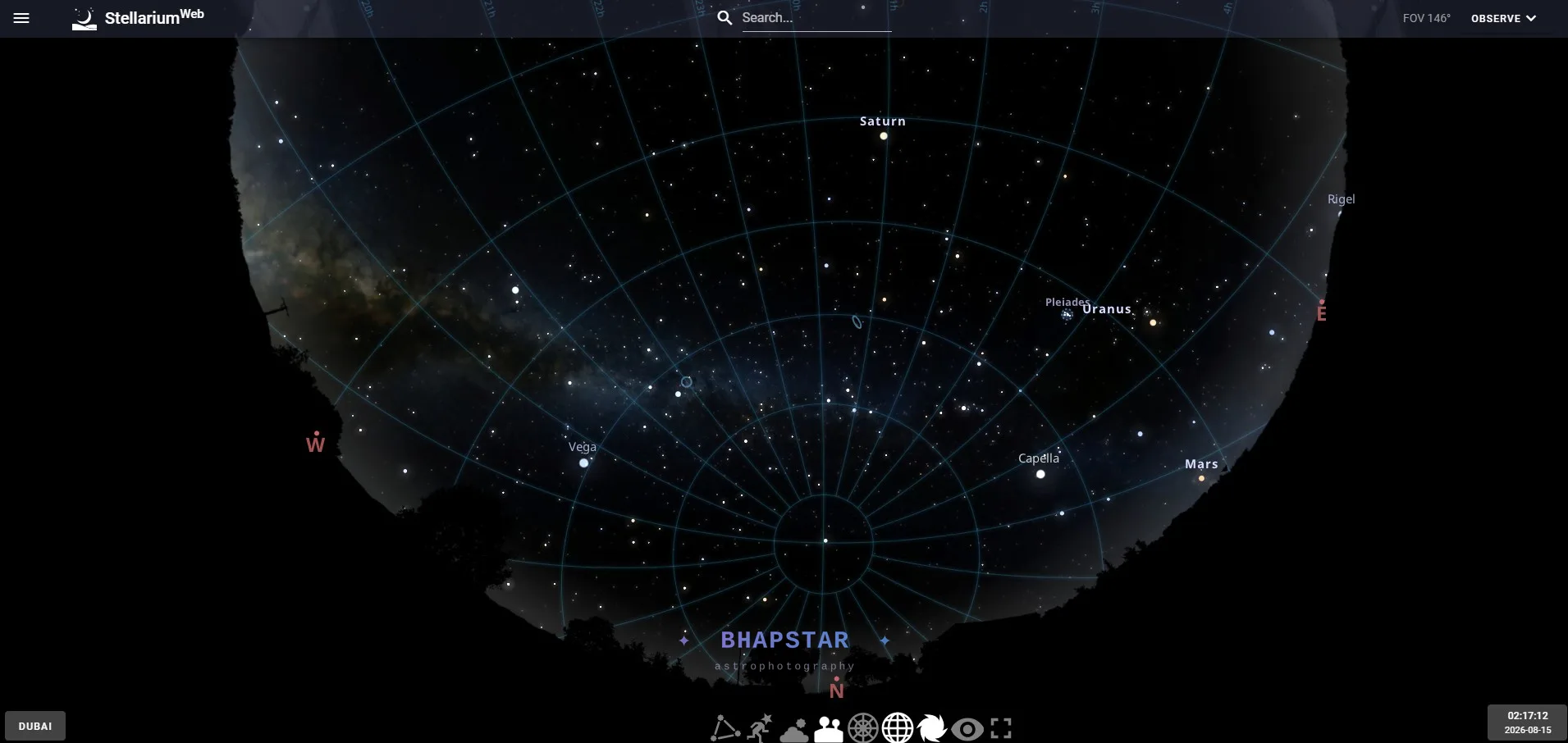
Even now I use it for quick questions. It answers the ordinary ones perfectly well:
- What is up tonight?
- When does Orion clear the buildings?
- Where is Saturn?
- Which constellations belong to this month?
- When does proper darkness begin?
That last one is worth knowing properly. Sunset is not darkness. There is a long gap afterwards while the sky is still bright enough to spoil an exposure, and astronomical darknessThe part of the night when the Sun is far enough below the horizon that it adds no light to the sky at all. It starts well after sunset and is the only time the faintest things can be photographed properly., the point where it stops mattering, arrives later than most people assume. How much later changes through the year and with how far north or south you are.
The five things I check before anything is packed
This is the whole routine, and it takes about ten minutes.
What is visible. Not what is technically above the horizon, but what is high enough to be worth pointing at.
How high it gets. The altitudeHow high something is above the horizon, measured in degrees. Zero is the horizon and 90 is straight overhead. The higher it is, the less air you are looking through. a target reaches decides how much atmosphere you are shooting through. Low down you are looking through a much thicker, dirtier slice of air, and from a city that slice is full of light.
When it is highest. Every object reaches a highest point and then starts back down. That moment is culminationThe moment an object reaches its highest point in the sky before it starts back down. It is the best time to photograph something, because that is when you are looking through the least air., and it is the middle of your best window.
What the Moon is doing. Phase and position, both. A bright Moon on the far side of the sky leaves you plenty to work with. Once it is within forty degrees of your target you will want a narrowbandA filter that only lets through the few exact colours that glowing gas clouds give off, and blocks nearly everything else. Streetlight is mostly blocked, the nebula is not. filter, which is a whole subject of its own that I have written about in the piece on Bortle skies and narrowband filters.
How long I realistically have. Between the sky going properly dark, the target clearing the obstruction, and the target dropping too low again, there is a window. Sometimes it is five hours. From a balcony with a building on one side, sometimes it is ninety minutes, and knowing that changes what is worth attempting.
Framing is the part worth paying for
Everything else in this article is free. The framing rectangles at the top of this page are the one part that can cost money, and they are the part I would pay for again without thinking about it.
Before this I framed by trial and error. Now the composition is settled before I leave the flat, which counts for a lot on a target that only clears the rooftops for a couple of hours.
Worth being clear about what costs money, because the naming is confusing. Stellarium on a computer is free and open source, and it has this feature built in. The phone app is a different product with a free tier, and the framing tool is one of the things behind the paid Plus unlock. I use the phone version, so I paid. If you work at a desk, you do not have to.
Build the equipment library once
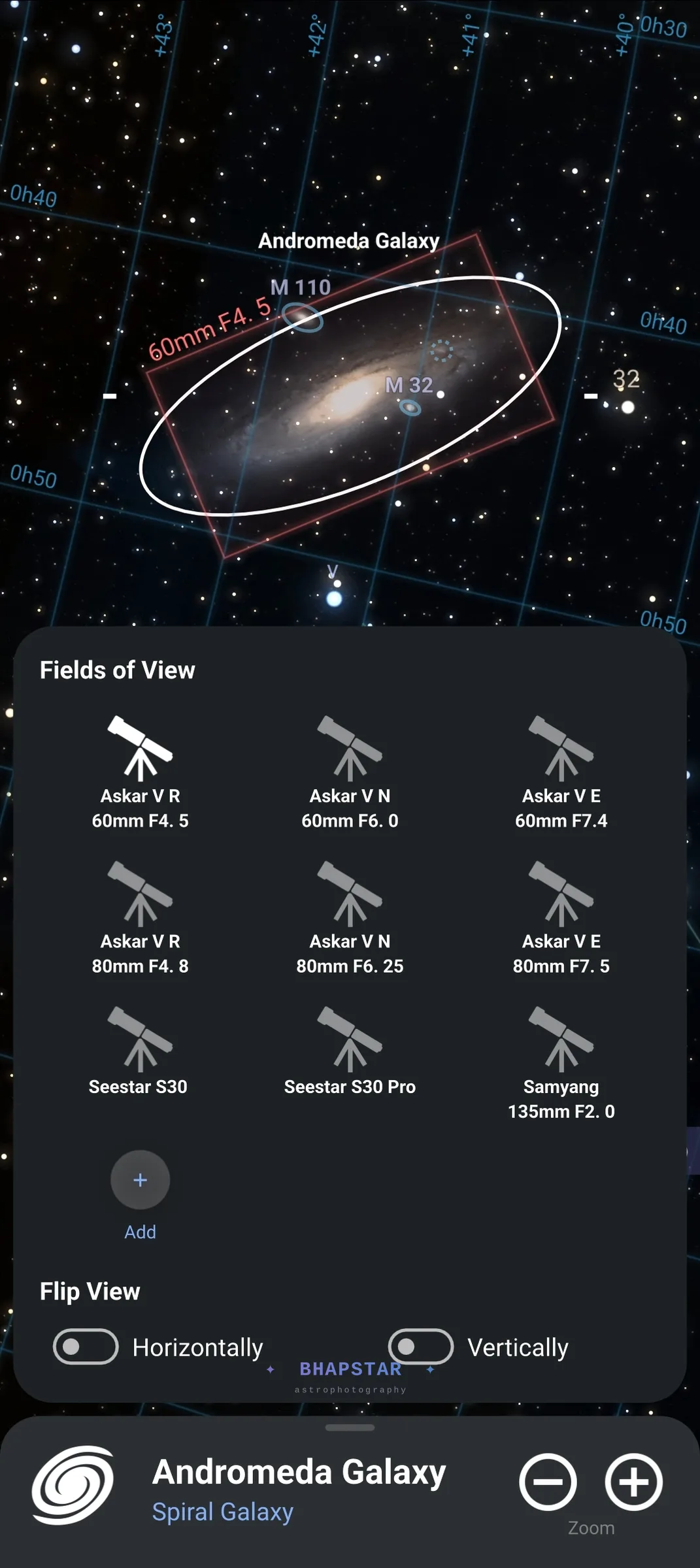
The setup is the boring bit and it is worth doing properly. Sit down for half an hour and enter every combination you own. After that it is permanent.
Mine currently holds nine. The Askar V is a modular scope, so it accounts for six of them on its own: the reducer, native and extender configurations, each at 60mm and 80mm of apertureThe size of the opening the light comes through, written as an f number such as f/2.8. Confusingly, a smaller f number means a bigger opening and more light.. Then the two Seestar units, and the Samyang 135mm for wide work. The six Askar frames are drawn for the ASI585MC Air, the two Seestars carry their own sensors, and the Samyang is paired with the full-frameA camera whose sensor is the size of an old 35mm film frame. Bigger sensors gather more light, which is why they cope better in the dark. Sony A7 III. The frame is always a product of the optics and the chip together, so changing the camera changes every rectangle that uses it.
Once they exist, the question changes. It stops being "will this fit" and becomes "which of these nine frames it best", and that is a question you can answer by tapping through them while the kettle boils.
Let the target choose the telescope
Deep-skyAnything beyond our own solar system: nebulae, galaxies and star clusters. Faint, far away, and the reason for long exposures. objects vary in apparent sizeHow big something looks from Earth, rather than how big it really is. Measured as an angle, so the Moon and the Sun have almost the same apparent size even though one is vastly larger. far more than people expect. Andromeda is six times the width of the full Moon. The Ring Nebula is about a twentieth of that width. No single focal length suits both, which is exactly why it is worth matching the scope to the target before you set up.
The same process works in reverse when a scope is already set up and I want to know what suits it tonight. Pick the frame, then scroll the sky for something shaped to fit it.
Planning around a balcony
City imaging adds a constraint the software handles better than I expected. My balcony faces one way. There is a building to one side and a wall on the other. Plenty of the sky simply is not available to me, and plenty more is only available between certain hours.
Because Stellarium knows my latitude and can run time forward, I can find the exact window when something crosses the gap I can actually shoot through. That turns a frustrating site into a workable one. It is also how I know when a target is worth waiting three weeks for, because three weeks earlier in the evening puts it somewhere different.
For the dark site trips out to Al Quaa it does a different job. Those nights are long and there is no obstruction, so the plan becomes a running order: this one while it is high, that one after it culminates, the wide field once the Milky Way coreThe bright, crowded middle of our own galaxy, seen edge on. From the northern half of the world it sits low in the south in summer. is up. Everything is decided in the warm, in advance, so the night itself is just working through the list.
It teaches you the sky along the way
The bonus I did not plan for is that I now know where things are. Not from memorising a chart, but from watching the same sky wheel round the same way a few hundred times at ten thousand times normal speed.
I know Orion is a winter target and that Cygnus owns the summer. I know roughly where to look for Andromeda without checking. That knowledge makes everything downstream faster, and it is the sort of thing that is much easier to absorb by playing with a model than by reading about it. If you want the underlying framework rather than the software, I have written about how the sky is laid out and why it moves the way it does.
Is the paid version worth it
For learning the sky and for casual use, no. The free options are complete and I would happily recommend them to anyone who never intends to photograph anything.
For photography, the framing tool alone repaid the cost on the first night it stopped me packing the wrong scope. That is a low bar for a piece of software that costs less than a filter, and it is worth checking before you spend, because on a computer that feature is free.
The summary is that Stellarium has changed my hit rate more than any single piece of hardware I have bought. Not because it makes the pictures better, but because it puts me on targets that were always going to work. Given how few genuinely good nights there are in a year here, that turns out to matter more than almost anything else in the rest of the setup.