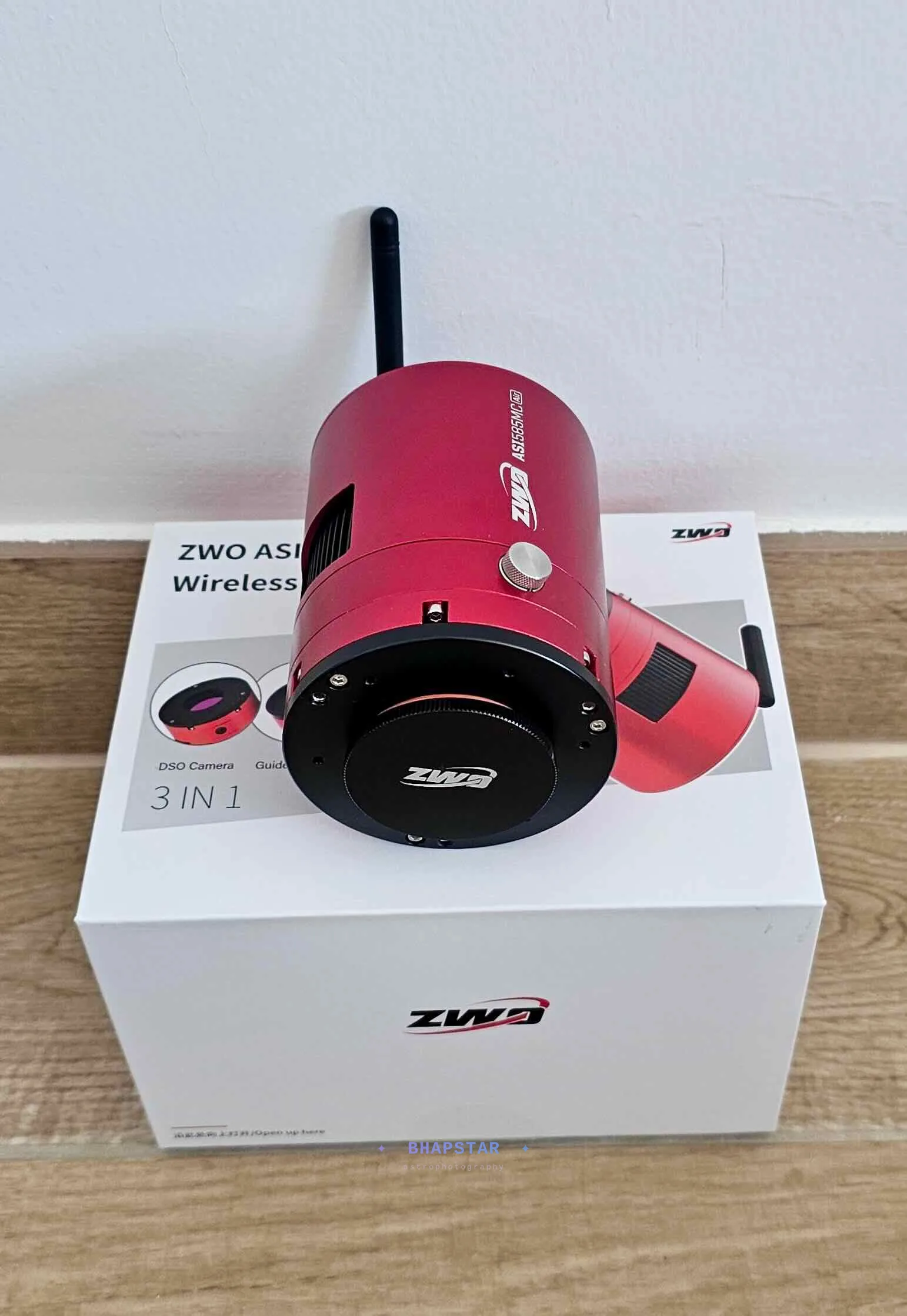
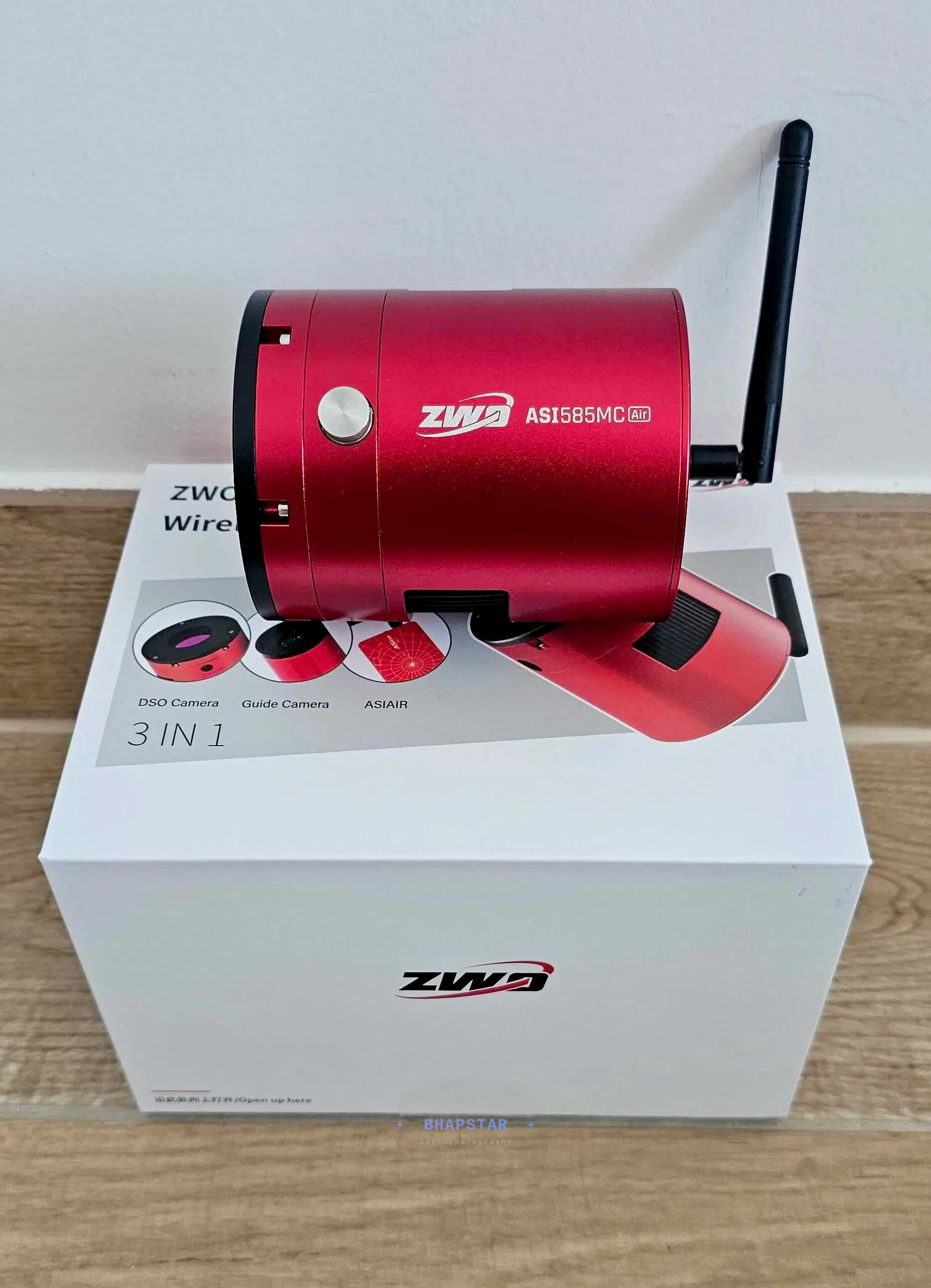
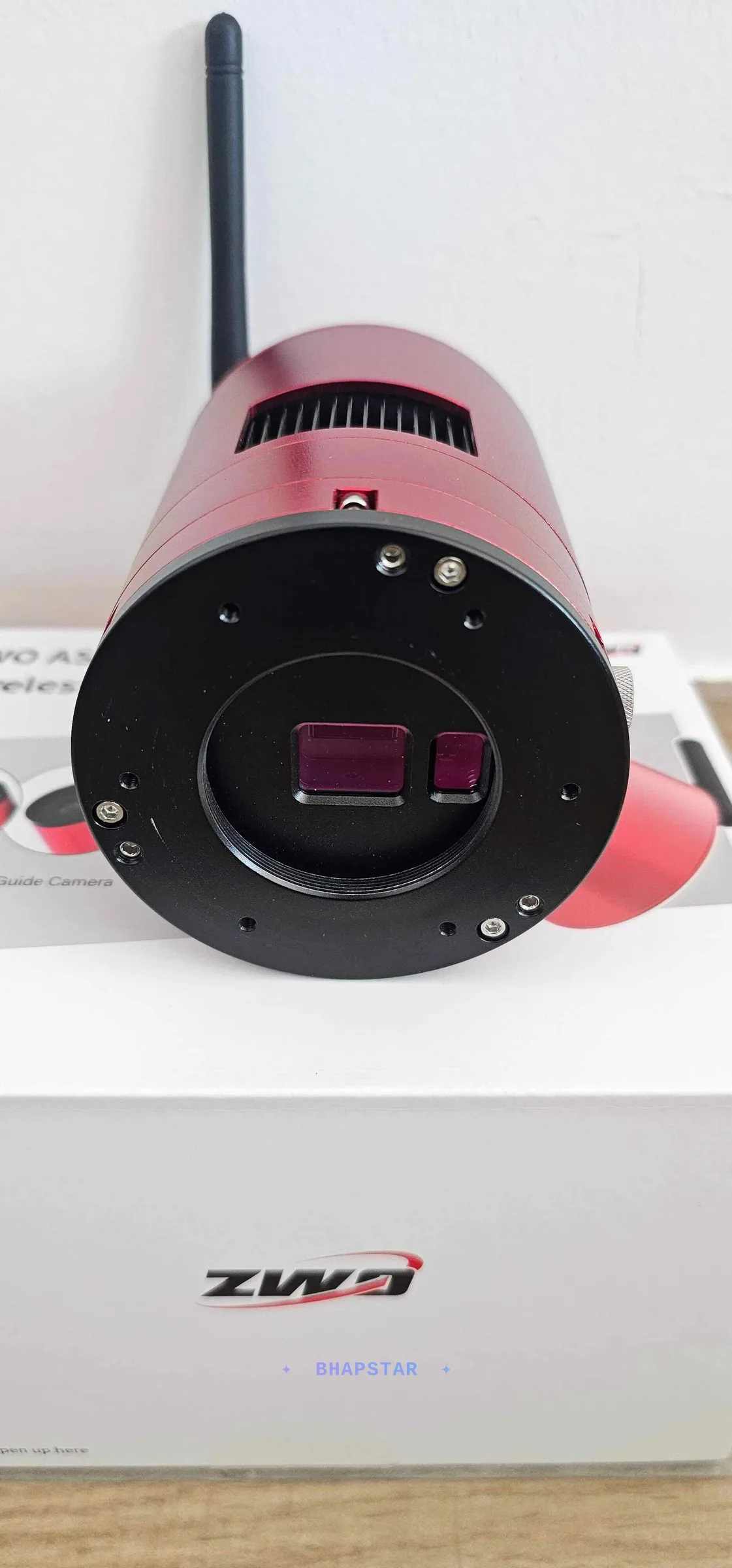
ZWO ASI585MC Air Camera
A cooled, guided, controlled imaging system compressed into a single body. The Sony IMX585 sensor at its heart is extraordinarily sensitive to faint light, and the built-in cooling pulls heat from the chip to keep the long exposures clean and quiet. Guide cameraA small second camera that watches one star and reports any drift, so the mount can be corrected while the main camera keeps working., controller, and wireless connection are all folded in, leaving nothing between the telescope and the sky but the lens cap, before it comes off.
Three boxes in one
A conventional imaging setup needs a main camera, a guide camera with its own optics, and a control computer, each with cables and power of its own. The ASI585MC Air puts the imaging sensor, a 2.1MP guide sensor and a full ASIAIRA small controller from ZWO that runs the mount, camera and focuser from a phone or tablet. It replaces the laptop at the telescope. controller inside one housing.
What that means in the field is one power lead and a phone. Anyone who has lost a session to an intermittent USB fault in the dark will recognise why that matters more than any figure on the box.
The sensor
The IMX585 is an 8.3 megapixel back-illuminatedA sensor built with its wiring behind the light-sensitive layer rather than in front of it, so less of the incoming light is blocked on the way in. STARVIS 2 sensor, 3840 by 2160, with 2.9 micronA thousandth of a millimetre. Sensor pixels and focus tolerances are both measured in them, and both are small enough that a few tens of microns matter. pixels on a 1/1.2 inch format and peak quantum efficiencyHow much of the light landing on a sensor actually gets recorded. Eighty per cent means four photons in five are counted and the rest are lost. around 88%. Small pixels suit short and medium focal lengths, which makes it a natural partner for the Askar V across most of its range.
Cooling is a two-stage thermoelectricElectrically driven cooling with no moving parts, used to hold a camera sensor well below the air temperature so it collects less heat noise. system rated to hold the sensor 30 to 35 degrees below ambient. In a temperate climate that is a convenience. Imaging through a Gulf summer it is the feature that makes long exposures viable at all, since dark currentSignal that builds up in a sensor because it is warm rather than because light arrived. It roughly doubles for every six or seven degrees, which is why cameras get cooled. roughly doubles for every 6 to 7 degrees the sensor gains.
Framing, and what the format means
The 1/1.2 inch format gives a narrower field than an APS-CA sensor size smaller than full frame and larger than the ones in most astronomy cameras. It sits in the middle of the range for how much sky it covers. camera on the same telescope, so the largest targets want a shorter focal lengthHow much a lens or telescope magnifies, measured in millimetres. A small number gives a wide view of the sky, a large number a narrow, closer one. or a mosaicSeveral overlapping frames joined together into one much wider picture, for targets too big to fit in a single view.. In exchange, a small sensor asks much less of the optics at the edges and makes flats considerably less troublesome. Most of the recent gallery was shot with it, including Orion and the Flame and Horsehead.
It works well with the filter drawer and the EAF, which between them mean a filter change or a refocus does not involve touching the imaging trainThe chain of parts between the telescope and the sensor: flattener, spacers, filter drawer, camera. Every one of them takes up length, which is why the order and the spacing matter.. One consequence of the all-in-one design is that the parts are married, so moving to a larger sensor later means replacing the controller and guide camera too.
Getting one to the UAE
Mine came directly from ZWO in China and arrived in Dubai without any difficulty. Buying straight from the manufacturer is the shortest route for ZWO kit, and for a camera with an integrated controller it has the additional advantage that warranty and firmware support come from the same place that built it.
Where to buy
Some links above are affiliate links. If you buy through them I may earn a small commission, at no extra cost to you. It does not affect which gear I use or recommend.