The short version
A city sky does not dim a nebula. It buries it.
The nebula sends down exactly as much light over Dubai as it does over the desert. What changes is everything else arriving with it. The fix is a filter that only opens two tiny windows, one on each of the two colours a nebula glows in, and shuts out the rest. It works beautifully on glowing gas clouds and does nothing at all for galaxies.
A dozen stars, or a few thousand
Step onto a balcony in Dubai on a clear night and count what you can see. On a good night I get to about a dozen stars. The sky is a flat grey-orange, and in several years of looking I have never once seen the Milky Way from there.
Drive two hours inland and the same sky, on the same night, has thousands of stars in it. The Milky Way comes up as a solid band with dark dust lanes running through it, bright enough that you notice it before your eyes have finished adjusting. Nothing about the sky changed. Only the ground underneath it did.
This is not a rare problem. Roughly a third of the people alive today cannot see the Milky Way from where they live, and most of them have never seen it at all.
The Bortle scale: a score out of nine for your sky
John Bortle published this scale in Sky & Telescope in 2001, and astronomers have used it ever since. It runs from Class 1, the darkest sky left anywhere on Earth, to Class 9, the middle of a big city.
What makes it useful is that it is written in terms of what you can actually see, rather than a number off a meter. Class 1 says the Milky Way is bright enough to cast a shadow. Class 8 says there is enough skyglowThe glow of that scattered artificial light coming back down at you. It is what makes a city sky look washed out rather than black. to read a newspaper outside at midnight.
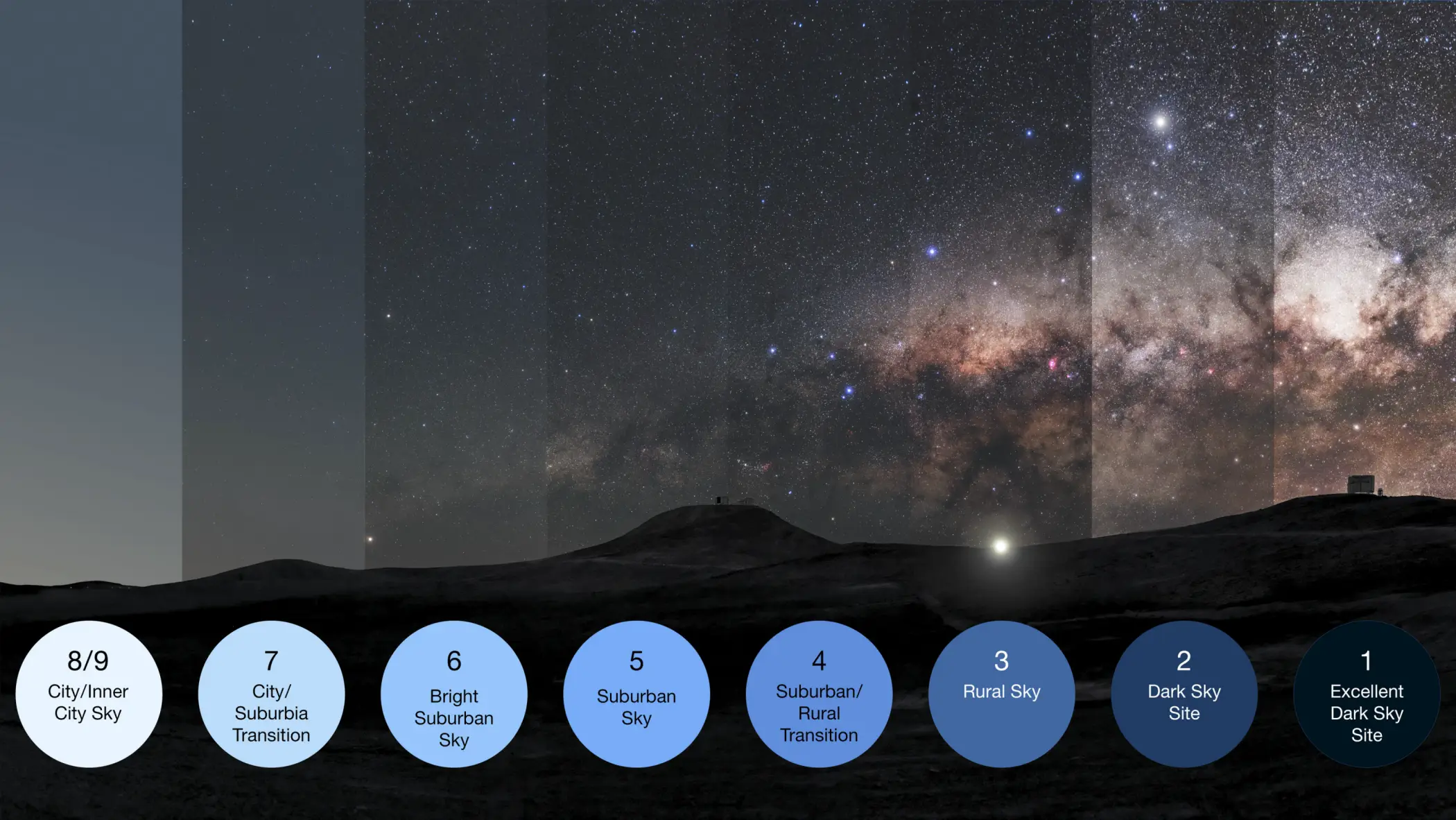
| Class | Where | Looking up, you see | What you can photograph |
|---|---|---|---|
| 1 | Almost nowhere left | A Milky Way bright enough to cast a shadow | Anything you point at. A filter is a choice here, not a rescue. |
| 2 | Deep desert, remote mountains | The Milky Way with obvious dark lanes in it | Anything, and faint dust with enough hours. |
| 3 | Rural | The Milky Way clearly, with a glow over distant towns | Galaxies and clusters look their best. Nebulae still gain from a filter. |
| 4 | Edge of a village | The Milky Way overhead, washed out near the horizon | Still very good, with a slope of brightness creeping in. |
| 5 | Suburbs | A faint Milky Way, and only overhead | Unfiltered shots get harder. Filtered nebulae get a lot better. |
| 6 | Bright suburbs | No real Milky Way. The sky has a colour. | Unfiltered frames fill with skyglow fast. |
| 7 | Edge of a city | A grey sky and the well-known constellations | Nebulae through a filter. Galaxies want a drive. |
| 8 | City. My balcony. | A dozen or so of the brightest stars | Glowing gas clouds only, and only behind a tight filter. |
| 9 | Inner city | A handful of stars, if that | The Moon, the planets, the brightest clusters. |
One thing that column can give the wrong impression about. A narrowband filter is not a city tool that stops being useful once you leave town. It lifts a glowing nebula out of its background under any sky, which is why the same filter goes in the car to the desert, and it is also what lets you keep working when the Moon is up. What the Bortle class actually decides is whether the filter is a choice or the only thing that works: at Class 2 it is one option among several, and at Class 8 it is the difference between an image and a blank orange frame.
If you like numbers
Each class also maps onto two measurements. The first is the faintest star you can pick out with your eyes alone, quoted as a magnitudeThe brightness scale for stars, and it runs backwards. Smaller numbers are brighter, and each step of one is about two and a half times., where bigger numbers mean fainter stars. The second is a Sky Quality Meter reading, which is a direct measurement of how much light the sky itself is giving off. One point on the SQMSky quality meter, a proper measurement of how bright the night sky is. Higher numbers mean a darker sky. scale is about two and a half times the brightness, so small differences in the number are large differences in the sky.
Treat all of it as a rough guide. A study in 2014 found Bortle was optimistic about what a typical person can actually see, and different sources draw the boundaries between classes in slightly different places. The scale tells you roughly where you are. It is not a certificate.
Work out your own number tonight
You do not need any equipment for this. Go outside, give your eyes twenty minutes away from screens and porch lights, then find Orion, which sits in the evening sky from about November to March. Four bright stars mark its corners and three in a line make the belt.
Now count the stars inside that rectangle, ignoring the four corners and the three belt stars. That count is a decent proxy for your sky:
- Fewer than 5. Bortle 7 to 9. City sky.
- 5 to 15. Bortle 5 to 6. Suburban.
- 15 to 30. Bortle 4. You are doing well.
- More than 30. Bortle 3 or better. Stay there.
Outside the Orion months, the same trick works with any pattern you can recognise: count the faint stars between the bright ones. It is worth doing once from home and once on a trip somewhere dark, because the gap between the two numbers is the thing this whole article is about.
Then check yourself against the satellites. Drop a pin on lightpollutionmap.app and it will give you a Bortle class and an SQM figure for that exact spot, built from night-time satellite data. It is also the fastest way to find out how far you would actually have to drive to reach a darker class, which is usually less far than people expect.
Why a bright sky is such a problem
The obvious assumption is that city lights drown the nebula out, in the sense that its light gets weaker. That is not what happens. Light from the Rosette Nebula lands on my camera at exactly the same rate on the balcony as it does in the desert. Nothing a city does can reach across five thousand light years and turn a nebula down.
What changes is what arrives alongside it. Skyglow lands on every pixel of the sensor, and it does not arrive smoothly, it arrives in a grainy flicker. The brighter the glow, the coarser the flicker. The nebula is still there in the picture, sitting on top of a noisy floor far taller than it is.
Try to hear someone whispering next to a motorway. Turning the volume up does not help, because you turn the motorway up too. Subtracting the average level of the traffic is easy. Subtracting the roar is impossible, and the whisper is lost somewhere inside it.
In practice that means a few things:
- Exposures have to be kept short, or the sky itself fills the sensor up.
- Stars swell and lose their colour.
- The glow is not the same brightness across the frame, so pictures come out with a slope of brightness across them.
- You need far more hours of data for the same result, which is usually what decides whether a target is worth trying at all.
The trick: a nebula only glows in a few colours
Here is the loophole, and it is a good one.
A glowing nebula is not lit up like an object in daylight. Its gas is being energised by nearby hot stars, and energised gas behaves like a neon sign: it emits a few pure colours and nothing in between. Hydrogen puts out a deep red at 656nm. Oxygen puts out a blue-green at 501nm. Almost all the light from the Rosette or the Orion Nebula arrives in a small number of narrow spikes like those.
City lighting does the opposite. Old orange street lights at least had a few strong colours you could block, which is what the light pollutionArtificial light from streets and buildings that scatters in the air and brightens the whole night sky, hiding everything faint. filters of the 1990s were built for. Modern LED lighting, which is what the Gulf is lit with now, throws out a smooth white spread across every colour at once. There is nothing specific to block. It is everywhere.
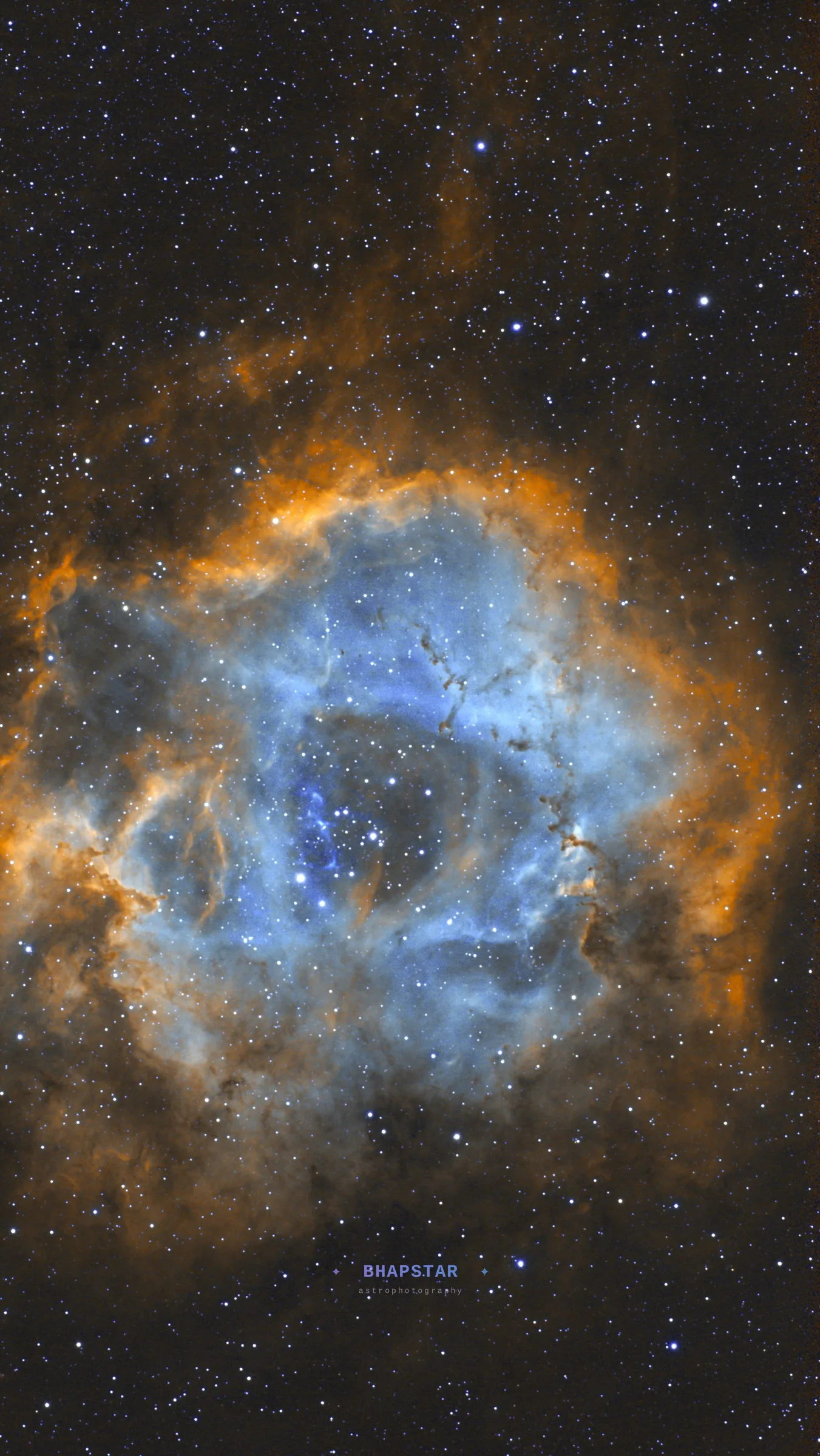
That mismatch is the entire opportunity. If the target only sends light in two narrow colours, and the city sends light in all of them, then a filter that opens two narrow windows throws away nearly all the skyglow and keeps nearly all the nebula.
One aside, because it is worth sitting with. Most of this picture is hydrogen glowing at 656nm, a red so deep that the eye barely registers it. That light left the Rosette Nebula around five thousand years ago, before the pyramids were built, and it travelled the whole way at the speed of light only to be very nearly stopped by a car park in Dubai.
The gold you can see is that same light. A dual narrowband filter collects two channels, hydrogen and oxygen, and processing maps them onto separate colours so the structure pulls apart instead of sitting in one flat red. The colours are real information, honestly recorded. They are just not the colours you would see if you could stand there and look.
What the filters actually do
The Optolong L-eXtreme is the one I use most. It opens a 7nm window at the red hydrogen line and a 7nm window at the blue-green oxygen line, and blocks essentially everything else. Out of roughly 300nm of colour that your eye can see, it is open for 14 of them. It is shut for about 95% of the visible spectrum, on purpose.
The Svbony SV220 does the same job with windows less than half as wide. Narrower windows let through roughly half as much skyglow, while the nebula's colours are narrow enough that most of the signal still fits through. The catch is that very tight filters get fussy about fast telescopes, where light hits the coating at a steep angle. The Askar V is slow enough that this is not an issue.
What this looks like on a real night is longer exposures. Behind a 3nm filter, a five minute frame from the balcony has less sky in it than a thirty second frame without one. The sensor is no longer racing to fill up with orange glow, so each frame can run long enough for the faint stuff to climb clear. You still need plenty of hours, because the filter is throwing away real photons too, but the hours now go somewhere useful.
Two side effects come with the territory. Bright stars can grow halos, which is down to the coating and varies from filter to filter. And star colour goes strange, because the only starlight getting through is whatever happens to fall in those two windows, so everything comes out magenta and teal. Both are dealt with in processing, and the Siril guide covers the star handling.
Where a filter does nothing at all
Galaxies, star clusters and reflection nebulaeA cloud of dust that has no light of its own and simply reflects the light of nearby stars, usually a soft blue. A narrowband filter blocks it almost completely. do not glow like neon signs. They shine with ordinary starlight, or by reflecting it, which means they emit every colour at once, exactly like the city does.
Put a narrowband filter in front of a galaxy and it cuts the galaxy by the same proportion it cuts the sky. The contrast between them does not improve at all, and you have thrown away most of your light for nothing.
| What you are shooting | How it glows | Does a narrowband filter help? |
|---|---|---|
| Glowing gas clouds (Orion, Rosette, Lobster) | A few pure colours | Yes, enormously |
| Exploded star remnants (Jellyfish, Thor's Helmet) | A few pure colours | Yes |
| Planetary nebulae | Mostly the blue-green oxygen line | Yes |
| Galaxies (Andromeda, Pinwheel, Leo Triplet) | Every colour at once | No. Drive somewhere dark. |
| Star clusters (Pleiades, M41) | Every colour at once | No. Drive somewhere dark. |
| Reflection nebulae | Every colour at once, borrowed | No. Drive somewhere dark. |
| The Moon and the planets | Bright enough not to care | Not needed |
This is where the L-Quad Enhance comes in. It leaves several wide windows open rather than two narrow ones, blocking the worst of the artificial lines while leaving enough of the spectrum open for a galaxy to register. It is a much gentler intervention, and a correspondingly smaller improvement. Optolong do not recommend it above Bortle 7, and the balcony is Bortle 8, so it sits in the category of things that help a bit rather than things that solve a problem.
What no filter can fix
A filter changes which light reaches the sensor. It does not change anything else about a bad site.
- Uneven skyglow. One horizon is always brighter than the other. A filter reduces that slope without flattening it, so there is still work to do later.
- Haze. Dust and humidity scatter the light you want just as readily as the light you do not. In a Gulf summer, the haze costs more than the city does.
- Turbulence. Wobbling air sets how small a star can look. No filter touches it.
- Galaxies. Covered above, and the main reason a Bortle 8 gallery ends up full of nebulae.
The bottom line
A 3nm dual narrowband filter over a Bortle 8 city sky gets glowing nebulae to roughly where an ordinary camera would get them from a Bortle 4 country sky. For everything else it does nothing whatsoever.
That is a big win in a narrow lane, and it is the reason this site looks the way it does. Every nebula here was photographed from the balcony. Every galaxy was photographed from the car.