The short version
The sky is a giant ball, and you are standing in the middle of it.
The whole thing turns once a day. There are two spots that do not move, one in the north and one in the south, and everything else circles around them. In the north there is a star sitting almost exactly on that spot. It is called Polaris. Find it and you have found north, your latitude, and the starting point for every other line on the map.
The sky turns, and you can watch it happen
Stand outside for half an hour and the sky moves. Something that was behind a dune is clear of it. Something that was overhead has slid west.
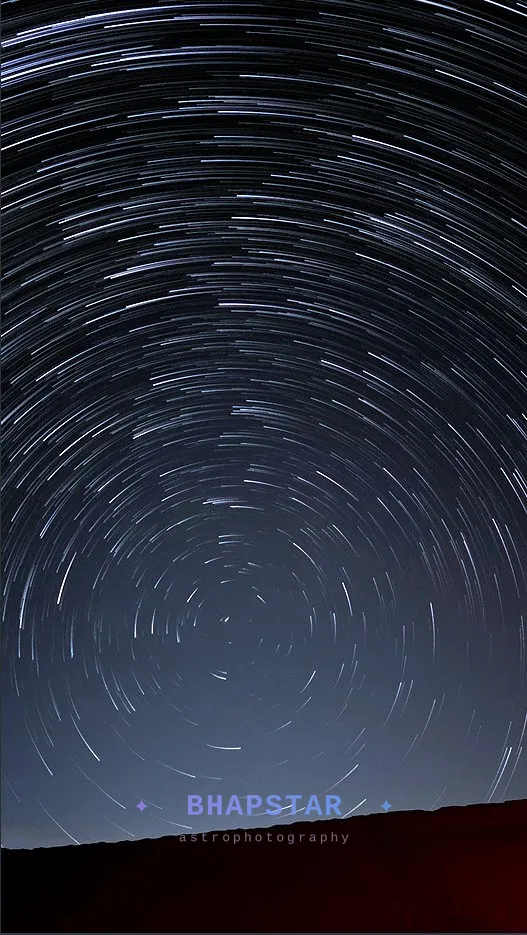
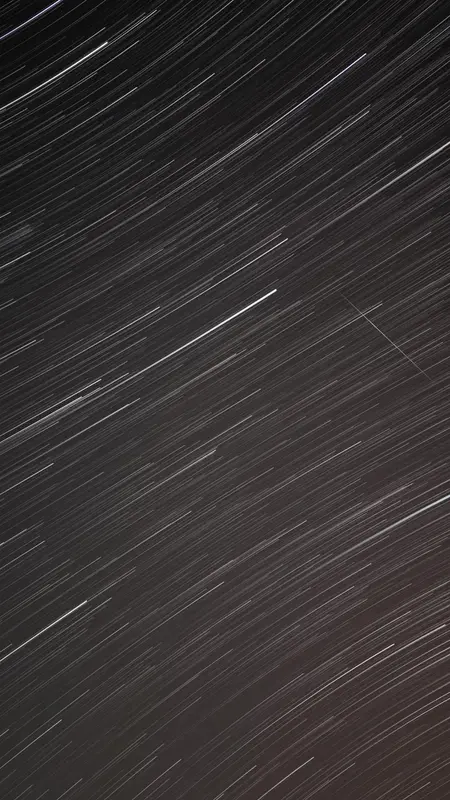
It is not the sky doing the moving. It is us. The Earth spins once a day, and from where we are standing it looks like everything else is going round instead. Leave a camera running for an hour and you can see it happen. The stars stop being dots and turn into curved streaks.
Because the sky looks like a dome with lights stuck to it, that is the easiest way to think about it. Astronomers call it the celestial sphere. Imagine a huge hollow ball with the stars painted on the inside and Earth sitting right in the centre.
The two spots that never move
If the sky is turning, it has to be turning around something. Picture Earth's axis, the invisible rod it spins on, poking out of the north pole and the south pole and carrying on into space. Where those two lines hit the sky are the celestial poles.
Everything else circles around them once a day. The poles themselves stay still.
This is exactly what a star trail photograph shows you. Point a camera at the pole and the trails come out as neat circles inside one another. Point it somewhere else and you get long sweeping arcs instead.
Polaris, the north star
We are lucky in the northern half of the world. There is a star sitting almost on top of the north celestial pole, and it is called Polaris.
Two things usually surprise people about it.
It is not very bright. Lots of people expect the north star to be the brightest thing up there and go straight past it looking for something more obvious. It is useful because of where it sits, not because it stands out.
And it is not quite on the pole. It is about two thirds of a degree off, which is a little more than the width of a full Moon. Close enough that it looks completely still to your eye all night. Not close enough for a telescope, which is why alignment apps ask you to put Polaris in a particular spot on a small circle rather than dead in the middle.
The south has no north star
The southern half of the world got a worse deal. There is nothing bright anywhere near the south celestial pole. The closest star to it is faint enough that you need a properly dark sky just to see it at all, so it is no use as a signpost.
Southern stargazers work around it. Take the long axis of the Southern Cross and carry it on about four and a half times further. Then take the two bright stars next to it, Alpha Centauri and Hadar, and draw a line at right angles through the middle of them. Where those two lines cross is close to the pole. Neither line is exact, but together they get you near enough to start from.
The celestial equator
Halfway between the two poles runs the celestial equator. It is just Earth's equator, projected out onto the sky.
It has one property worth remembering, because it is true from anywhere on the planet. Anything on the celestial equator rises exactly due east and sets exactly due west. Everything else rises a bit north or a bit south of east, depending on which side of the line it sits.
How high it climbs depends on where you are. From Dubai it reaches about two thirds of the way up the southern sky, which is generous, and is a big part of why so much is reachable from here.
The meridian
The meridian is the line that starts at due north on your horizon, goes straight up over your head, and comes back down at due south.
It is not stuck to the sky. It is stuck to you. Drive a few miles east and you have a new one.
Everything in the sky crosses your meridian once a day, and that crossing is the moment it is at its highest. That is the useful bit. If you want the cleanest view of something, look at it near the meridian, because that is when you are peering through the least amount of air and are furthest from whatever glow sits low on your horizon.
What that means from here
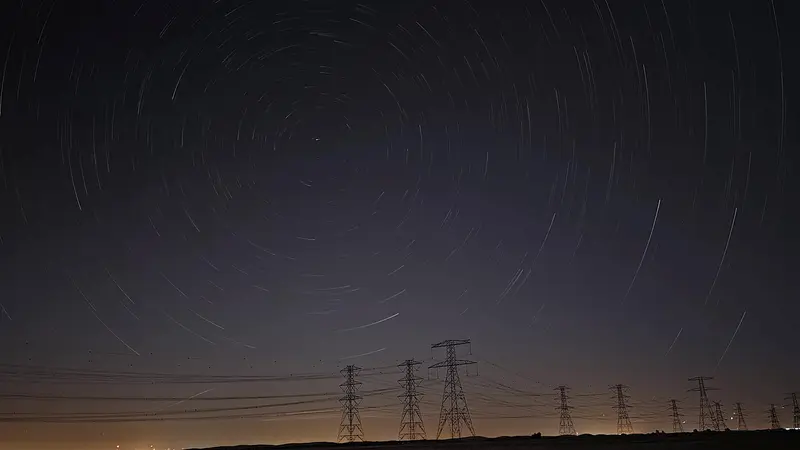
Here is the neatest rule in the whole article. The pole sits as high above your horizon as your latitude. That is it. From the UAE, at roughly 25 degrees north, the north celestial pole is about a quarter of the way up the northern sky.
Worth knowing before you set up, because that is fairly low. If there is a building or a dune to your north you may not be able to see Polaris at all.
The same number tells you what never sets. Anything within 25 degrees of the pole just goes round and round all night without ever dipping below the horizon. The Plough does not quite manage it from here, which is why Cassiopeia matters rather than being a footnote. There are hours when the Plough has gone and you need the other route to Polaris.
At the far end, anything within 25 degrees of the south celestial pole never rises for us at all. The Southern Cross technically scrapes above the horizon from the UAE, but only by a degree or two, so in practice it is buried in the murk. It stays on the list of things worth travelling for.
The sky's address system
Once you have the poles and the equator, giving anything an address is easy. It works like latitude and longitude, with two new names.
Declination is latitude. How far north or south of the celestial equator something is, in degrees. Zero at the equator, 90 at the poles.
Right ascension is longitude, and it is the one oddity: it is measured in hours rather than degrees. There are 24 hours all the way round the sky, so one hour is 15 degrees.
Those hours are not random. The sky turns 15 degrees every hour, so two things an hour apart in right ascension cross your meridian an hour apart. Once that lands, planning a night stops being guesswork.
| Word | What it means | Fixed to |
|---|---|---|
| Celestial pole | The spot the whole sky turns around. One north, one south. | The sky |
| Celestial equator | Earth's equator projected onto the sky. Rises due east, sets due west. | The sky |
| Ecliptic | The path the Sun traces over a year. The Moon and planets stay close to it. | The sky |
| Declination | How far north or south of the celestial equator, in degrees. | The sky |
| Right ascension | How far round the sky, in hours. 24 hours all the way round. | The sky |
| Zenith | The point straight above your head. | You |
| Meridian | North horizon, over your head, down to the south horizon. Things are highest crossing it. | You |
Why it matters with a telescope
All of this turns up the moment you put a telescope on a tripod.
An equatorial mount, like my Juwei 14, has one axis deliberately lined up with Earth's own. Aim that axis at the celestial pole and a single slow motor cancels out the sky's rotation completely. That is what polar alignment is, and it is why the mount has a latitude setting on it. Here it gets set to 25.
It also explains something that catches people out with smart telescopes. Left flat, they track by swivelling and tilting at the same time, which keeps the target centred but slowly rotates the picture around it. The TH10 head under my Seestar S30 Pro is there purely to tilt the whole telescope over by that same 25 degrees so it can point at the pole instead. Nothing else about it changes, and the exposures it can hold go from about half a minute to a full minute.
Go and try it
The fastest way to make any of this stick is to stand outside and use it.
Find Polaris from the Plough. Then hold your arm straight out. A spread hand is roughly 20 degrees across and your little finger is about one degree, so you can measure how high Polaris sits and check it against your latitude. Then turn round and face south, and watch something come up exactly due east.
Use a stargazing app as well, by all means. But an app tells you where things are, and it does not really tell you why. The geometry is worth carrying in your head, because it is the same geometry whether you are lining up a mount, planning a night, or explaining to forty people in the desert why the whole sky is quietly wheeling around one fairly ordinary star in the north.