The short version
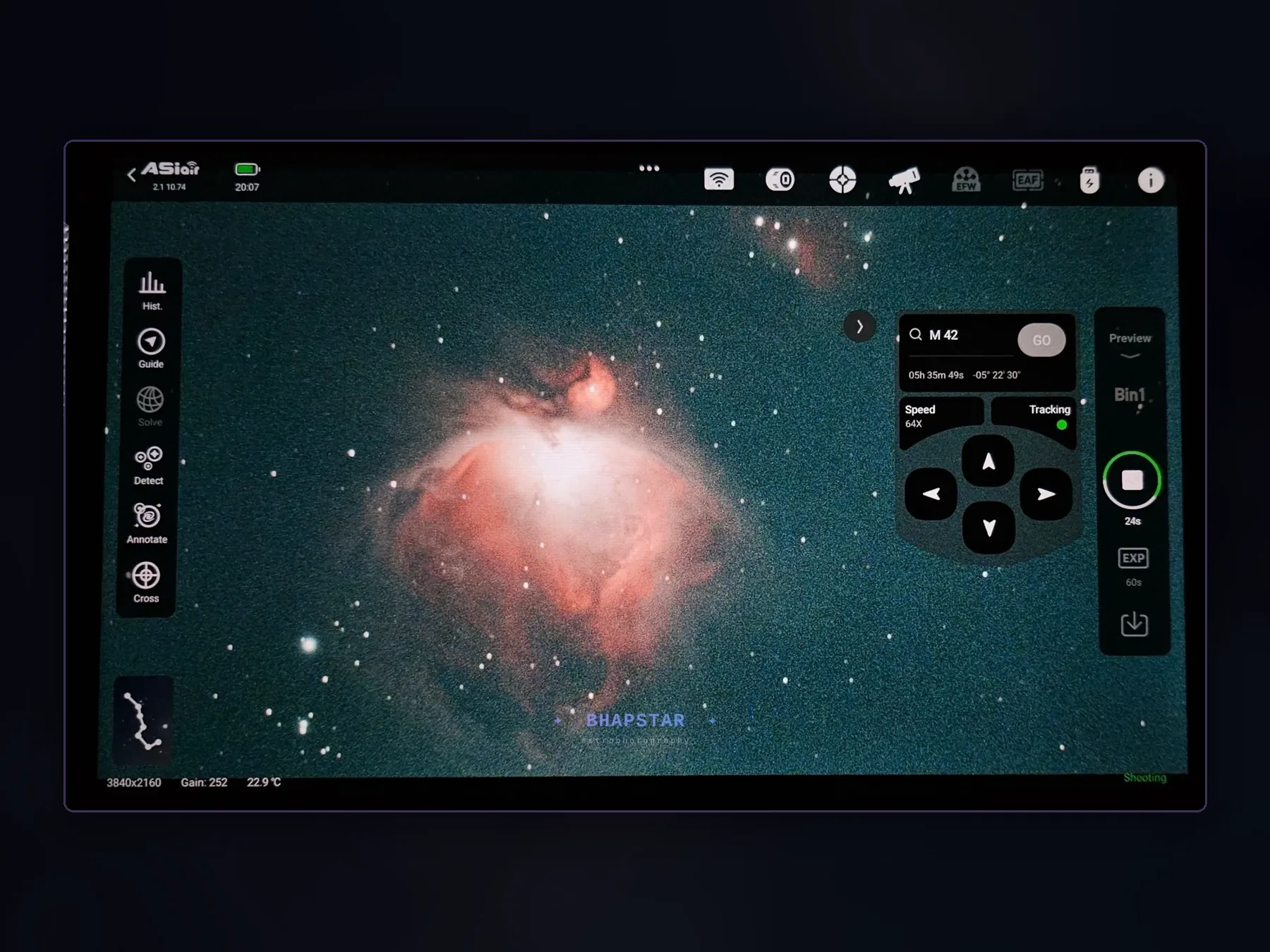
Everything plugs into one box on the telescope, and you run the night from a phone or tablet.
It replaces the laptop, the extension lead, the folding table and the long cable back to the house. Plate solving, autofocus, guiding and the whole imaging sequence are driven from whichever screen you are holding, and shortening the cable runs to a few centimetres on the scope itself removes most of the failures that lose a session. The cost is a closed ecosystem: ZWO cameras and a defined list of mounts, rather than anything that speaks ASCOMA shared language that lets astronomy software and hardware from different makers talk to each other, so a mount from one company works with software from another..
What it actually is
An ASIAirA small controller from ZWO that runs the mount, camera and focuser from a phone or tablet. It replaces the laptop at the telescope. is a small Linux computer with a handful of USB ports, a 12 volt input, a few switched power outputs and its own Wi-Fi radio. It sits on the telescope, everything else plugs into it, and you control the entire rig from a phone or tablet. That is the whole idea. It replaces the laptop, the extension lead, the folding table and the long trailing cable that used to run back to the house.
Either works, and the app is identical on both. In practice I use a tablet almost every time. The preview frame is what you spend the night looking at, and checking focus, framing and star shape is easier on a larger screen, particularly when the target sits near the edge. The autofocus curve and the guiding graph are both easier to read at a glance too. A phone is still the better thing for a quick look from indoors, or as a spare if the tablet is flat, and you can move between the two mid-session without disturbing anything, because the run lives on the box rather than on the screen.
It matters more than it sounds. Almost every session I have lost was lost to something mundane — a USB cable working loose in the cold, a laptop lid closing, a hub dropping a device mid-run. Shortening the cable runs to a few centimetres on the scope itself removes most of that class of failure at a stroke.
A night, in the order it happens
The app is arranged around the sequence a session actually follows, which is the reason it is quick to learn even if you have never used capture software before.
Polar alignment
The routine takes two exposures a set distance apart in right ascensionThe sky's version of longitude. It is measured in hours rather than degrees, going all the way round from 0h to 24h., plate-solves both, works out where your polar axis actually points and then draws live arrows telling you which way to turn the altitudeHow high something is above the horizon, measured in degrees. Zero is the horizon and 90 is straight overhead. The higher it is, the less air you are looking through. and azimuthThe compass direction of something, measured round the horizon from north. Due east is 90 degrees. bolts. It does not need PolarisThe bright star that sits almost exactly above the Earth's northern axis. It barely moves all night, which is why polar alignment usually starts by pointing at it. to be visible, which is the single most useful thing about it if you image from a balcony with an obstructed north.
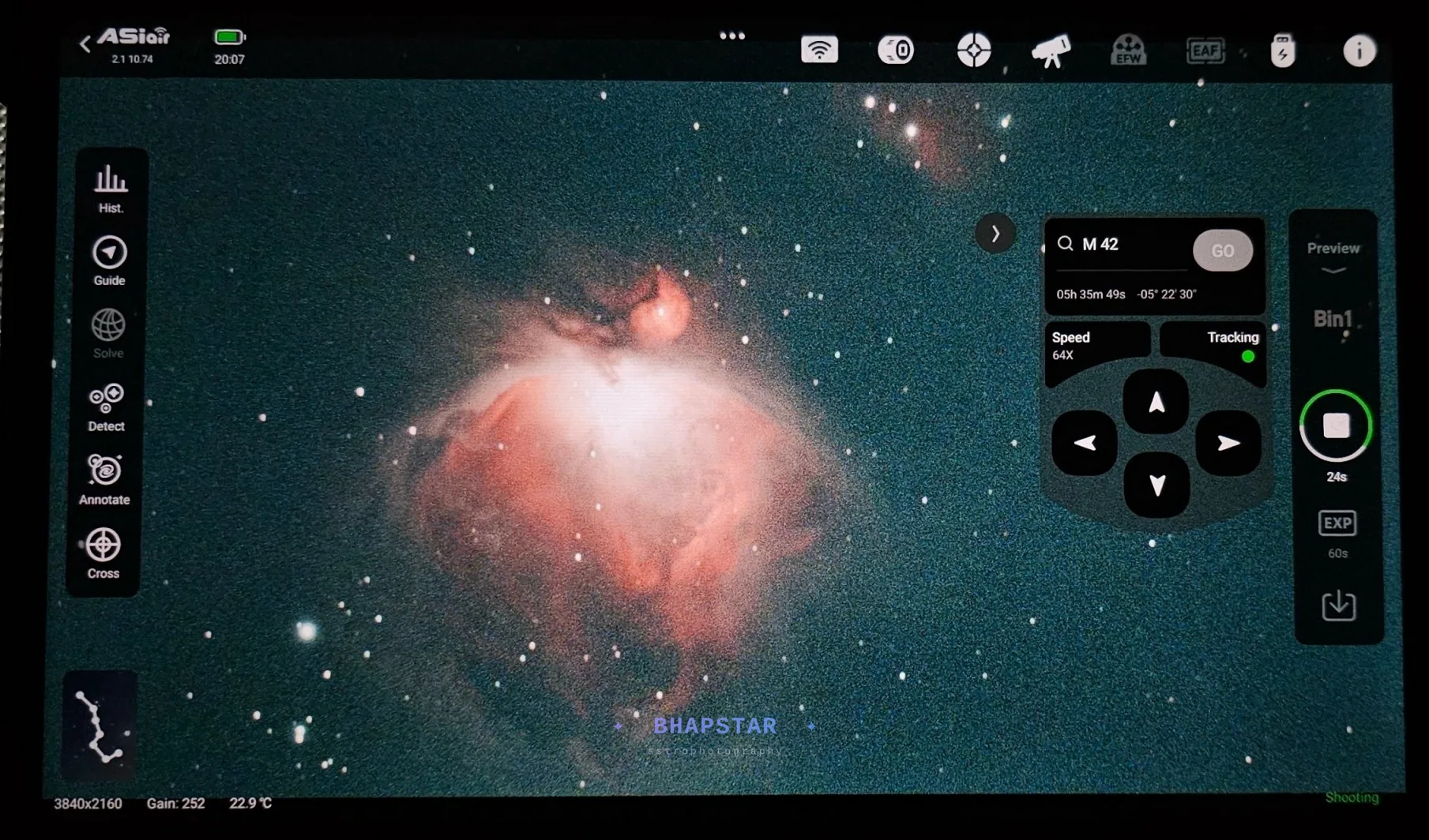
Plate solving and goto
Plate solving is the feature that changes the hobby. The camera takes a short exposure, the software identifies the star pattern against a catalogue, and the mount then knows precisely where it is pointing rather than where it believes it is pointing. Ask for a target, and it will slewThe mount moving quickly from one part of the sky to another., solve, correct and re-solve until the object is on the pixel you asked for. Star alignment routines, hand controllers and finder scopes all become optional.
Autofocus
With an electronic focuser attached, the ASIAir steps the focuserThe part that slides the camera in and out until the stars are sharp. An electronic one does it with a small motor, on command. through a range of positions, measures star size at each, fits a V-curvePlot how big the stars look against where the focuser is, and you get a V shape. The bottom of the V is perfect focus. and returns to the minimum. It takes about a minute and it is more accurate than I am with a Bahtinov maskA slotted cover placed over the front of a telescope. It turns a bright star into crossed spikes that line up only when the focus is exactly right.. More to the point it can be set to repeat automatically every hour or after a given temperature drop, which is what actually keeps a long night sharp — a refractorA telescope that uses lenses to gather light, like a very good spotting scope. The other main type uses mirrors instead. moves focus measurably as the tube cools.
Autorun, guiding and dithering
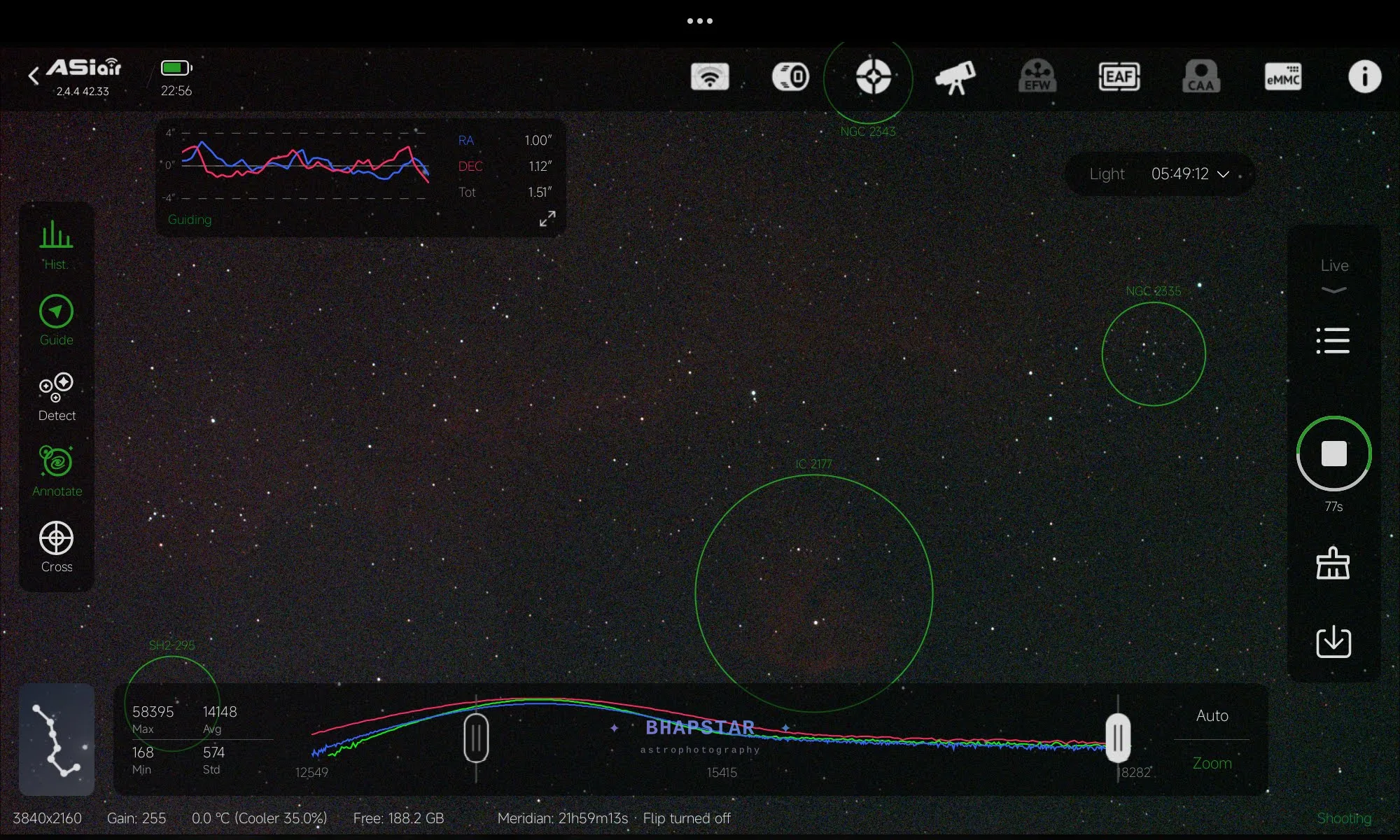
Autorun is the plan: a list of exposures, a count, a filter, and optionally several targets in sequence. Guiding runs alongside it, making small corrections from the guide sensor, and ditheringShifting the aim by a few pixels between frames on purpose. Faults in the sensor then land somewhere different each time and average away in the stack. nudges the mount a few pixels between frames so that fixed sensor noise lands in a different place each time and averages away during stacking. Dithering is free and it is the cheapest noise reduction available; leave it on.
Live is the other way to spend the same night. Instead of writing frames away for later, the box stacks them as they arrive and shows the result building on the screen, getting cleaner every minute. It is the wrong choice if you want the best possible picture, because you keep the stack rather than the frames that made it, and it is the right choice if there are people standing next to you. On a public night in the desert, a nebula appearing on a tablet in real time does more than any finished image shown a week later.
Where it is strong, and where it is not
The strength is integration. Everything talks to everything else, nothing needs configuring, and there is no driver layer to go wrong. Frames are written to the onboard storage, so a tablet going flat or wandering out of range does not stop the run — the box carries on regardless, which is exactly what you want at three in the morning.
The cost of that is a closed ecosystem. It expects ZWO cameras, and it supports a defined list of mounts and accessories rather than anything that speaks ASCOM. If you already own a camera from another manufacturer, this is not the controller for you, and a mini PC running NINAA free Windows program that runs an imaging session from a laptop, controlling the mount, camera and focuser through the night. will be more flexible and considerably more work. It is a deliberate trade: less choice, far fewer things to debug in the dark.
Four things worth knowing before your first night
- Station mode is better than the default. Out of the box the ASIAir broadcasts its own network, which means your phone or tablet leaves your home Wi-Fi to connect to it. Joining it to your house network instead lets you keep both, and lets you check on a run from inside.
- Give it a proper power supply. A single 12 V feed runs the controller, a cooled camera, the mount and the dew heatersA low-power heater strip wrapped round the front of the telescope. Holding the glass a degree or two above the air temperature is enough to stop dew ever forming on it.. Undersized supplies cause failures that look like software faults, especially when cooling and slewing happen at the same time.
- Take flats before you take anything down. The moment the camera rotates in the focuser, that night's flats stop matching. It is a two-minute job at the end of the session and it saves a re-shoot.
- Copy the data off before the card fills. The onboard storage is generous but not infinite, and a night of short subframesOne single exposure out of the many that get stacked together. Sixty subs of one minute each make one hour of data. fills it faster than expected.
Everything in the recent gallery was captured this way, on the Askar V riding the Juwei 14. If you want to see what the box is actually plugged into, the rig tour walks through every part of it. Once the sequence is running the work moves indoors, which is where Siril takes over.