The Bubble Nebula (NGC 7635)
The Bubble Nebula is a round shell of gas in Cassiopeia, blown out by a single star. The star is so hot and so bright that the wind coming off it has pushed the gas around it into a bubble.
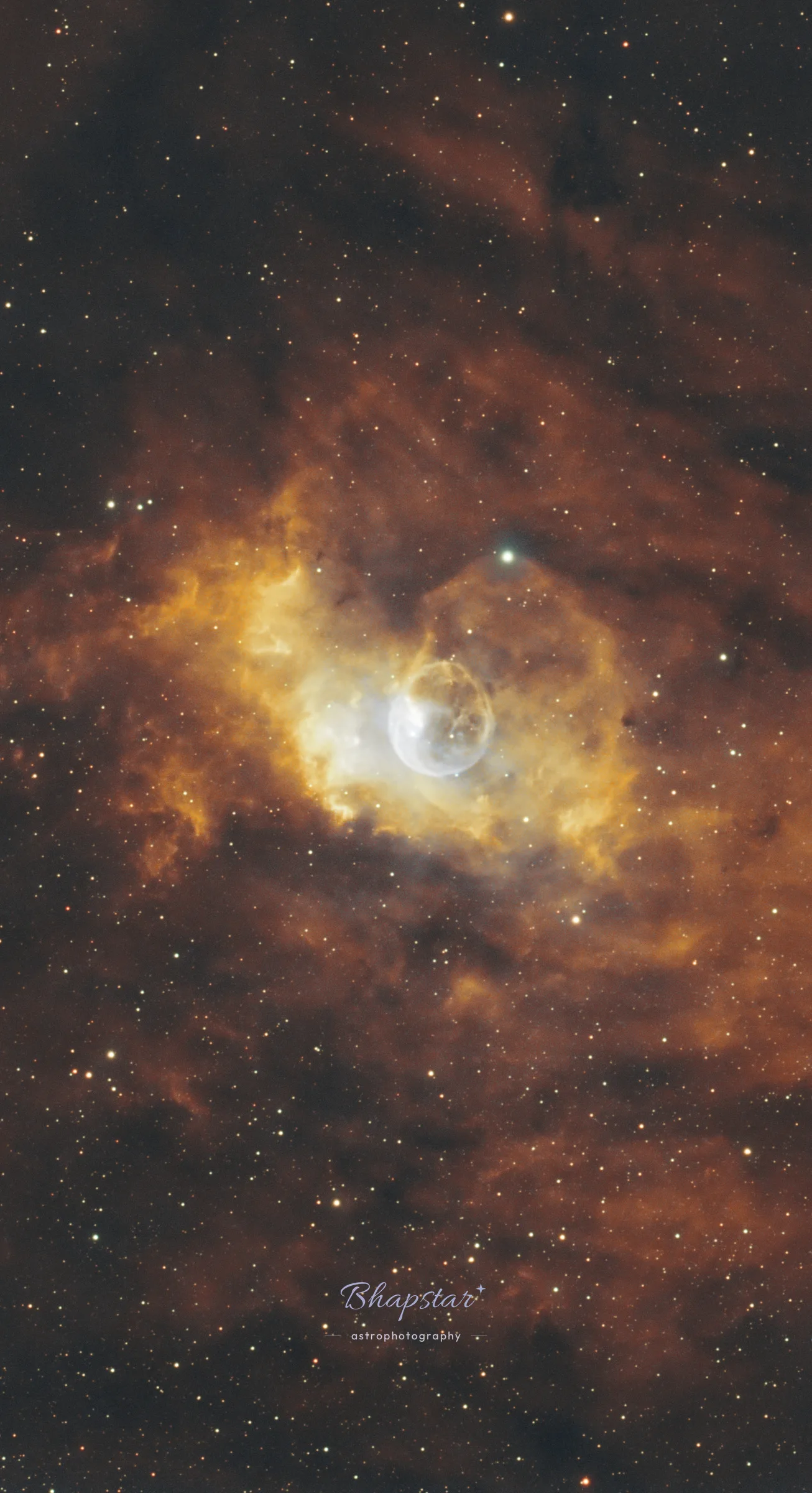
The Bubble lies about 7,100 light-years away in Cassiopeia. The bubble itself is about 7 light-years across, more than one and a half times the distance from the Sun to the nearest other star. It sits inside a much bigger cloud of glowing gas, which fills the rest of the picture. William Herschel found it in 1787.
The bubble is made by one star, about 45 times heavier than the Sun. It is so hot that it blows out a constant stream of gas, called a stellar wind, at more than 6 million kilometres an hour. That wind pushes into the cooler gas around the star and piles it up, like a snowplough pushing snow. The edge of that pile is the thin shell you can see.
The star is not in the middle of its bubble. On one side the bubble has run into thicker gas, which slows it down, so it has grown further the other way. The star is about 4 million years old, which is young for a star. It uses up its fuel so quickly that it will probably explode as a supernovaThe explosion of a dying star, briefly bright enough to rival its whole galaxy. What is left behind is a shell of gas thrown outwards at enormous speed, still glowing thousands of years later. That wreckage is the remnant. in 10 to 20 million years.
From the UAE the Bubble is an autumn target. It climbs to just over 50 degrees above the northern horizon, and in early November it is highest at around 9pm.