The Elephant's Trunk Nebula (IC 1396A)
The Elephant's Trunk is a long, dark column of gas and dust reaching into the middle of ICThe Index Catalogue, two additions to the NGC published in 1895 and 1908 that listed more than 5,000 extra objects. IC 443 means number 443 on that list. 1396, a huge glowing cloud in Cepheus. Its bright edge shows where starlight is slowly wearing it away.
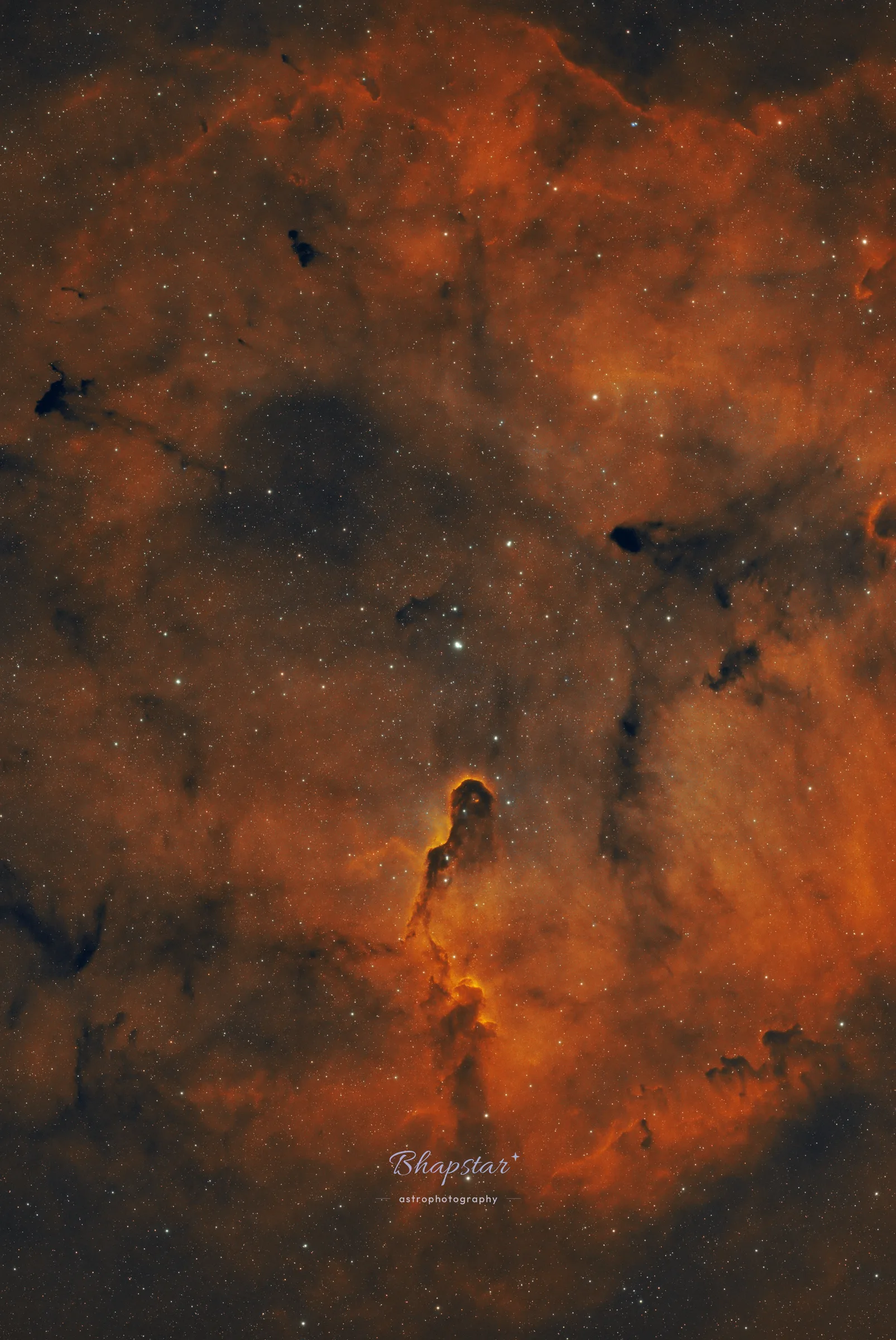

IC 1396 lies about 3,000 light-years away in Cepheus. It covers around three degrees of sky, about six times the width of the full moon, and this frame shows most of it. Edward Barnard found it on a photograph in 1893.
The cloud glows because of a group of very hot, very big stars near the middle of the picture, called HD 206267. Their light makes the gas around them shine, and over time it pushes that gas away. The Elephant's Trunk (IC 1396A), just below the centre, is a thicker patch of gas and dust. It is harder to push away, so it has stayed behind while the thinner gas around it was cleared. It is more than 20 light-years long. The bright curl at its tip is the part facing the stars, where their light hits it hardest.
The same starlight is also squashing the trunk, and that is helping new stars to form inside it. The dust hides them, so normal cameras cannot see them. In 2003 the Spitzer Space Telescope, which can see heat (infrared light) through dust, spotted young stars inside the trunk. The other dark blobs and streaks in the picture are thick clouds like this one.
From the UAE the Elephant's Trunk is a late summer and autumn target. It climbs to almost 60 degrees above the northern horizon, and in early November it is highest soon after dark.