The Triangulum Galaxy (M33)
M33 is the third-largest galaxy in the Local Group, the group of galaxies that includes the Milky Way and Andromeda. It is a face-on spiral in Triangulum, with faint, spread-out arms and bright HII regionsA cloud of hydrogen gas lit up by hot young stars inside it, so it glows pink-red. In other galaxies they show up as small pink knots along the spiral arms..

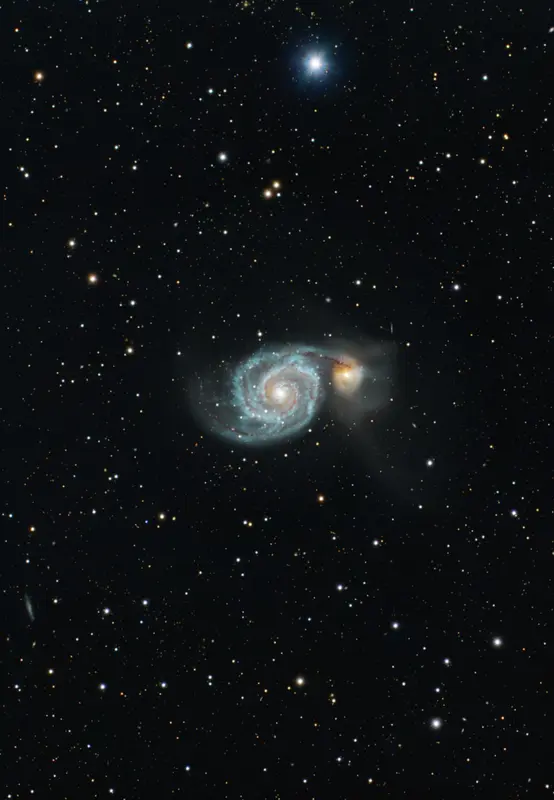
MessierA list of 110 fuzzy objects in the sky, started by the French astronomer Charles Messier in the 1700s so he would not mistake them for comets. M42 means number 42 on his list. 33 lies around 2.73 million light-years away in the small constellation Triangulum, making it one of our closest galactic neighbours after Andromeda. Despite its relative proximity, it has an extremely low surface brightness - its light is spread across a large apparent area, making it notoriously difficult to detect visually and requiring significant integrationThe total time of every frame added together. Three hours of integration might be one hundred and eighty frames of one minute. time to photograph well.
Within its arms sit some of the largest and brightest HII regions known - NGCThe New General Catalogue, a list of nearly 8,000 nebulae, star clusters and galaxies published in 1888. NGC 2244 means number 2244 on that list. 604 in particular is a giant star-forming complex that dwarfs anything in the Milky Way, visible as a bright knot within the spiral arm structure.
The more integration time you give the Triangulum Galaxy, the more its faint outer arms and the HII regions within them emerge from the background, so it is a target worth coming back to.