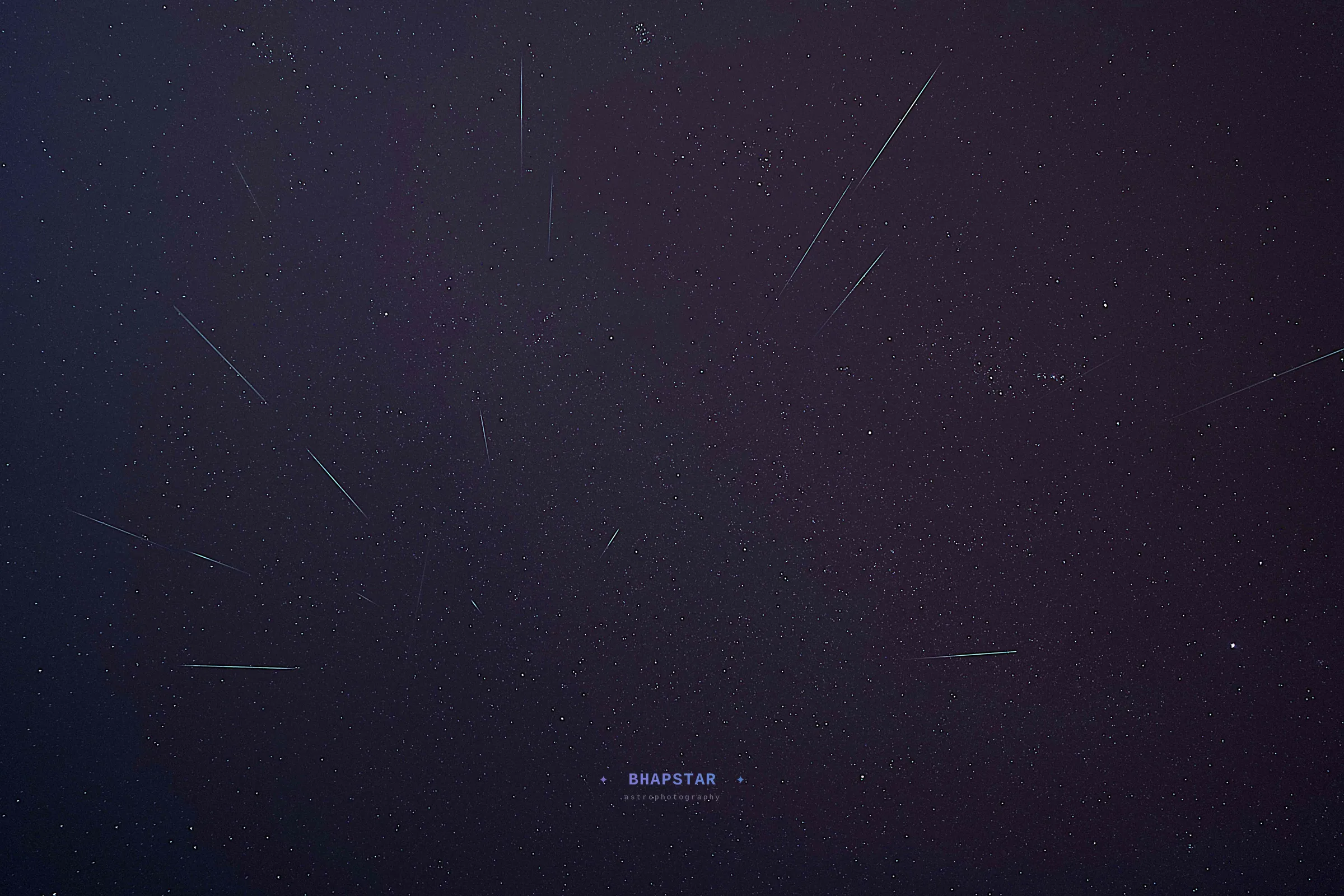
Community viewing
Perseids on the lawn — evening of Wednesday 12 August
I will be set up on the community lawn from around 9pm on the evening of Wednesday 12 August, and staying out well past midnight. Anyone is welcome to come along, with a camera or without one. Bring something to lie back on — a picnic blanket or a reclining chair beats standing and craning your neck — and please keep phone screens dimmed and torches red once your eyes have adjusted. Full darkness takes about twenty minutes to arrive and one white torch beam undoes it for everybody.
2026 is the good year
The Perseids peak on the night of 12–13 August, and this year the peak falls on a new moon. That is as good as the conditions get. In an average year the moon washes out everything but the brightest meteors; in 2026 the sky stays properly dark all night, and under a decent sky the shower can deliver in the region of a meteor a minute at its best.
Rates build through the night. In the early evening the radiant — the point in Perseus the meteors appear to stream away from — is still low in the north-east, so most of the shower is happening below the horizon. By midnight it is well up, and by the small hours the Earth has rotated to face into the stream head-on. If you can only stay out for part of it, stay late rather than arriving early.
What to bring
A camera that shoots manual and RAW, the widest and fastest lens you own, and a tripod that will not creep. That is genuinely it. A full-frame body like the Sony A7 III makes life easier because it holds ISO 3200 without falling apart, but any camera with manual control will catch a bright Perseid. There is more on the bodies and lenses I use over on the gear pages.
Lens choice is about coverage. A meteor lands somewhere random in the sky, so the more sky you have in frame, the better your odds — and a fast aperture matters because the streak is over in a fraction of a second, so it either records in that instant or it does not. A 14mm or 18mm at f/2.8 is close to ideal: wide enough to cover a large slice of sky, fast enough to register the meteor, and inexpensive in manual-focus form. The other things worth having are a spare battery or two, a remote release that locks on, and a lens cloth. In August here, dew on the front element is the thing most likely to end your night early.
Settings
Set everything manually and then do not touch it again. Autofocus, auto ISO and auto white balance will all hunt in the dark and produce an inconsistent set of frames.
| Setting | Use | Why |
|---|---|---|
| Mode | Manual | Nothing should change between frames |
| File | RAW | You will lift shadows heavily later |
| Aperture | f/2.8, wide open | The meteor is instantaneous; light gathered per instant is all that counts |
| ISO | 3200 dark site, 1600–2500 suburban | High enough to record faint trails, low enough to keep the sky from clipping |
| Shutter | 20s at 14mm, 15s at 18mm | Long enough to be efficient, short enough that stars stay points |
| Focus | Manual, on a bright star | Magnify to 100× in live view and nail it — the infinity mark is not reliable |
| White balance | Manual, around 4000K | Consistent colour across hundreds of frames |
| Long exposure NR | Off | It doubles your dead time, and every gap is a meteor missed |
| Stabilisation | Off | On a tripod it introduces drift rather than removing it |
| Drive | Continuous, remote locked on | Shoot without pause for hours |
How long an exposure before stars trail?
The old rule of thumb divides 500 by the focal length. It dates from film and it is too generous for a modern sensor viewed at full size. The NPF rule accounts for aperture and pixel size and gives a stricter, more honest answer. Both are plotted below for a 24-megapixel full-frame body at f/2.8.
Composition, and then patience
A frame of nothing but sky is a technical record. Put something in the bottom of it — a tree line, a building edge, a person looking up — and it becomes a photograph. Because you are shooting hundreds of frames from a fixed position, the composition you choose in the first five minutes is the one you live with, so it is worth spending those five minutes.
Then start the intervalometer and stop looking at the camera. Lie back and watch. The camera will catch what it catches, and the reliable way to miss the best meteor of the night is to be hunched over the screen reviewing the last frame when it goes over. Expect most frames to be empty; over a good few hours a handful will not be, and one or two of those will be worth keeping.
Afterwards
You will come home with several hundred near-identical frames. There are three useful things to do with them. Pick the single best meteor frame and process it as a normal wide-field night shot. Or composite several meteors onto one sky — legitimate as long as you say that is what you did. Or ignore the meteors entirely and stack the whole run into a star trail, which is a free second image from data you already have.
All of it processes happily in Siril, and if all you have on the night is the phone in your pocket, that works too.