The Whirlpool Galaxy (M51)
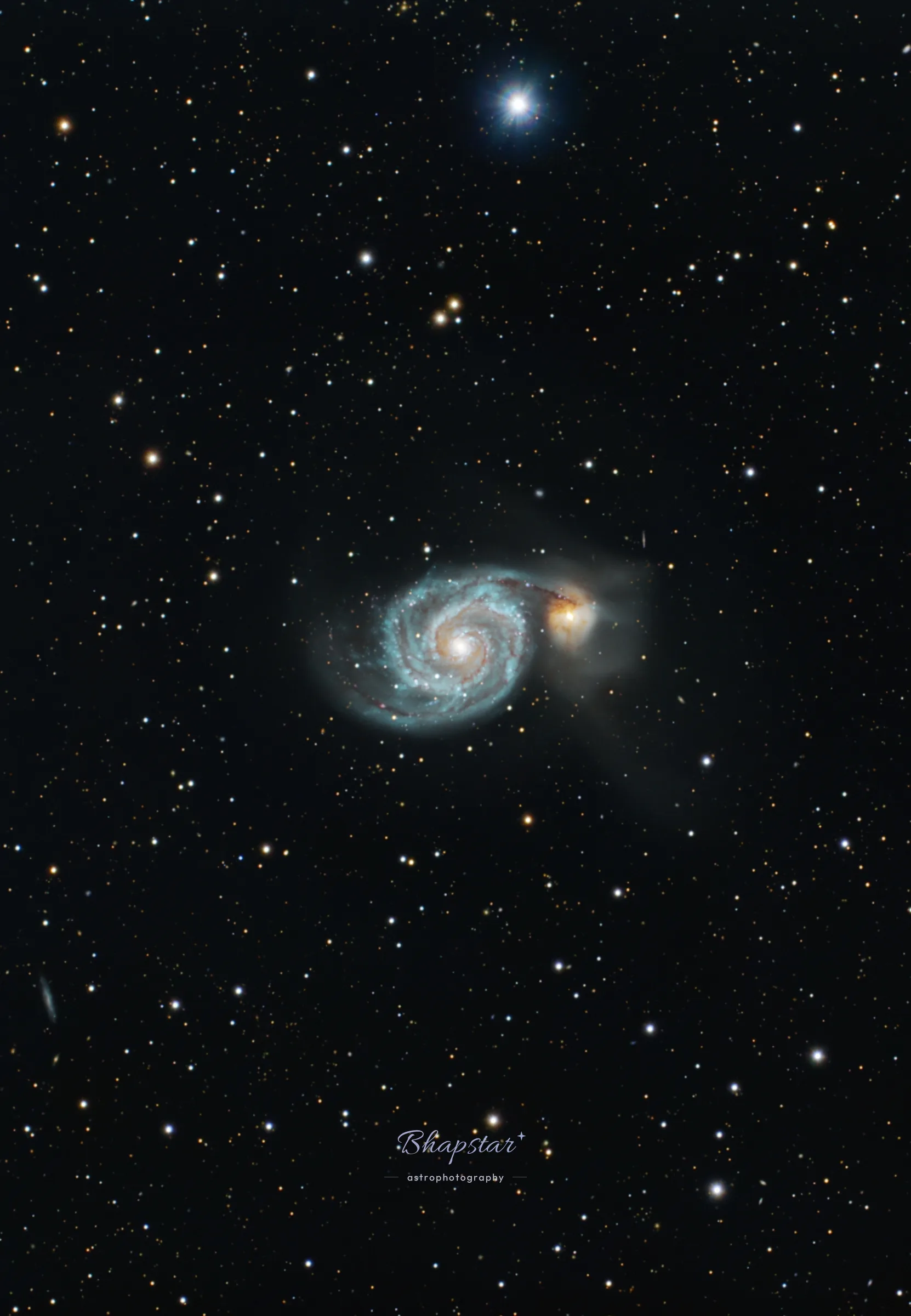
The Whirlpool is a spiral galaxy that we see face-on, so its arms wind neatly around its bright centre. A smaller galaxy, NGCThe New General Catalogue, a list of nearly 8,000 nebulae, star clusters and galaxies published in 1888. NGC 2244 means number 2244 on that list. 5195, sits at the end of one of those arms.
The Whirlpool lies around 30 million light-years away in Canes Venatici, near the end of the Big Dipper's handle. It is a little smaller than our own Milky Way. Charles MessierA list of 110 fuzzy objects in the sky, started by the French astronomer Charles Messier in the 1700s so he would not mistake them for comets. M42 means number 42 on his list. found it in 1773, and Pierre Méchain spotted the small companion in 1781. In 1845 Lord Rosse looked at it through what was then the biggest telescope in the world and saw its spiral shape. It was the first galaxy ever seen to have one.
The two galaxies are pulling on each other. The small one passed close to the Whirlpool millions of years ago, and astronomers think that is why the Whirlpool's arms are so clear and bright. The pull squeezed the gas in the arms, and squeezed gas makes new stars. The blue in the arms is light from those young stars, and the small pink spots are clouds where more stars are forming now.
From here it looks as if one arm reaches out and touches the small galaxy, but the small galaxy is actually behind it. The dark line across its face is dust in the Whirlpool's arm, passing in front of it. The faint grey wisps around the small galaxy are stars and gas pulled loose when the two met.
From the UAE the Whirlpool is a spring target. It climbs to almost 70 degrees above the northern horizon, and in mid April it is highest around midnight.