The short version
You do not chase meteors. You point at a good patch of sky and wait.
A meteor lasts a fraction of a second, so the only thing that decides whether you catch one is how much of the night your shutterHow long the camera collects light for one frame. Twenty seconds means the sensor is gathering light for twenty seconds before the frame is saved. was open. Set the camera or the phone going, take hundreds of frames, and let the sky come to you. Every frame you take is also a Milky Way picture, so a quiet night is never a wasted one.
The showers worth planning around
Meteor showers happen when the Earth passes through the dust left behind by a comet or an asteroid. Because that is an orbit rather than an event, the same showers arrive on roughly the same dates every year. You can plan a whole year of them in advance.
These are the ones worth clearing a night for.
| Shower | Peak | Rough rate at a dark site | Worth knowing |
|---|---|---|---|
| Quadrantids | 3 to 4 January | 25 to 50 an hour | The peak is very short, often only a few hours. Get the night right or miss it entirely |
| Lyrids | 22 to 23 April | 10 to 20 an hour | Modest, but it breaks the long gap between January and August |
| Eta Aquariids | 5 to 6 May | 20 to 40 an hour | Dust from Halley's Comet. Fast, and best in the hours before dawn |
| Perseids | 12 to 13 August | 50 to 80 an hour | Warm nights and a high radiant make this the easiest one to sit through |
| Orionids | 21 to 22 October | 10 to 20 an hour | Halley's Comet again, from the other side of its orbit |
| Leonids | 17 to 18 November | 10 to 15 an hour | Quiet most years, with occasional storms decades apart |
| Geminids | 13 to 14 December | 60 to 100 an hour | The best of the year. Bright, slow, and coming from an asteroid rather than a comet |
| Ursids | 22 to 23 December | 5 to 10 an hour | Small, and easy to combine with the Geminids the week before |
Those rates are what a patient person sees by eye at a genuinely dark site, with the radiant high and the moon out of the way. Published figures are often higher because they describe an idealised sky. Your camera will record fewer than your eyes do, because it is only looking at one part of the sky at a time.
Check the moon before you check anything else
This is the step that decides the night. A bright moon washes the sky out in exactly the way a city does, and it will hide most of the fainter meteors along with the Milky Way behind them. A shower peaking two days after full moon is worth skipping. The same shower on a moonless night is a different experience altogether.
Any stargazing app will show you the moon phase and, more usefully, what time the moon rises and sets. A shower peaking on a bright night is often still worth shooting in the window after the moon has set, even if that window is only from three in the morning.
Point away from the radiant
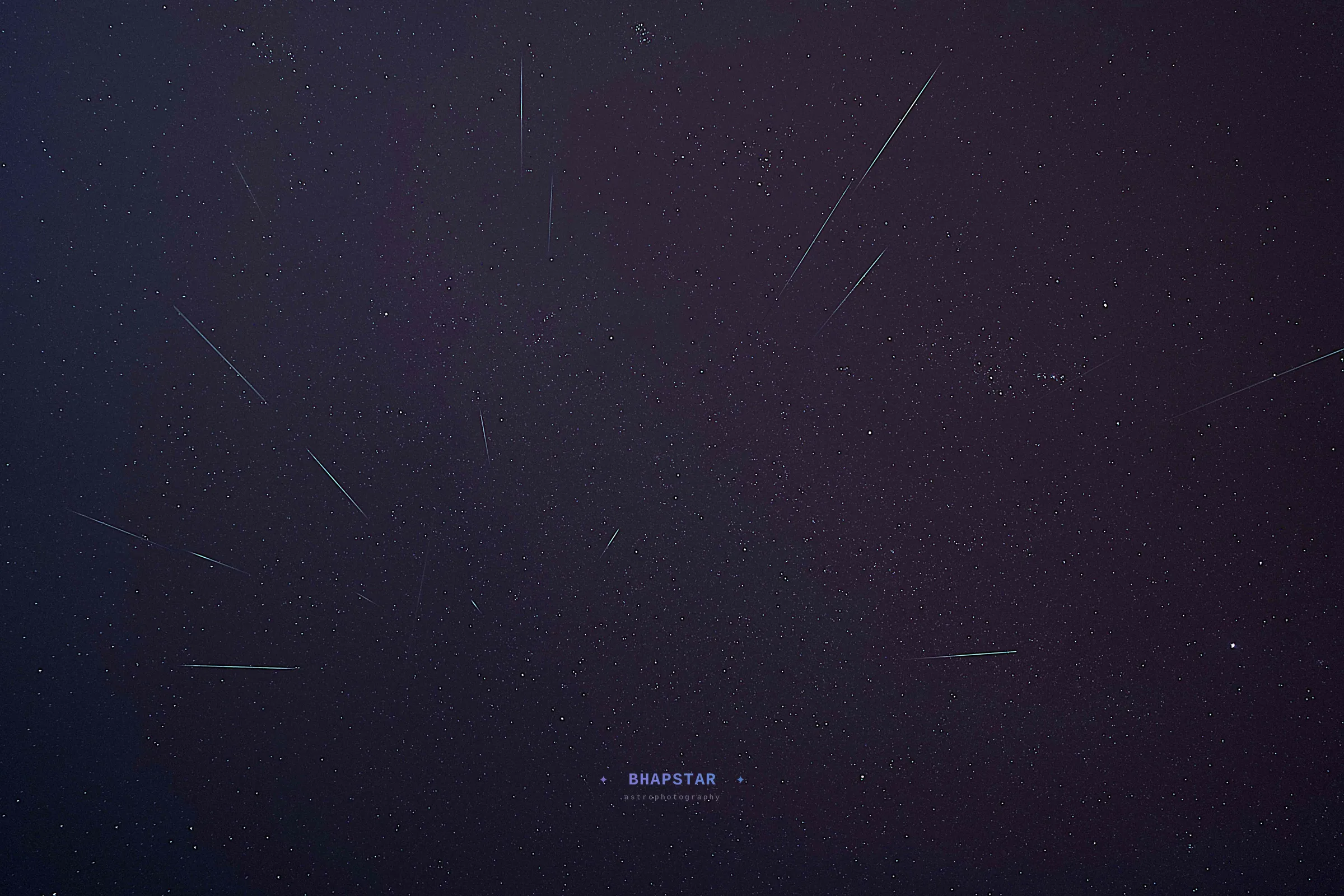
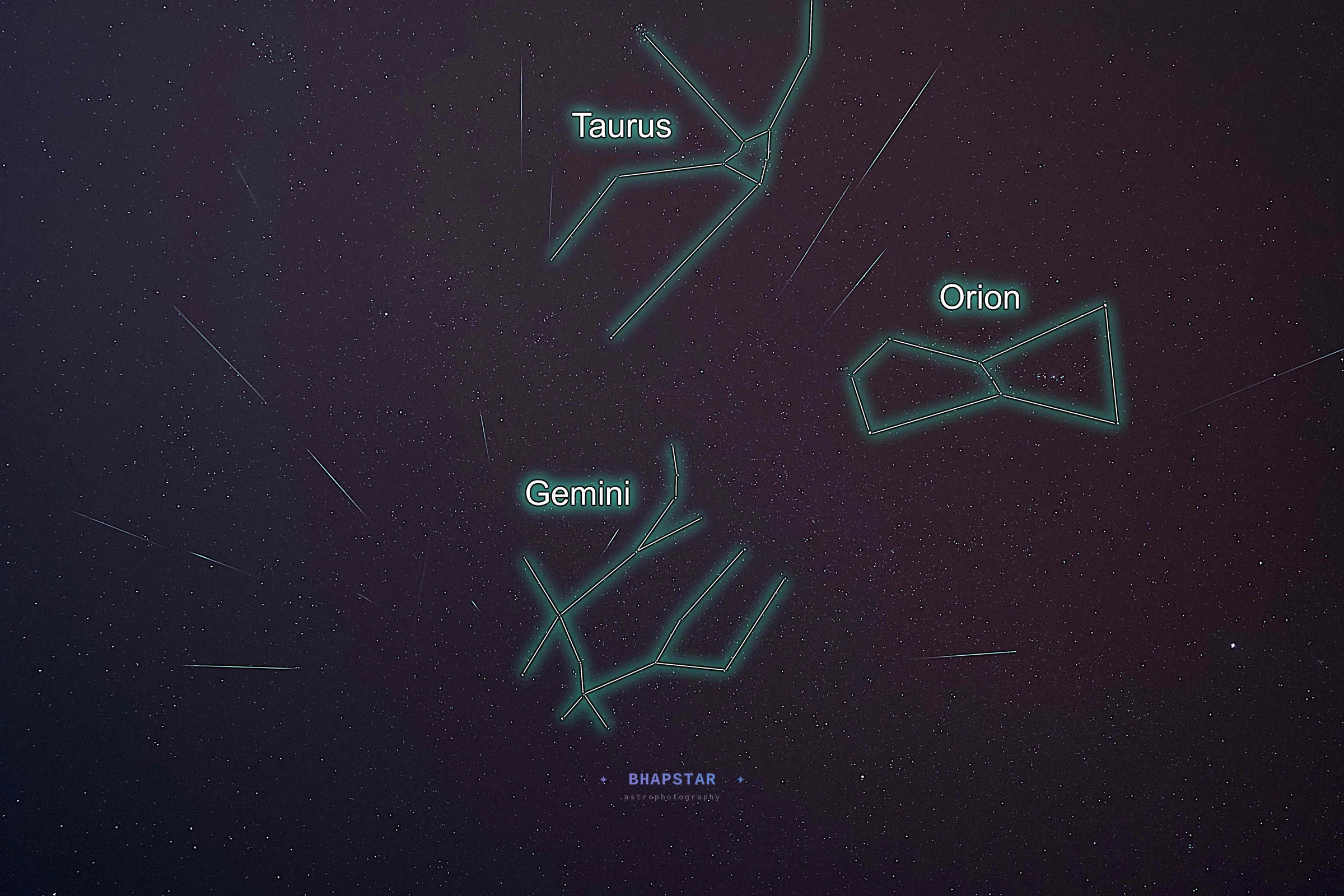
Every shower appears to stream out from one point in the sky, called the radiant, and each shower is named after the constellation it sits in. The Geminids radiate from Gemini, the Perseids from Perseus.
The instinct is to point the camera straight at it. Do the opposite. Meteors near the radiant are travelling almost directly towards you, so they appear as short stubs. The long, photogenic ones are always well off to the side, roughly 40 to 60 degrees away.
That leaves you a lot of freedom. Anywhere high and dark will do, so use the freedom to pick the direction with the least streetlight and the best foreground. A tree line, a dune ridge or a building edge along the bottom of the frame turns a record into a picture.
Stay late
Rates almost always build through the night. Early on, the radiant is still low and a large part of the shower is happening below the horizon where you cannot see it. By the small hours the Earth has turned to face directly into the stream of dust, and you are on the leading side rather than the trailing one.
If you can only be out for part of the night, arrive late rather than leaving early. The hours between two and five in the morning are usually worth more than the whole evening before them.
What to shoot with
Both work, and neither needs anything special beyond a tripod.
A phone will do this, particularly on a night with bright meteors like the Geminids. Use night mode on a tripod, or a Pro mode set to around 20 seconds at ISOHow strongly the camera amplifies the light it has collected. A higher number makes a dark scene look brighter, but it also makes the picture grainier, so you use the lowest number that still shows the sky. 3200, and fire it repeatedly. If your phone has a timelapseHundreds of still frames played back one after another as a short video, so hours of sky movement pass in seconds. or interval option that keeps the individual frames, set that going instead of tapping the shutter all night. The full phone guide covers where that mode lives on an iPhone, a Pixel and a Samsung.
A camera gives you more, mostly because it will run unattended for hours. Manual mode, RAWThe camera's unprocessed file, holding everything the sensor recorded. A JPEG throws most of that away, and you need it when you come to brighten a very dark picture., the lowest f-numberThe focal length divided by the width of the lens, written like f/5.8 and often called the f-number. Smaller numbers gather light faster, so you need less time on the target, but focus becomes more critical. your lens has, ISO 3200 at a dark site, and a shutter around 15 to 20 seconds on a wide lens. Lock the intervalometerA timer that presses the camera's shutter over and over on its own, so you can take hundreds of frames without touching it. Many cameras have one built into the menus, and if yours does not, a small plug-in remote does the same job. on and leave it. The full camera guide has the complete settings table and the exposure limits for each focal lengthHow much a lens or telescope magnifies, measured in millimetres. A small number gives a wide view of the sky, a large number a narrow, closer one..
One adjustment applies to both. If you are used to a long night mode, such as the four minute astrophotography exposure on a Pixel, shorten it. A meteor that lands in a four minute frame is competing with four minutes of accumulated skyglowThe glow of that scattered artificial light coming back down at you. It is what makes a city sky look washed out rather than black.. The same meteor in a 20 second frame stands out sharply.
Take far more frames than feels sensible
This is the whole trick, and it is worth being blunt about the numbers. One exposure is a lottery ticket. Thirty is a fair chance of something. A few hundred, across two or three hours, is how people come home with the shot.
Expect most of your frames to contain nothing at all. That is completely normal and not a sign anything is wrong. Across a good night a handful will have a meteor in them, and one or two of those will be keepers. Meanwhile every single frame is also a Milky Way exposure, which is why this is such a forgiving thing to attempt.
A few practical things that decide whether you last the night:
- Bring more power than you think. Two spare camera batteries, or a power bank for a phone. Cold drains both faster than you expect.
- Check the card space before you leave. Three hours of 20 second exposures is around 500 RAW files.
- Watch for dewWater that condenses out of the air onto cold glass overnight and quietly fogs everything. A small heater strip or a cloth hood keeps it off.. On a humid night condensation creeps onto the lens gradually, and the frames go soft without anything obviously changing. Check the front element every half hour.
- Dress for two hours longer than you plan to stay. Standing still in the dark is much colder than walking around in it.
What to do with them afterwards
You will come home with several hundred near-identical frames, and there are three separate pictures hiding in that folder.
Pick the best meteor frame and process it on its own. One good bright trail over a decent foreground is often the strongest single image of the night.
Combine several meteors onto one sky. This is standard practice and completely legitimate, as long as you say that is what you did. Because the camera has not moved, the stars line up and only the meteors need placing.
Average the whole run into one clean Milky Way image, or stack it into a star trailA picture where the stars are drawn as long arcs rather than points, made by leaving the shutter open, or by stacking a long run of frames end to end.. Both come free from files you already have.
All of it processes happily in Siril, which is free.
The best part of a meteor night is that the equipment stops mattering an hour in. Once the intervalometer is running there is nothing to adjust and nothing to watch on a screen. Lie back, keep your eyes on the darkest part of the sky, and let the camera do its own waiting.