The short version
Your camera doesn't just capture the night sky.
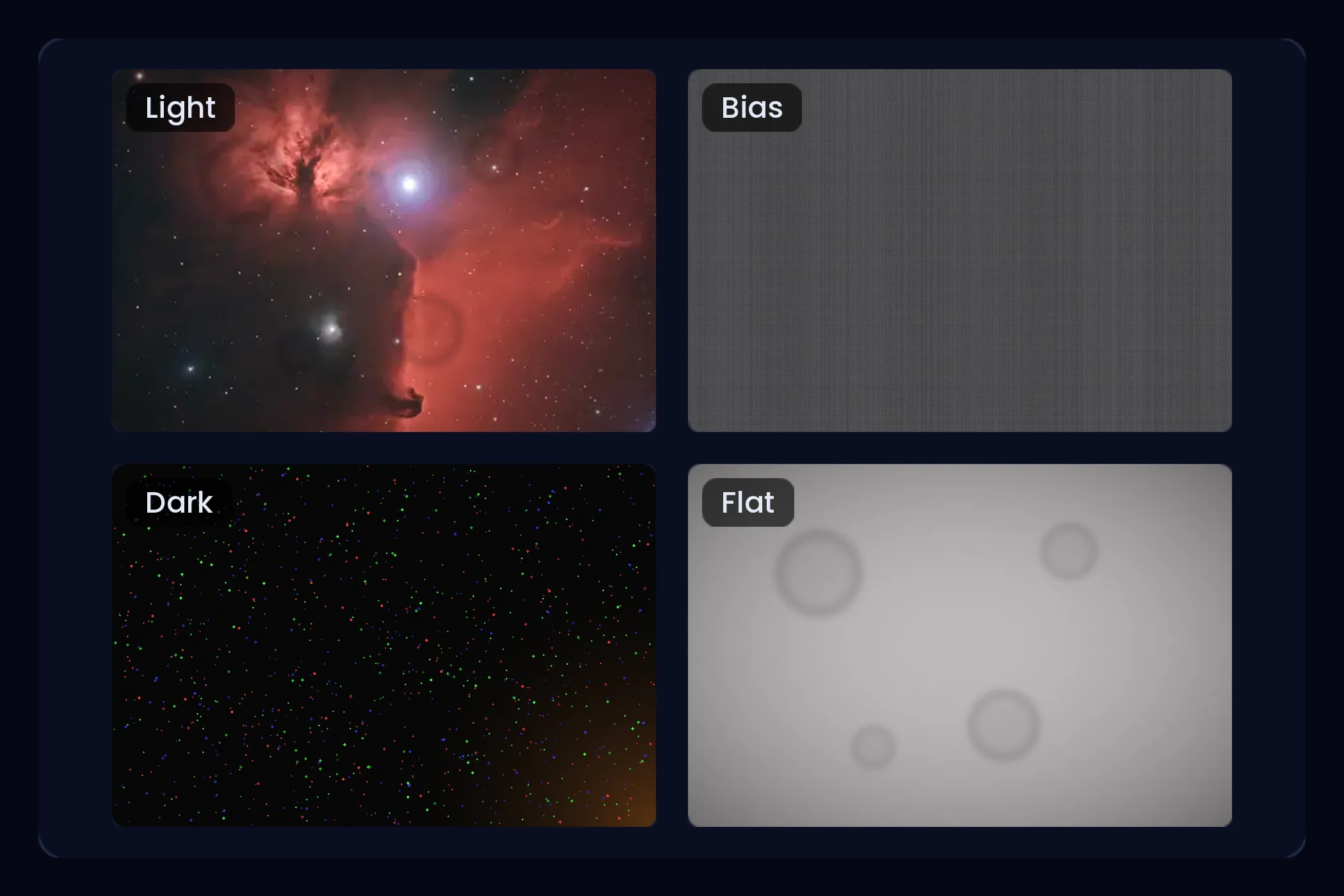
Every frame you take contains the night sky plus a set of marks the camera and telescope put there on their own: dust shadows, darkened corners, heat, and an electrical floor. Calibration frames are pictures of those marks with no sky in them, so the software can work out what to remove. It is twenty minutes of work and it is the difference between a clean picture and a blotchy one.
Shooting the sky means shooting artifacts as well
Point a camera at a nebula for five minutes and you get a frame with a nebula in it. You also get every speck of dust sitting on the sensor window, the fact that the corners of the frame receive less light than the middle, a scattering of pixels that read bright whether or not any light arrived, and a faint electrical offset the sensor adds to everything before it hands the numbers over.
None of that is a problem while the picture is dark, because you cannot see any of it. It becomes a problem the moment you stretchBrightening the faint parts of an image far more than the bright parts. It is the step that makes a nebula appear out of what looked like a black frame., which is the step that takes an almost-black frame and pulls the faint stuff up into view. Stretching does not know which faint stuff you wanted. It lifts the dust shadows and the dark corners just as enthusiastically as it lifts the nebula.
The fix is to photograph the marks on their own, without any sky, and then have the software remove them. Those pictures of the marks are the calibration frames, and there are three of them.
That formula is worth a second look, because SirilA free, open source program for turning a folder of raw frames into a finished astrophotograph. It does the stacking and most of the processing.'s own manual writes it a different way: image minus dark minus bias, all divided by the flat. It is the same arithmetic. The dark you subtract is the raw one, straight off the camera, and a dark already has the bias sitting inside it, so subtracting the dark takes both out in one pass. That leaves the flat as the only frame still carrying an offset of its own, which is why the bias appears once, on that side of the division. Siril's workflow does exactly this: it builds the master flat with the bias subtracted, and the master dark without.
Darks: the heat and the stuck pixels
A camera sensor produces a signal from warmth as well as from light. Leave the shutterHow long the camera collects light for one frame. Twenty seconds means the sensor is gathering light for twenty seconds before the frame is saved. open for five minutes and some pixels quietly fill up on their own, and a handful of them are stuck bright permanently. That pattern is repeatable, which is the useful part: photograph it once and you can subtract it from every frame.
A dark is simply a frame taken with no light reaching the sensor at all. Cap the telescope, or leave the lens cap on, and take the same exposure at the same gainThe same idea as ISO, but on an astronomy camera. More gain gives a brighter frame with more grain in it. and the same sensor temperature as your real frames. Everything has to match, because the amount of heat signal depends on all three.
Twenty to thirty is plenty. If your camera is cooled it will hold the same temperature every night, which means the same set of darks works for months. That is one of the quieter arguments for a cooled camera, and it is why the ASI585MC Air earns its keep on this rig. Without cooling, take them at the end of the same session while the air is still the temperature it was.
Biases: the sensor's starting number
Before any light or heat is involved, a sensor adds a small fixed offset to every pixel so the readings never go below zero. It is not noise so much as a starting number, and it is in every frame you take, including the darks and the flats.
A bias frameThe shortest exposure the camera can take, with the lens capped. It records the small electrical signal the sensor adds to every single frame. is the shortest exposure your camera will physically take, with the cap on. A thousandth of a second, in the dark. They cost nothing, so take fifty or a hundred.
You will see biases described as optional on modern cameras, and there is something in that. What is not optional is removing the offset from the flats before they are used, and there are two ways to do it. One is a bias frame. The other is a dark flat, which is a frame taken at the same exposure as the flat, with the cap on. On a lot of current sensors the dark flat is the better behaved of the two, and if you take dark flats you do not need biases at all.
Flats: the ones that catch everybody out
A flat records the optical path rather than the sensor. It maps how much light reaches each part of the frame, which is never even: the corners are always darker than the middle, and every mote of dust between the sky and the sensor throws a soft shadow that looks like a faint doughnut.
The software divides your frame by the flat. Where the flat is dim, the division brightens; where the flat is bright, it does not. What comes out has an even background.
What a flat frameA shot of an evenly lit blank surface, taken through the same telescope. It maps the dust shadows and darkened corners so they can be divided out. actually removes
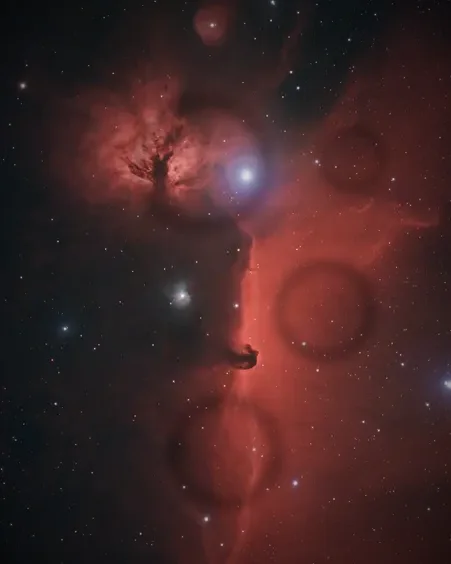
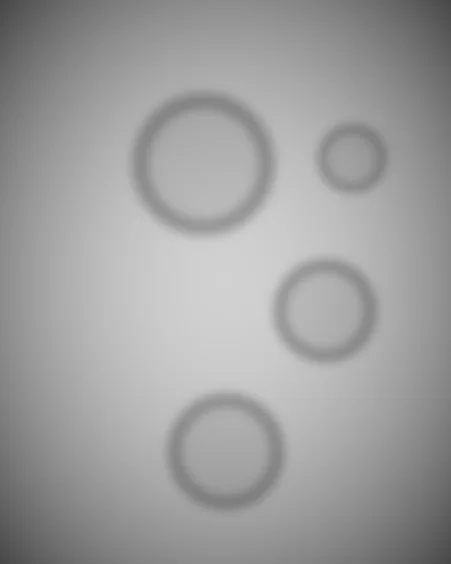
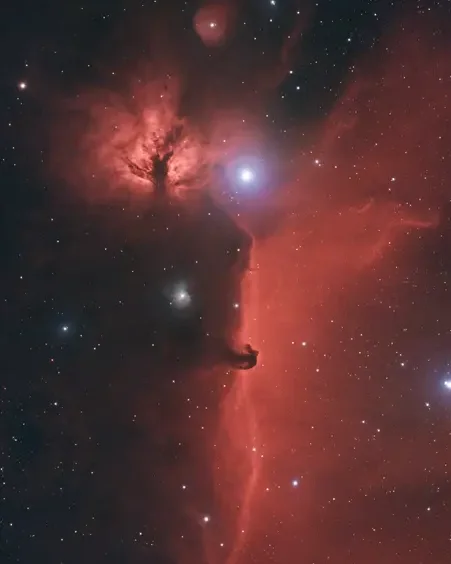
To take one, point the telescope at something evenly lit and photograph it through the whole imaging trainThe chain of parts between the telescope and the sensor: flattener, spacers, filter drawer, camera. Every one of them takes up length, which is why the order and the spacing matter. exactly as it stands. The dawn or dusk sky works. So does a white T-shirt stretched over the front of the tube with a tablet screen behind it, and a proper flat panel is not expensive. Set the exposure so the histogramA chart of how many pixels in the picture are dark, middling and bright. It tells you at a glance whether an exposure is about right. peak lands somewhere around the middle, not up against either end, and take thirty or so.
The rules people break
Flats are the calibration frame that goes wrong most often, and almost always for the same handful of reasons.
- Take them before you take anything apart. The moment the camera rotates in the focuserThe part that slides the camera in and out until the stars are sharp. An electronic one does it with a small motor, on command., even slightly, the dust shadows move and that night's flats stop matching. This is the single most common mistake, and it costs you the whole session's worth of flats. The ASIAir makes it a two minute job at the end of the run.
- Do not touch focus. Dust shadows change size with focus position. A flat taken at a different focus point removes the wrong shapes.
- One set per filter. Each filter has its own dust and its own transmissionHow much of the light a filter is meant to pass actually gets through. Ninety per cent transmission means a tenth is lost even in the window it is designed for., so a flat through the L-eXtreme is not a flat through the SV220. A filter drawer makes changing filters quick, but it does not exempt you from re-shooting the flats.
- NarrowbandA filter that only lets through the few exact colours that glowing gas clouds give off, and blocks nearly everything else. Streetlight is mostly blocked, the nebula is not. flats take longer than you expect. A 3nm filter blocks nearly everything, so a panel bright enough for an unfiltered flat will give you a nearly black one through narrowband. Dim the panel and extend the exposure rather than the other way round.
- Do not aim at a bright, uneven thing. A cloud, a wall in sunlight or a laptop screen with a gradient on it will all produce a flat that makes the picture worse, because the software will faithfully divide out whatever unevenness you photographed.
How many, and how long they last
| Frame | What it removes | How to take it | How many | Reusable? |
|---|---|---|---|---|
| Dark | Heat signal and hot pixelsA pixel that reads bright whether or not any light reached it. Dark frames record where they are so they can be taken out later. | Cap on, same exposure, gain and temperature as your lights | 20 to 30 | Yes, for months, if the camera is cooled |
| Bias | The sensor's fixed offset | Cap on, shortest exposure the camera allows | 50 to 100 | Yes, until you change gain |
| Flat | Dust shadows and darkened corners | Even light source, through the whole train, nothing moved | About 30 | No. Every session, every filter. |
| Dark flat | The offset, from the flats | Cap on, same exposure as the flats | Match the flats | With the flats |
What it costs you to skip them
Skipping darks costs you some noise and leaves coloured speckles behind. It is survivable, and if you ditheredShifting the aim by a few pixels between frames on purpose. Faults in the sensor then land somewhere different each time and average away in the stack. during capture, nudging the mount a few pixels between frames, the stackingCombining many frames of the same patch of sky into one. The random grain is different in every frame so it averages away, while the real detail is in the same place every time and stays. software will reject most of the hot pixels anyway.
Skipping flats is different, and it is the one that ruins pictures. Dark corners and dust doughnuts are multiplied into the frame, not added to it, so the background extractionThe processing step that measures that uneven glow across the frame and removes it, leaving an even sky behind the target. you run later cannot model them properly. It is built for the additive kind of unevenness, the skyglowThe glow of that scattered artificial light coming back down at you. It is what makes a city sky look washed out rather than black. gradient you get from a bright sky. Ask it to flatten a vignette as well and you will get an image that looks nearly right and is subtly wrong everywhere.
The honest way to think about it is that calibration does not make an image better. It stops the equipment making it worse. Everything you do afterwards, the stretching, the colour, the noise work, is applied to whatever calibration left behind, which is why it is worth twenty minutes at the end of a night that already cost you five hours.
Where it actually happens
None of this is done by hand. Put your frames in folders called
lights, darks, flats and
biases, point
Siril at the parent folder and run its one-shot-colour script. It stacks the
calibration frames into masters, applies them, aligns everything and stacks the
result, all unattended.
The part worth being careful about is the half hour before that, in the dark, with the telescope still pointing where it was.